
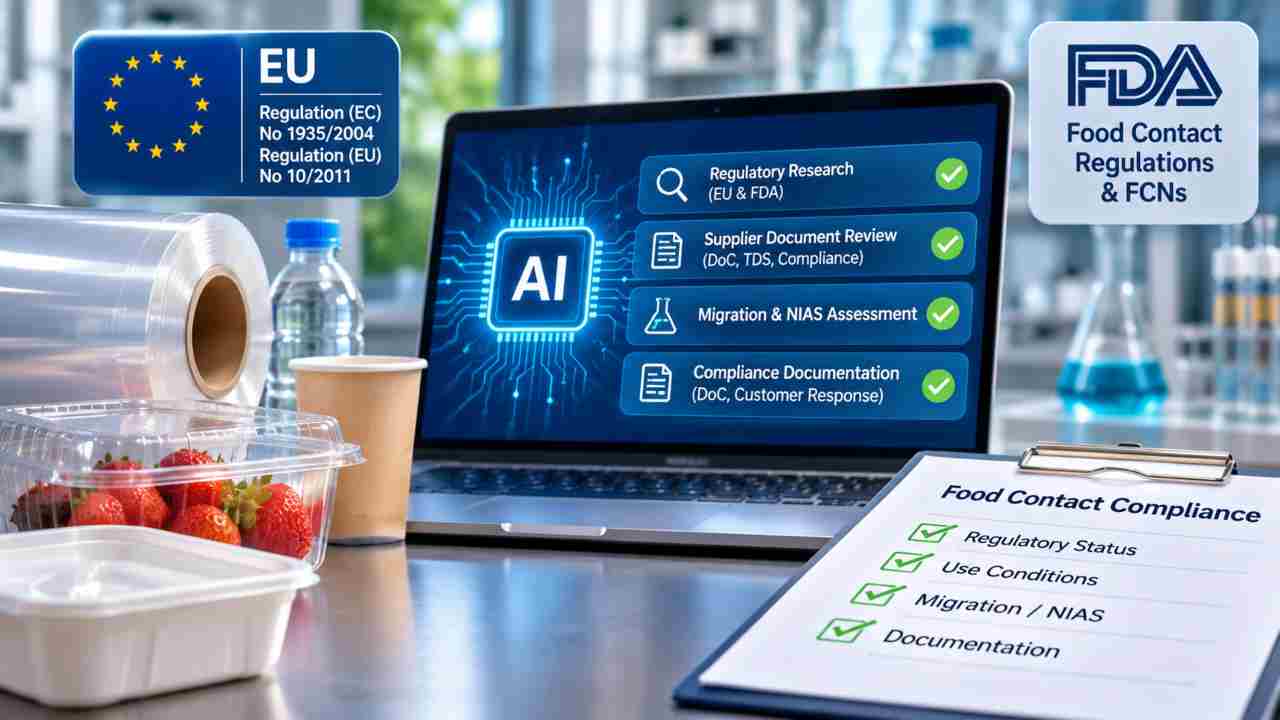
Food contact material compliance is becoming increasingly demanding for manufacturers developing packaging films, adhesives, coatings, polymers, and multilayer structures for international markets. Regulatory teams must interpret different legal requirements, examine supplier documentation, evaluate migration data, investigate non-intentionally added substances (NIAS), and maintain accurate technical records throughout product development.
The difficulty is not necessarily a lack of information. It is that relevant information is distributed across regulations, regulatory databases, scientific publications, laboratory reports, and supplier declarations, frequently in incompatible formats.
Artificial intelligence offers opportunities to reduce the time spent searching, organizing, comparing, and reviewing this information. However, the same technology introduces serious concerns about inaccurate regulatory interpretations, missing evidence, confidentiality, and unjustified safety conclusions.
The real opportunity lies in developing AI-assisted compliance procedures that improve efficiency while preserving expert judgement, source verification, and documented accountability.
1. Why EU–FDA Compliance Requires More Than Faster Information Retrieval
European and US food contact requirements share an overarching objective of protecting consumer safety, but their regulatory structures differ considerably. This creates difficulties for organizations supplying both markets, particularly when a material contains several polymers, additives, adhesives, coatings, and processing aids.
In the European Union, Regulation (EC) No 1935/2004 establishes general requirements for food contact materials, while Regulation (EU) No 10/2011 introduces specific provisions for plastic materials and articles. Additional requirements address good manufacturing practice, recycled plastics, and certain other materials. The 2025 amendments to the plastics regulation also introduced changes concerning quality control, purity, and supporting compliance information.
The US FDA operates through applicable food additive regulations, effective Food Contact Notifications (FCNs), and other legally recognized regulatory pathways. Importantly, an effective FCN is associated with the identified manufacturer or supplier, substance, and conditions of use. Finding a chemically similar substance in the FDA inventory does not automatically establish authorization for another supplier's material.
AI can help identify and organize these differences, but its answers must be checked against the actual regulatory texts and authorization conditions. A plausible summary is not sufficient evidence of compliance.
2. Using AI to Build More Reliable Regulatory Intelligence
Regulatory research is one of the most immediately useful applications of AI. Rather than manually searching multiple databases for every new formulation component, technical teams can use controlled AI-assisted retrieval to identify relevant regulations, substance entries, restrictions, and supporting guidance.
The most effective approach begins with a defined compliance question. For example, an R&D team evaluating an additive for a food packaging film needs to establish its identity, proposed concentration, material application, food-contact conditions, applicable authorizations, and relevant restrictions.
AI can assist by organizing source documents and identifying information that needs further verification. However, it should not decide that a substance is permitted simply because its chemical name appears in a database.
A particularly useful practice is maintaining a Compliance Evidence Table, in which every important conclusion is associated with a verified source and a review status.
Review item | Information requiring verification |
|---|---|
Substance identity | Chemical identity, relevant identifiers, and supplier information |
EU status | Applicable authorization, restrictions, specifications, and material scope |
FDA status | Applicable regulation or other legal basis, including manufacturer-specific FCN conditions |
Migration requirements | Relevant limits, testing conditions, and supporting evidence |
Review outcome | Source reference, unresolved questions, and expert approval |
This approach makes AI-generated research easier to challenge, update, and audit. When regulations change, the team can identify which conclusions depend on the affected provisions rather than repeating the entire investigation.
3. Identifying Gaps in Supplier Declarations and Technical Documentation
Supplier documentation is another area where AI can provide practical benefits. Food contact material manufacturers routinely receive Declarations of Compliance (DoCs), technical data sheets, migration reports, composition statements, and regulatory confirmations from different suppliers.
These documents may appear complete while omitting information required for the intended application. A declaration might not adequately describe maximum use conditions, relevant restrictions, or the assumptions underlying its compliance conclusion.
AI-assisted document review can help identify missing fields, compare information across documents, and flag inconsistencies. For example, an adhesive supplier's declaration may refer to specific processing or food-contact conditions that differ from the proposed multilayer packaging application.
The system can identify the discrepancy, but a qualified reviewer must determine its significance and whether additional supplier evidence or testing is necessary.
For EU plastics, the DoC and supporting documentation have defined regulatory functions. A well-formatted AI-generated document cannot replace the underlying evidence or establish compliance where that evidence is insufficient.
This distinction is essential. AI should improve the quality and consistency of document review, not convert incomplete supplier statements into apparently definitive regulatory conclusions.
4. Where AI Can Support Migration and NIAS Risk Assessment
Migration and NIAS evaluation involve complex scientific decisions that cannot be resolved through document automation alone. Formulators must consider material composition, possible reaction by-products, processing conditions, intended food contact, analytical findings, exposure, and toxicological information.
AI can support the investigation by connecting chemical information from different sources. For example, it may help organize suspected degradation products, identify potentially relevant toxicological publications, compare known substance information, and highlight missing data in an analytical report.
For a multilayer packaging structure, AI-assisted review could bring together the adhesive formulation, processing temperature, migration test conditions, and reported chromatographic findings. This provides a more organized starting point for deciding which substances require closer investigation.
Nevertheless, AI cannot reliably establish the identity of an unknown chromatographic peak from an unsupported textual description. Nor can it determine that a substance is safe simply because no adverse toxicological information was retrieved.
Predictive toxicology, read-across, and quantitative structure–activity relationship methods may contribute to risk assessment when scientifically appropriate. Their applicability depends on the substance, available evidence, model domain, and regulatory context.
The most valuable role of AI is therefore to improve investigation efficiency and expose uncertainty. Decisions about additional testing, substance identification, dietary exposure, and toxicological acceptability must remain scientifically justified and independently reviewed.
5. Improving Documentation and Customer Technical Responses
A substantial amount of regulatory work involves translating technical evidence into documentation that can be understood by auditors, customers, and internal decision-makers.
AI can assist with drafting technical summaries, identifying inconsistencies between document versions, organizing supporting references, and preparing initial responses to customer questionnaires. These activities can reduce repetitive administrative effort, particularly when several customers request similar information about the same material.
However, document generation introduces its own risks. A system may reproduce an outdated regulatory statement, omit a product-specific restriction, or combine information from different formulations. Such errors become especially problematic when apparently authoritative answers are released without verification.
A controlled documentation procedure should therefore identify the approved source material, applicable product version, reviewer, and final authorization. Changes to formulation, supplier, intended use, or regulatory requirements should trigger appropriate document reassessment.
The same principle applies to customer technical enquiries. AI-generated answers should be based on verified company information rather than unrestricted responses drawn from general online knowledge.
When implemented correctly, these controls can improve both response speed and consistency while reducing the risk of contradictory technical statements.
6. AI Governance: Keeping Regulatory Decisions Defensible
The greatest limitation of AI in compliance work is not necessarily its ability to retrieve information. It is the possibility that inaccurate or incomplete output will be treated as a verified technical conclusion.
Generative AI systems can provide convincing answers containing incorrect references, misinterpreted restrictions, or unsupported assumptions. This makes source verification essential, particularly where the result influences material approval, regulatory declarations, or customer-facing documentation.
Confidentiality also requires attention. Supplier compositions, proprietary formulations, unpublished analytical results, and commercial specifications should not be uploaded to unauthorized public AI services. Organizations need suitable controls over access permissions, retention, data handling, and approved processing environments.
Equally important is deciding where human review becomes mandatory. AI can assist with research and document preparation, but decisions involving regulatory applicability, toxicological conclusions, final declarations, and product release require accountable technical oversight.
A practical implementation can begin with lower-risk activities such as literature organization and regulatory change monitoring before extending into supplier qualification and evidence-controlled technical documentation.
Performance should be measured using more than time saved. Useful indicators include missed restrictions, unsupported citations, document inconsistencies, reviewer corrections, and the completeness of the resulting evidence trail.
7. Moving from AI Experimentation to an Effective Compliance Process
Many organizations begin exploring AI through individual prompts, document summaries, or isolated research tasks. These experiments can demonstrate useful capabilities, but they rarely establish a reliable operating process across the compliance function.
A more sustainable approach is to define repeatable procedures for specific activities. Regulatory intelligence, supplier document review, migration investigation, declaration preparation, and customer technical responses each require different inputs, review criteria, and approval responsibilities.
The distinction matters because AI should not introduce a separate, uncontrolled source of regulatory information. It should operate within established quality and document-management processes, improving how evidence is collected and assessed while preserving the organization's existing technical responsibilities.
For food contact material manufacturers, the strongest applications are likely to be those that combine measurable efficiency improvements with transparent evidence, clear escalation procedures, and consistent expert review.
The objective is not automated regulatory approval. It is a more efficient and reliable compliance function in which experienced professionals spend less time organizing information and more time evaluating the technical questions that genuinely require their expertise.
Put AI to Work in EU & FDA Food Contact Compliance with OnlyTRAININGS
Understanding where AI may assist compliance activities is only the beginning. The more difficult task is designing practical procedures that a technical team can use consistently, with reliable evidence, appropriate verification, and clear responsibility for final decisions.
This is particularly important when managing multiple suppliers, reviewing unfamiliar substances, investigating NIAS, or preparing documentation for products intended for both European and US markets. Without defined procedures, AI may simply produce information faster without making the compliance process more dependable.
ONLYTRAININGS | ADVANCED EXPERT-LED TRAINING
AI for Faster EU & FDA Food Contact Material Compliance
Reduce repetitive compliance work while maintaining technical accuracy, traceability, and expert control.
This specialized OnlyTRAININGS program moves beyond general AI demonstrations to practical implementation procedures for food contact material compliance teams.
The training covers AI-assisted EU–FDA regulatory research, supplier document qualification, migration and NIAS investigation, Declaration of Compliance preparation, customer technical responses, regulatory change monitoring, and scientific literature review.
A distinguishing feature is its focus on seven practical Standard Operating Procedures, providing structured approaches that participants can adapt to their existing regulatory and quality-management processes.
The program also addresses source verification, AI governance, expert intervention, and the limitations that must be understood before AI-assisted work can support real compliance decisions.
Designed for regulatory affairs professionals, food packaging R&D teams, adhesive and coating formulators, quality assurance specialists, and technical managers responsible for food contact material compliance.
EXPLORE THE AI FOOD CONTACT COMPLIANCE TRAINING & REGISTER
Includes six-month training access, downloadable materials, practical resources, a verifiable certificate, and expert discussion support.
Technical References
European Commission. Food Contact Materials — Legislation. Overview of European food-contact requirements, including Regulation (EC) No 1935/2004 and Regulation (EU) No 10/2011.
European Commission. Regulation (EU) 2025/351. Amendments concerning plastic food-contact materials, manufacturing, quality control, and supporting requirements.
US FDA. Determining the Regulatory Status of Components of a Food Contact Material.
US FDA. Preparation of Premarket Submissions for Food Contact Substances — Chemistry Recommendations.
US FDA. Inventory of Effective Food Contact Substance Notifications.
Advancing the implementation of artificial intelligence in regulatory frameworks for chemical safety assessment by defining robust readiness criteria. (2026). Read research.