
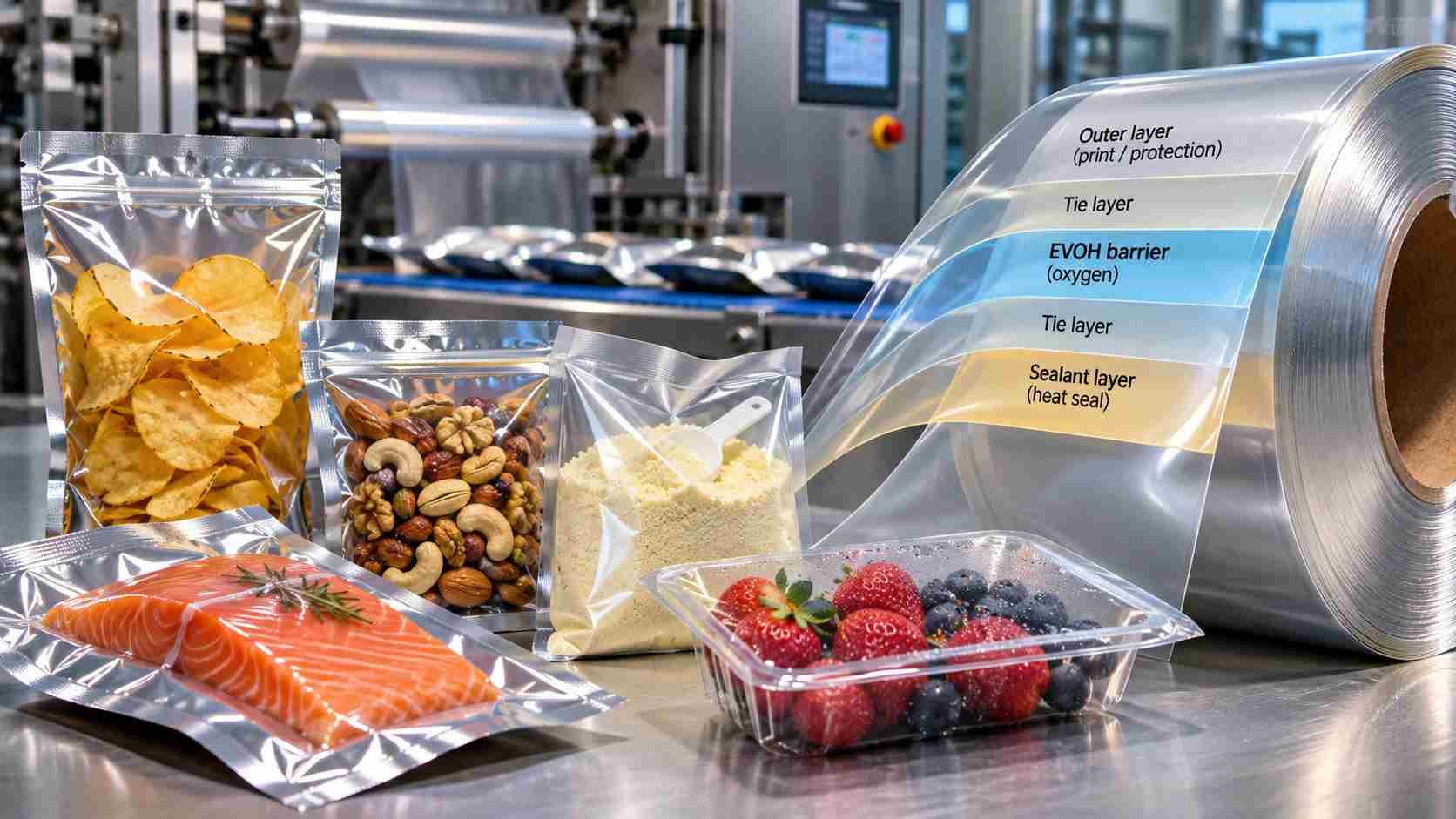
A film specification can look reassuringly precise. Oxygen transmission rate is reported to two decimal places, water vapor transmission rate is compared against a familiar benchmark, and the supplier identifies an impressive barrier polymer. Yet none of those numbers alone tells a packaging engineer how much protection the food will receive in a formed, filled, sealed and distributed pack.
Snacks, hygroscopic powders and chilled foods present different deterioration mechanisms, storage conditions and sealing demands.
The useful question is not simply which film has the lowest OTR? It is which complete packaging construction delivers dependable protection, food-contact safety and a credible end-of-life pathway under its actual conditions of use?
TECHNICAL INSIGHT
A high-barrier film is a component, not a shelf-life guarantee. The weakest performance may emerge at the seal, an interface, or after the packaging has been converted.
1. The film data sheet measures only part of the protection
Oxygen transmission rate (OTR) describes oxygen passage through a defined film area over time under stated test conditions. Water vapor transmission rate (WVTR) describes moisture-vapor passage. Typical reporting units include cm³/m²/day for OTR and g/m²/day for WVTR, but comparisons are meaningful only when temperature, relative humidity, gas conditions, specimen preparation and test method are aligned.
A shelf-life requirement is not automatically a film-property requirement. Headspace oxygen, dissolved oxygen and leakage at seals also contribute to product exposure.
A first-pass estimate is film-mediated oxygen ingress ≈ measured OTR × effective film area × time, where test conditions and pressure gradient match the intended use. Oxygen consumption, changing headspace composition and imperfect seals limit this screening approximation.
Do not compare barrier grades without comparing the temperature and humidity at which their OTR and WVTR were measured. ASTM D3985-24 explicitly treats OTR as an important, but not sole, determinant of packaging protection.
2. Water can change the hierarchy of barrier materials
Ethylene-vinyl alcohol (EVOH) is valued for strong oxygen-barrier performance, but its effectiveness is sensitive to moisture. Water interacts with its polar structure, increasing molecular mobility and potentially increasing oxygen permeability. EVOH is consequently often placed between outer layers that help manage moisture exposure rather than used as an exposed surface.
Polyethylene (PE) and polypropylene (PP) provide moisture-barrier and sealing functions but cannot simply replace EVOH’s oxygen-barrier role. Polyamide (PA) responds to moisture; polyester (PET) contributes mechanical and thermal performance.
Metallized films, aluminum foil and transparent metal-oxide coatings offer another set of trade-offs. Thin inorganic coatings can provide excellent initial barrier values while remaining vulnerable to defects, cracking or damage during conversion and handling. Foil may be a strong barrier choice, but it changes optical, mechanical, processing and recycling considerations.
Material labels cannot establish one barrier ranking across all conditions. The relevant comparison is between finished structures after realistic conditioning, not idealized material families.
3. Layer architecture can undermine good polymer selection
Multilayer design distributes responsibilities. One layer may be selected for oxygen resistance, another for moisture management, another for stiffness or puncture protection, and the innermost layer for dependable heat sealing. Tie layers, adhesives and coatings make these functions coexist, but their behavior is not incidental.
Consider a coextruded polyolefin/EVOH construction. Nominal EVOH content means little without its thickness, continuity, location and humidity exposure. Layer variation or poor adhesion can undermine the finished film. Similarly, an oxide-coated film can lose performance if a brittle barrier layer is damaged during folding, lamination or pouch formation.
Product contamination, inadequate sealing energy, wrinkles or poor sealant selection can create leakage paths that negate the film web’s barrier advantage.
The most robust architecture is not necessarily the structure with the largest number of functional layers. It is the structure whose barrier, adhesion, sealability and dimensional stability remain compatible throughout conversion and use.
4. Test the package as a system, not as a flat specimen
Transmission tests are essential screening tools. ASTM D3985-24 covers oxygen transmission measurements through plastic films and sheeting using a coulometric sensor. ASTM F1249-25 addresses water-vapor transmission through flexible barrier materials using a modulated infrared sensor. Both are valuable when specimen history and test conditions are specified consistently.
Neither replaces package qualification. Validation should progress from flat film to converted web, seals, finished-pack integrity and shelf-life trials under relevant humidity, flexing or thermal stresses.
ASTM F88/F88M-23, for example, supports seal-strength measurement, which is useful for tracking sealing-process consistency. Seal strength is not identical to leak tightness, so appropriate integrity assessments must also be selected for the package design. Sensitive foods may require monitoring of oxygen, moisture, oxidation and sensory changes.
A strong qualification report records what was tested, after which conditioning, on which construction, and under what distribution conditions.
5. A food-contact-compliant resin does not approve the entire laminate
Barrier performance and food-contact compliance are different questions. In the European Union, Regulation (EC) No 1935/2004 establishes the general framework for food-contact materials, with good manufacturing practice under Regulation (EC) No 2023/2006. Plastic materials are addressed specifically under Regulation (EU) No 10/2011, as amended, including changes introduced by Regulation (EU) 2025/351.
For multilayers, assess applicable rules for the layers and finished article, food type, contact time, temperature and migration limits. Adhesives, inks, coatings, residual substances and non-intentionally added substances (NIAS) may require attention even where the principal polymer appears familiar. A functional-barrier argument is not a universal exemption and must meet the relevant legal conditions.
The United States uses a different authorization system. FDA food-contact status may arise through applicable regulations, effective Food Contact Notifications, other recognized authorizations or exemptions. Notifications are manufacturer- and intended-use-specific. An EU Declaration of Compliance cannot simply be relabeled as proof of U.S. authorization.
The evidence chain must cover layer composition, authorizations, migration data, traceability, required declarations and controlled changes. Compliance conclusions are specific to the construction and intended use.
6. Recyclability changes which barrier solution is commercially viable
Multimaterial designs can combine excellent barrier and mechanical performance, yet create difficulties in separation, sorting or recycling. The push toward mono-material PE- or PP-based constructions therefore changes the engineering problem. Recycling compatibility depends on barrier chemistry, loading, adhesives, coatings and available reprocessing routes. No universal EVOH percentage guarantees recyclability.
The EU Packaging and Packaging Waste Regulation (EU) 2025/40 began applying on 12 August 2026, with additional recyclability requirements phased in toward 2030. A food-contact-compliant package is not necessarily recyclable; recycled plastics for EU food contact also face Regulation (EU) 2022/1616.
The most productive design review starts with the food rather than a preferred laminate technology:
Packaging situation | Primary engineering tension | Evidence to prioritize |
|---|---|---|
Oxidation-sensitive snacks | Oxygen entry versus moisture exclusion and seal reliability | OTR/WVTR at relevant humidity, sealed-pack shelf life |
Hygroscopic dry powders | Moisture gain versus material reduction and pack handling | WVTR, moisture uptake, seal integrity after distribution |
Chilled high-moisture foods | Gas management, humidity and puncture resistance | Conditioned barrier data, pack integrity, food-specific trials |
Thermally processed foods | Barrier retention versus heat resistance and adhesion | Post-process transmission, laminate integrity, migration assessment |
These are decision prompts, not universal material prescriptions. The specification should identify the product’s failure threshold and work backward to a film structure, conversion process and evidence package.
Make barrier performance a packaging-system decision
A defensible barrier specification links food deterioration mechanisms to the converted structure, sealing process, distribution stresses and regulatory evidence. Test conditions, product needs, food-contact obligations and recycling assumptions belong in the same engineering decision.
Specialist training connects polymer choices to processing, compliance and validation.
ONLYTRAININGS | ADVANCED TECHNICAL TRAINING
Barrier Films for Food Packaging
Design barrier structures that protect food without overlooking processing, regulatory and recyclability constraints.
This expert-led training addresses:
EVOH, PA, PET and alternative barrier materials, including coatings and metallized structures.
Coextrusion, lamination, layer positioning, adhesion and production-related barrier defects.
OTR/WVTR validation, humidity effects and translating permeability data into packaging decisions.
EU and U.S. food-contact requirements, migration, NIAS and compliance documentation.
Mono-material design, recycling compatibility, real-world problem solving and emerging technologies.
EXPLORE THE TRAINING & REGISTER
The course page lists six-month access, training materials, a verifiable certificate, and expert discussion-forum access.
Technical and regulatory references
ASTM D3985-24, Oxygen gas transmission rate through plastic film and sheeting.
ASTM F1249-25, Water vapor transmission rate through flexible barrier materials.
ASTM F88/F88M-23, Seal strength of flexible barrier materials.
Commission Regulation (EU) 2025/351, food-contact plastic amendments.
U.S. FDA, Regulation of substances that come into contact with food.
Regulation (EU) 2022/1616, recycled plastics for food contact.