
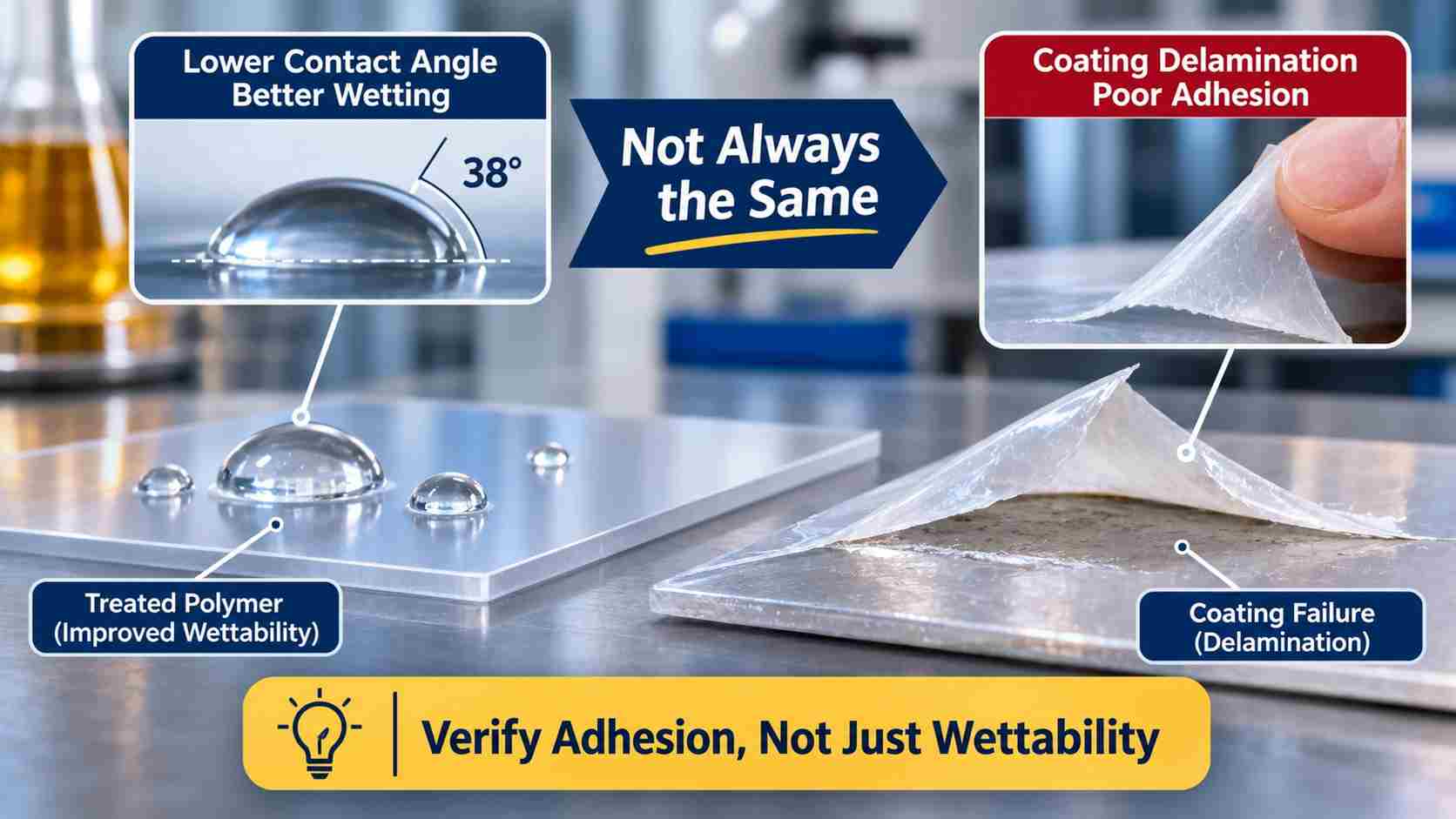
A polypropylene component leaves plasma treatment with a visibly improved wetting response. Water spreads more readily, the coating lays down evenly, and the quality log shows a lower contact angle than the untreated control. Yet after conditioning, the coating begins to lift around molded edges. The treatment worked in one measurable sense. The finished interface did not.
This is an important distinction for engineers working with plastic housings, printed films, coated composites and difficult-to-bond parts. Surface wettability describes how a liquid meets a surface; adhesion durability describes whether the resulting assembly survives its actual stresses. One is necessary for many applications, but it cannot stand in for the other. The diagnostic challenge is to discover which step between surface preparation and the finished bond is failing.
INTERFACE INSIGHT
Measure the surface at the time coating is actually applied, not only when treatment ends. Pair wetting evidence with an adhesion test and a documented failure location.
1. A contact angle is a measurement, not an adhesion certificate
A water droplet on a solid responds to interfacial energies and local surface condition. A lower static contact angle generally indicates improved wetting by water under the specified conditions. It does not establish whether a particular liquid adhesive wets identically, whether that interface develops chemical interactions, or whether the substrate surface itself has sufficient cohesive strength.
The distinction is explicit in ASTM D5946-24, which uses water contact angle to characterize corona-treated polymer films but cautions against treating the angle alone as proof of ink, coating or adhesive adhesion. ASTM D7334-08(2022) provides an advancing-angle approach for surface wettability, another reminder that measurement technique matters.
Real components complicate interpretation. An injection-molded part may have orientation, local roughness, mold-release residues and surface variations. A droplet placed on one smooth region does not describe a rib, weld line or contaminated handling area. Record droplet volume, measurement timing, locations, test liquid and surface history before comparing numbers.
2. One surface-energy number conceals important chemistry
A common specification asks whether a treated film has reached a nominal wetting-tension threshold. This is a useful production indicator only after it has been correlated with acceptable performance for the particular coating and substrate. ASTM D2578-23 states that measured wetting tension can be related to ink, coating or adhesive retention through experience; it is not a universal bond-strength threshold.
A liquid's polar and dispersive interactions matter. Two surfaces with similar calculated total surface energy can interact differently with a waterborne acrylic, a solventborne primer or a reactive adhesive. Multi-liquid contact-angle methods can estimate the components of surface free energy, provided the selected model, liquids and specimen condition are stated. ISO 19403-2:2024 addresses determination of solid surface free energy by contact-angle measurement.
Advancing and receding angles add information that a single static value hides. Large contact-angle hysteresis may indicate roughness, chemical heterogeneity or contact-line pinning, but it does not uniquely diagnose contamination. Use it to identify a surface needing further investigation, not to name a contaminant without supporting evidence.
3. More aggressive activation can create a weaker boundary
Corona and plasma treatment can introduce polar functionalities, remove some contaminants and change near-surface morphology. For low-energy polyethylene and polypropylene, these effects frequently improve wetting and can help bonding. However, extending treatment severity is not automatically beneficial.
Polymer-chain scission and oxidation may generate low-molecular-weight oxidized material at the treated surface. This material can present a wettable outer layer while remaining poorly anchored to the underlying polymer. Published research on plasma-treated polypropylene identifies these weak boundary layers as a potential cause of reduced adhesive-joint strength. A 2024 review likewise describes why surface fragments may improve apparent wettability without creating a reliable coating interface.
The right response to delamination is therefore not necessarily another pass under the treatment head. Examine whether failure occurs at the coating–substrate interface, within a fragile modified polymer layer, or within the coating itself. Where the mechanism is uncertain, compare controlled treatment doses and use suitable surface analysis, such as XPS, alongside bond testing.
4. The surface starts changing as soon as treatment ends
Plasma-activated polymers can undergo hydrophobic recovery during storage. Polar groups may reorient away from the outermost surface, low-molecular-weight constituents may migrate, and environmental exposure can alter the interface. The rate depends on polymer structure, treatment conditions, temperature and storage environment. Research on atmospheric-pressure plasma-treated nonpolar polymers shows that post-treatment stability differs among substrates.
This makes production timing a technical variable. A sample measured immediately after activation may not represent a roll coated two days later or a molded part sent to another factory. Handling can add oils and dust; packaging materials can introduce further contamination. A surface may meet its wetting target at the treater yet no longer support the approved application window at the coating station.
Instead of assuming a fixed allowable delay, qualify a treatment-to-coating interval using actual storage and transport conditions. Measure at relevant hold times, then apply the coating and assess its durability. Protect verified surfaces and define re-treatment rules only where repeat activation has been validated.
5. Good wetting cannot repair a weak coating process
A surface can be adequately prepared while the deposited layer still fails. Incorrect solvent evaporation, premature skin formation, inadequate film coalescence, incomplete cure or moisture sensitivity may leave a weak coating. Low surface tension helps a liquid spread but does not establish that its binder has formed a durable network.
Surface-active additives create a second trade-off. A wetting agent may reduce craters or improve coverage while altering interfacial composition, water sensitivity or subsequent overcoating. Adhesion promoters and primers can provide useful chemistry, but only when matched to the substrate, application conditions and curing sequence. Increasing additive concentration without locating the failure mechanism often produces another ambiguous trial.
Separate the variables: establish a reference substrate preparation; hold coating thickness, drying and cure history constant; then change one treatment or formulation factor at a time. For an illustrative plastic-part trial, compare a cleaned untreated control against several validated activation settings. Include a deliberately delayed-coating set to test whether time erodes the apparent improvement. Those conditions are experimental design examples, not universal process settings.
6. Build a release test around the failure, not the easiest number
A useful troubleshooting sequence starts with the failure surface. Inspect where coating remains after peel, cross-hatch or pull-off testing, and whether the exposed substrate shows transfer, discoloration or a fragile layer. Add microscopic or chemical analysis if routine observation cannot distinguish interfacial separation from cohesive failure.
Production observation | Possible competing mechanisms | Evidence to obtain next |
|---|---|---|
Low water angle, coating peels cleanly | Weak modified layer, incompatible binder, contamination | Failure-location inspection, controlled cleaning and dose comparison |
Good adhesion immediately, poor after storage | Hydrophobic recovery, migration, delayed cure or aging | Treatment-to-coating interval and conditioned adhesion tests |
Craters despite acceptable average angle | Local oils, silicone transfer, nonuniform activation | Surface mapping, contamination screening and coating-flow review |
Failure concentrated at molded edges | Geometry, handling, treatment shadowing or stress | Position-resolved contact angle and adhesion mapping |
For coatings, ASTM D3359-23 describes tape-test ratings, while ASTM D4541-22 provides pull-off measurement with portable adhesion testers. Their applicability depends on the coating and substrate; a tape rating is not equivalent to a quantified service-life prediction. For flexible films or bonded joints, select a peel or joint method appropriate to the geometry rather than forcing a rigid-coating method onto an unsuitable sample.
A production specification should connect the wetting check to the actual acceptance test. Record sampling positions, maximum approved hold time, coating conditions, failure mode and repeatability. The target is not the lowest attainable contact angle; it is a reproducible interface that retains adhesion after the exposures the product will face.
The interface must be qualified at the moment it matters
Surface activation, wettability measurement, coating formulation and cure are parts of one process chain. A favourable angle can show that treatment changed the surface, but it cannot demonstrate that the resulting bond will resist humidity, thermal cycling, mechanical stress or time-dependent deterioration.
The stronger engineering decision is to establish what each measurement proves, investigate what it does not, and connect the treatment window directly to finished-product testing. That approach avoids both undertreating difficult plastics and damaging them in pursuit of an impressive laboratory wetting result.
ONLYTRAININGS | ADVANCED TECHNICAL TRAINING
Surface Wettability and Adhesion Enhancement Techniques & Strategies for Optimal Results
Turn contact-angle observations into reliable surface preparation, formulation and adhesion decisions across demanding substrates.
This expert-led training addresses:
Surface energy, polar–dispersive matching, static and dynamic contact-angle interpretation.
Wettability challenges on PP, PE, engineering plastics, composites and contaminated surfaces.
Cleaning, corona, plasma, flame and chemical treatment selection for targeted applications.
Adhesion promoters, wetting additives and formulation adjustments for robust interfacial performance.
Surface aging, treatment validation, contamination diagnosis and production control.
EXPLORE THE TRAINING & ACCESS NOW
The training page lists six-month access, presentation and Q&A materials, a training certificate and an expert discussion forum.
Technical references
ASTM D5946-24, Corona-Treated Polymer Films Using Water Contact Angle Measurements.
ASTM D7334-08(2022), Surface Wettability by Advancing Contact Angle Measurement.
ASTM D2578-23, Wetting Tension of Polyethylene and Polypropylene Films.
Surface Modification of Polymers by Plasma Treatment for Appropriate Adhesion of Coatings (2024).