
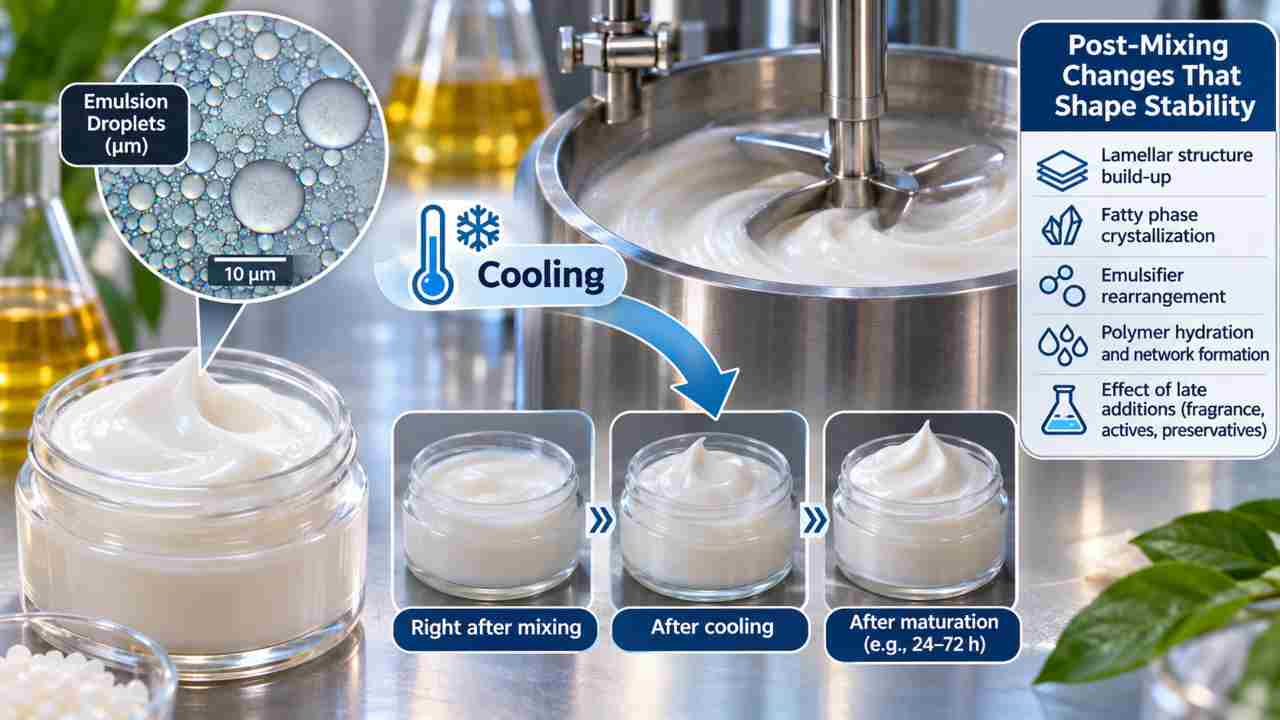
The batch looks finished when the high-shear mixer stops. Droplets appear finely dispersed, the cream is smooth, and the first viscosity reading sits inside the target range. Yet two days later, one batch has become noticeably thinner while another develops a grainy texture. Nothing obvious changed in the ingredient declaration. The difference may have been created during the period everyone treated as the end of emulsification.
A cosmetic emulsion is not frozen at the moment the rotor stops. Emulsifiers continue to organize, fatty components crystallize or assemble into networks, polymers hydrate, and the dispersed droplets respond to their surrounding phase. The product's final structure depends on the entire formulation and process history, not merely the initial droplet size. That makes cooling, holding and late additions critical engineering steps rather than routine finishing operations.
PROCESS INSIGHT
Record the temperature–time profile and mixer settings beyond primary emulsification. Compare samples after standardized maturation, not only immediately after discharge.
1. Droplet formation is only the first structural checkpoint
High shear helps divide one liquid phase into droplets within another. Newly created interface requires rapid coverage by suitable surface-active material; otherwise droplets can encounter each other and coalesce before an effective protective film develops. The resulting size distribution reflects an interaction between breakup, recoalescence, phase viscosity and available emulsifier, not mixer speed alone.
A fine initial distribution can improve the appearance and certain performance characteristics of an oil-in-water cream. It does not establish that the interfacial film will withstand subsequent temperature changes or that the continuous phase will prevent droplets from moving together. A particularly narrow or small distribution can also change texture and processing demand without automatically improving shelf stability.
Measure the initial distribution, but keep following it. Microscopy and an appropriate particle-sizing technique can show whether the population broadens, develops a coarse tail or remains essentially unchanged as the product ages. Record the sampling temperature and dilution procedure: sample preparation itself can disturb a structured cream.
2. Cooling can build the structure the mixer never made
In many creams, fatty alcohols and emulsifiers organize into lamellar gel networks during cooling. These ordered structures help determine yield behaviour, body, sensory response and the movement of dispersed droplets. Their formation depends on composition but also on the path through relevant phase-transition temperatures.
Research using rheology and small-angle scattering has shown that cooling rate and shear history influence lamellar network structure. The practical consequence is that two batches with the same formula and similar freshly measured droplet size may mature into different textures. One might acquire the network needed to resist droplet movement; another may end with a less useful structure or a changed recovery after pumping.
Faster cooling is not inherently superior. Neither is prolonged mixing. A hold can provide time for structural organization in one system, while mixing across a sensitive temperature range may disrupt the developing network in another. The correct profile must be established experimentally for the particular emulsifier–fatty alcohol–oil combination.
For development, collect samples during cooling, shortly after filling and after a defined rest period. Combine temperature history with suitable oscillatory rheology or other structural observations. A one-point viscosity number taken hot is a poor release criterion for a cream whose architecture forms as it cools.
3. The emulsifier package governs more than HLB
Hydrophilic–lipophilic balance can help screen surfactants for an oil–water system, but it does not fully predict performance in a complex cosmetic product. Interfacial adsorption, molecular packing, fatty-alcohol association, polymer interactions and changes in phase composition all matter. A mixed emulsifier system may deliver both droplet coverage and a structured external phase, while another mixture with a similar nominal HLB behaves differently.
Oil identity matters too. Replacing an ester with a hydrocarbon or silicone-based emollient can change the emulsifier requirements and the feel of the finished product. Changes in oil solubility and interfacial composition may also influence droplet growth through mechanisms such as Ostwald ripening, where components move between droplets through the continuous phase.
Do not automatically add more surfactant when a cream loses body. First determine whether the change involves droplet coalescence, altered network organization, flocculation or a shift in continuous-phase structure. Extra emulsifier might improve coverage, but it can also disturb the gel network or modify sensory properties. Formulation maps that vary emulsifier ratio and oil composition provide more useful evidence than changing one percentage without a mechanistic hypothesis.
4. Late additions can rewrite the continuous phase
Fragrance, electrolytes, humectants, solvents, preservatives, botanical extracts and concentrated actives often enter after primary emulsification. Their addition point is chosen for good reasons, including heat sensitivity and volatility, but the product is not chemically indifferent to them. A solvent can change solubility; an electrolyte can modify polymer thickening or electrostatic interactions; a fragrance may partition into the oil phase or interface.
Some polymeric rheology modifiers require controlled hydration or neutralization. Altering pH near the end of processing can change their swelling and the resulting continuous-phase flow behaviour. Preservative partitioning may also change when emollients or surfactants are replaced. Physical stability and microbiological protection are separate requirements, so improving one cannot be assumed to validate the other.
For troubleshooting, compare an unfragranced base with a finished formula, using matched processing histories. If the finished formula drifts, introduce late-stage components in a controlled sequence and measure pH, viscosity profile and droplet structure after each relevant addition. Preservation must be assessed using an appropriate product-specific strategy; ISO 11930:2019 addresses evaluation of antimicrobial protection, not prediction of physical separation.
5. Emulsion type changes the process window
An oil-in-water cream, a water-in-oil product, a highly concentrated emulsion and a nanoemulsion are not interchangeable variants of the same mixing recipe. Their continuous phases, interfacial requirements and processing sensitivities differ. Highly concentrated systems can resist flow as droplets become crowded; multiple emulsions introduce additional internal interfaces and routes for instability.
Nanoemulsions may use high-energy devices or low-energy phase-inversion strategies, but small droplets do not make them thermodynamically stable by definition. A microemulsion is a different colloidal state, often associated with thermodynamic stability within the appropriate composition range. Confusing the two can lead to unrealistic claims about process simplicity or shelf life.
A transfer from rotor–stator equipment to a production vessel should be judged by the complete process, including bulk turnover, local energy input, temperature trajectory and downstream pumping. Matching revolutions per minute across equipment sizes is rarely enough. Published cosmetic-emulsion process studies document how energy delivery and scale can change droplet size and rheology. The relevant endpoint is a reproducible finished product, not an identical mixer setting.
6. Diagnose the failure before changing the formulation
A single centrifuge result or an attractive sample at room temperature cannot reliably describe all modes of instability. Creaming or sedimentation involves droplet movement; flocculation involves clustering; coalescence produces larger droplets by merger; and phase inversion changes which liquid forms the continuous phase. These mechanisms require different corrective actions.
What changes during storage | Competing explanations | Evidence to collect next |
|---|---|---|
Viscosity falls while droplet size stays similar | Network relaxation, polymer response, lamellar restructuring | Time-dependent rheology, pH and polarized microscopy |
A coarse droplet population appears | Coalescence, processing damage or inadequate interfacial coverage | Microscopy, full size distribution and process-history comparison |
Creaming develops without obvious coalescence | Low yield resistance, density difference, flocculation | Layer inspection, low-shear response and droplet imaging |
Texture becomes grainy after cooling | Fatty-phase crystallization or inappropriate thermal history | Thermal cycling, microscopy and controlled cooling trial |
Build a small illustrative process design around matched compositions: compare two approved cooling profiles and two late-addition sequences, with replicates and consistent fill conditions. Measure at manufacture, after standardized maturation and through defined storage challenges. The objective is to isolate the stage responsible for divergence, not to prescribe universal cooling temperatures or hold times.
ISO/TR 18811:2018 offers guidance for cosmetic stability testing but does not impose one universal set of temperatures, durations or acceptance criteria. Those must be justified for the product, packaging and intended distribution conditions. Interpret accelerated findings alongside realistic storage rather than automatically converting them into a shelf-life claim.
Specify how the cream becomes stable
A successful cosmetic emulsion is not merely a list of compatible ingredients that survives the first mixing step. It is a controlled colloidal structure that continues to develop through cooling, late additions, holding, filling and storage. Each stage can influence interfacial integrity, continuous-phase organization and the consumer's experience.
Qualify the route from dispersion to finished product. When formulation teams track that route with droplet measurements, appropriate rheology and realistic stability studies, they can distinguish a defective recipe from a process history that never allowed the intended structure to form.
ONLYTRAININGS | ADVANCED TECHNICAL TRAINING
Cosmetic Emulsion Training: Formulations & Techniques
Understand how dispersion, interfacial chemistry and processing sequence determine emulsion stability, structure and consistency.
This expert-led training addresses:
Colloidal principles behind O/W, W/O and more complex cosmetic emulsion architectures.
Dispersion and emulsification techniques and their effects on final structure.
Microemulsions, nanoemulsions, highly concentrated emulsions and liquid-crystalline emulsion systems.
Formulation challenges involving emulsifier choice, processing conditions and stability.
Practical troubleshooting, representative applications, case studies and expert Q&A.
The training page lists six-month access, downloadable training materials, a verifiable training certificate and access to the expert discussion forum.
Technical references
OnlyTRAININGS, Cosmetic Emulsion Formulations Training: Types & Techniques.
IFSCC Monograph No. 4, Introduction to Cosmetic Emulsions and Emulsification.
Shear and Cooling Effects on Lamellar Gel Network Structure: Insights from Rheo-SANS (2024).
On the Key Role of Polymeric Rheology Modifiers in Emulsion-Based Cosmetics, Cosmetics (2025).
Early Detection of Lamellar Gel Network Instability in Cosmetic Emulsions, Cosmetics (2026).
Integrated Design of Emulsified Cosmetic Products: A Review (2020).
ISO/TR 18811:2018, Guidelines on the Stability Testing of Cosmetic Products.
ISO 11930:2019, Evaluation of Antimicrobial Protection of a Cosmetic Product.