
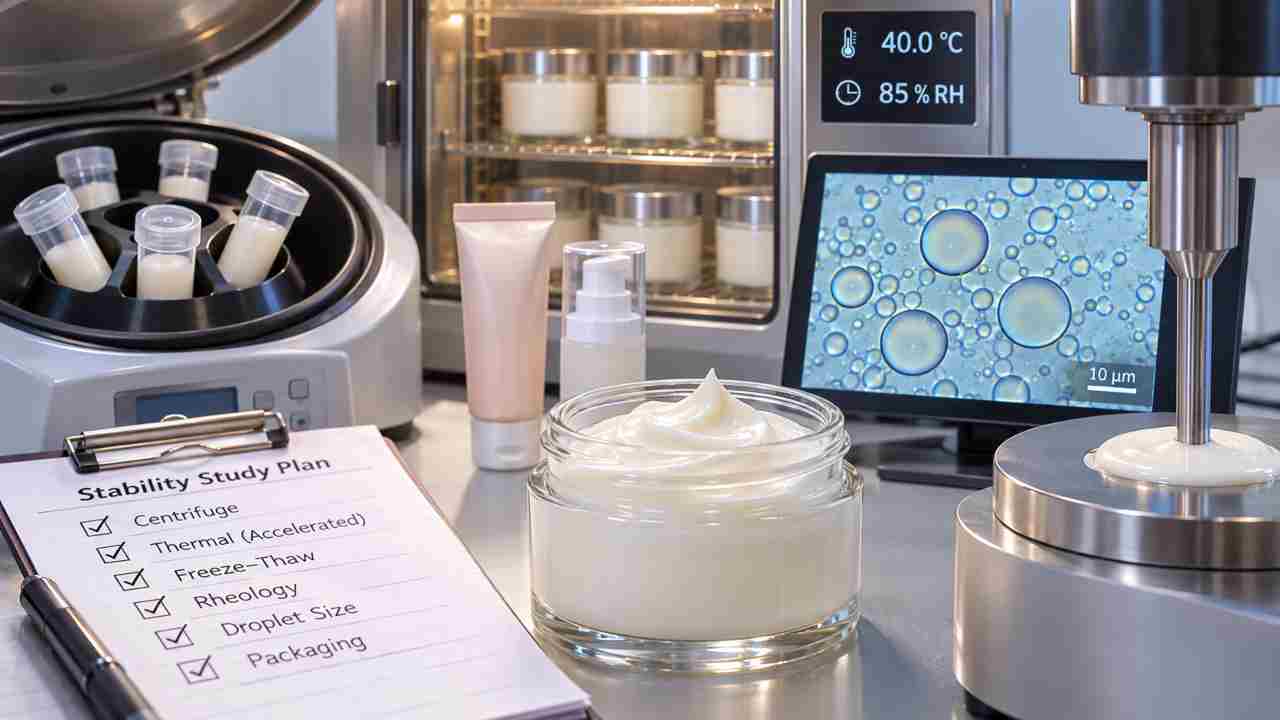
A cream can remain perfectly homogeneous in a stability chamber while its droplet population slowly changes, its dispensing behaviour drifts, or its preservative system becomes less dependable. The practical question is therefore not whether a cosmetic emulsion has “passed stability”, but which failure mechanisms the available evidence can reasonably exclude.
That distinction matters because accelerated methods impose different stresses. A centrifuge emphasizes density-driven movement; elevated temperature changes molecular mobility and formulation structure; freeze–thaw cycles challenge the system through ice formation and concentration effects. An apparently reassuring result from one method cannot automatically stand in for the others. ISO/TR 18811:2018 deliberately leaves protocols and acceptance criteria to scientifically justified, product-specific decisions [1].
DIAGNOSTIC INSIGHT
A stability result describes what happened under a defined stress, in a defined container, over a defined interval. It is not a universal expiry-date conversion factor.
1. First decide what failure would actually look like
Emulsion instability is not a single event. Creaming reflects migration of droplets under a density difference and may initially be reversible. Flocculation brings droplets into clusters without necessarily merging them. Coalescence involves rupture of the intervening film and formation of larger droplets. Ostwald ripening transfers dispersed-phase material between droplets through the continuous phase, while phase inversion changes which phase is continuous [2, 3]. These mechanisms can overlap, but they do not respond identically to a test.
A sample that shows no macroscopic separation may still develop a growing large-droplet tail. Another may retain its droplet distribution but lose the low-shear structure responsible for resisting creaming. The appearance alone cannot distinguish these trajectories.
Start the protocol with a failure-mode map: visual separation, droplet evolution, flow and dispensing, chemical quality, microbiological protection, and package interaction. For each concern, identify a measurement, a meaningful acceptance boundary and a reason the selected stress is relevant to actual storage or use.
2. A faster stress test does not necessarily reproduce slower ageing
Centrifugation can reveal susceptibility to density-driven migration or weak structure, but it does not recreate months of oxidation, emulsifier rearrangement or package contact. Conversely, an extreme centrifugal condition can force a response that would not occur under foreseeable distribution conditions.
Elevated-temperature storage is equally informative and equally easy to overinterpret. Heating can accelerate some kinetic processes, yet it may also change wax crystallinity, polymer hydration, lamellar structure or emulsifier behaviour. Once the formulation crosses a transition, the observed failure pathway may differ from ambient ageing. A simple rule that equates a particular number of hot days with a fixed number of shelf months is not a defensible universal prediction.
Freeze–thaw testing addresses a different vulnerability. Ice formation can concentrate electrolytes and soluble ingredients in the remaining unfrozen phase, while thawing may expose weakened interfaces. Acceleration is a hypothesis about the relevant failure mechanism, not a substitute for demonstrating that mechanism. Real-time retention samples remain important for testing and refining predictions [4].
3. Rheology and droplet measurements answer different questions
A single viscosity reading is attractive because it is fast, but its meaning depends on shear rate, temperature, pre-shear history and recovery interval. Two emulsions can produce similar readings at one spindle speed while differing substantially in yield behaviour, shear thinning and rebuilding after dispensing. Low-shear response and oscillatory measurements can help assess whether the continuous phase provides enough structure to delay droplet migration [5].
That does not mean higher viscosity is always better. More polymer can inhibit movement while creating stringiness, poor spreading or an unstable interaction with electrolytes and surfactants. Continuous-phase structure and interfacial stability are complementary, not interchangeable, controls [2, 5].
Track droplet-size distributions alongside rheology rather than reporting only an average diameter. A small but increasing coarse fraction may be more revealing than a stable mean. Record the microscopic method, dilution medium and preparation history: dilution can change flocculation or disturb the structure under examination.
The important signal is often a trend between defined time points, interpreted against method variability and an appropriate starting baseline, rather than an isolated specification result.
4. The package belongs inside the experiment
An emulsion in an inert laboratory jar is not necessarily the product a consumer receives. Airless pumps, squeeze tubes and open-mouth jars differ in headspace, wall contact, product withdrawal and opportunities for contamination. Package materials can interact with fragrance, oils and other ingredients; closure integrity and dispensing mechanisms can also influence weight loss or consistency. Cosmetics Europe explicitly includes container–content compatibility among the objectives of a stability programme [4].
Design the study around representative finished packs, alongside suitable laboratory controls when they help isolate the cause. Assess upright and other relevant orientations, dispensing performance, net weight, odour, colour, pH and package integrity. Where light exposure is foreseeable, compare exposure conditions appropriate to the actual package rather than assuming an opaque reference jar answers the question.
Manufacturing history matters as a controlled variable, not as a generic explanation for every failure. Record mixing order, shear input, temperature history, cooling, deaeration and filling conditions. If batches differ, determine whether those factors shifted the initial droplet distribution or rheological baseline before attributing later changes to storage.
A useful protocol fixes sampling intervals and methods before testing begins. Changing a spindle, sampling location or microscopy preparation midway can make an apparent ageing trend indistinguishable from measurement variation.
5. Use conflicting results to narrow the mechanism
Disagreement between tests is not automatically bad data. Often it identifies which physical process is being challenged. The purpose of an investigation is to select the next measurement that can separate competing explanations, rather than adding emulsifier or thickener immediately.
Observation | Plausible interpretation | More discriminating next check |
|---|---|---|
No visible separation, but larger droplets appear | Early coalescence or ripening | Repeat size distributions and microscopy at matched dilution and temperature |
Centrifuge separation with stable ambient samples | Susceptibility to imposed gravitational stress | Vary centrifugal severity; compare real-time creaming and low-shear rheology |
Viscosity falls after thermal cycling | Network disruption or altered polymer–electrolyte interactions | Measure flow curves, recovery and pH after controlled re-equilibration |
Only filled packs develop odour or colour changes | Package interaction, permeation or chemical degradation | Compare inert-control and final-pack samples with targeted analytical tests |
These are investigation pathways, not diagnoses from a single observation. For example, larger droplets do not by themselves distinguish coalescence from ripening. The relative importance of interfacial properties, dispersed-phase solubility and bulk rheology must be assessed for the specific formulation [2, 3]. Document the result, alternative explanations and the follow-up decision.
6. Decide what the evidence supports before claiming shelf life
Physical stability is only one part of product quality. A preserved water-containing emulsion also requires an appropriate microbiological assessment. ISO 11930:2019, including its published amendment, addresses evaluation of antimicrobial protection; ISO 17516:2026 sets microbiological limits for finished cosmetics [6, 7]. Neither is replaced by a passing centrifuge or temperature-cycling result. Chemical changes, ingredient compatibility and sensory acceptability require their own fit-for-purpose evidence.
The final review should distinguish observed performance from predicted shelf life. State which batches and packaging configurations were assessed, what limits were predefined, which mechanisms were challenged, what remains uncertain and how real-time samples will verify the forecast. ISO/TR 18811 does not prescribe a universal temperature, duration or acceptance criterion precisely because formulations and markets vary [1].
The United States FDA similarly explains that cosmetic shelf life depends on product, storage and use, and that manufacturers remain responsible for product safety even though ordinary cosmetics generally are not required to display expiration dates under US law [8].
A robust decision may be approval, conditional approval with continued monitoring, or a targeted reformulation. The defensible choice is the one supported by the combination of mechanisms, measured changes and real-world relevance, not the largest number of passing test boxes.
The most useful result is an explained one
A cosmetic emulsion does not become reliable because every sample looks unchanged. Reliability emerges when the formulator knows which structures resist which stresses, can identify early movement in the data, and understands where the evidence stops. The best stability programme is not simply faster. It makes the next formulation or release decision more specific, reproducible and defensible.
ONLYTRAININGS | ADVANCED TECHNICAL TRAINING
Cosmetic Emulsion Stability: Advanced Design and Failure Prevention
Explore how emulsion failure mechanisms, interfacial behaviour, rheology and stability methods connect in practical formulation work. This expert-led training addresses:
Diagnosing creaming, flocculation, coalescence, droplet-size drift and viscosity changes.
Designing accelerated stability programmes and interpreting centrifuge, thermal and real-time results.
Connecting emulsifier selection, phase balance, processing conditions and rheological structure to stability outcomes.
Selecting corrective formulation and testing strategies without relying on trial-and-error adjustments.
EXPLORE THE TRAINING & ACCESS NOW
The training page describes six-month access, presentation materials, expert-prepared FAQs and Q&A, a training certificate, and expert discussion access.
Technical references
ISO, ISO/TR 18811:2018, Cosmetics — Guidelines on the stability testing of cosmetic products.
Cosmetics Europe / CTFA, Guidelines on Stability Testing of Cosmetic Products (2004).
ISO, ISO 17516:2026, Cosmetics — Microbiology — Microbiological limits.
OnlyTRAININGS, Cosmetic Emulsion Stability: Advanced Design and Failure Prevention.