
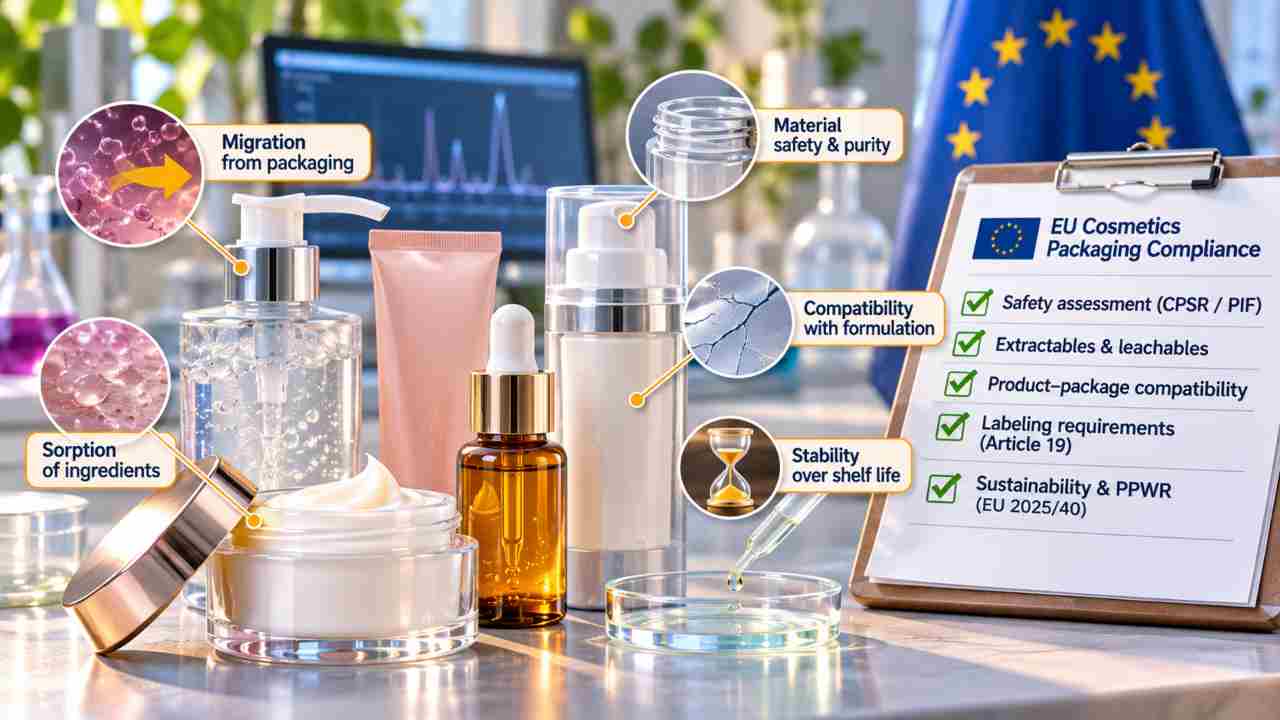
A facial serum can pass stability checks and appear ready for launch. Months later, it may show fragrance loss, reduced preservative availability or a new contaminant. The cause may be its bottle, pump or gasket.
Packaging is often selected for appearance, dispensing and cost. Yet it forms the chemical environment surrounding a formula throughout its commercial life. Contact surfaces can release substances, retain ingredients or alter oxygen, moisture and microbial exposure.
The EU-market question is whether the finished cosmetic and its intended packaging remain safe and suitable together.
PACKAGING SAFETY INSIGHT
A material can have a credible supplier declaration and still require product-specific compatibility evidence. Chemical migration and formula instability are different risks, and both matter.
1. The EU safety report cannot treat the container as decoration
Regulation (EC) No 1223/2009 requires cosmetic products to be safe under normal or reasonably foreseeable conditions of use. Under Article 10, the Responsible Person must ensure a safety assessment is performed and a Cosmetic Product Safety Report (CPSR) is prepared before market placement. Annex I, Part A, section 4 explicitly includes relevant packaging-material characteristics, particularly purity and stability, within the safety information.
Commission Implementing Decision 2013/674/EU explains why materials in direct contact with the finished cosmetic matter: the packaging, formulation and external environment can interact and potentially affect safety. A polymer name is only the beginning of an assessment.
There is no universal EU positive list approving all cosmetic containers. Food-contact rules can support evaluation, but food-contact compliance is neither universally required nor automatic proof of cosmetic suitability. Formulation chemistry and exposure still matter.
2. Migration, ingredient loss and package deterioration are separate problems
Three pathways deserve separate questions. Migration describes the transfer of substances from packaging into the product, potentially involving residual monomers, additives, processing aids, adhesive components, printing-ink constituents or non-intentionally added substances. Detection alone does not establish risk; concentration, exposure and toxicology matter.
Sorption works in the other direction: fragrance constituents, preservatives or other formulation components may partition into a plastic or elastomer. The result may be sensory change or reduced ingredient availability.
Finally, the formulation may attack the package. Solvent-rich or oily products can challenge certain plastics, seals and coatings, causing swelling, discoloration, stress cracking or corrosion. Metal containers also require assessment of liners and closures.
Map the contact surfaces: bottle, dip tube, exposed pump parts, valve, gasket, liner and relevant coatings or adhesives. Secondary packaging is not equivalent to direct contact.
3. Extractables and leachables answer different analytical questions
Extractables studies deliberately challenge a material under selected laboratory conditions to identify substances that could be released. Leachables are substances actually found in a finished formulation after contact under defined storage or use conditions. The former helps establish a hazard inventory; the latter is closer to the product-specific exposure question.
A risk-based plan begins with composition and supplier knowledge, then selects analytical methods according to plausible substances. GC–MS may suit volatile or semivolatile organics; LC–MS can help investigate less volatile compounds; and elemental analysis such as ICP–MS may be relevant for metals. Non-target screening can reveal unknown signals without establishing identity or exposure.
Compare the packaged product against an inert-reference container, include blanks, and record time, temperature, orientation and surface-area-to-volume ratio. Accelerated exposure may help screen failure modes, but excessive temperatures can create artifacts that do not represent ordinary storage.
Interpret results toxicologically; food-contact migration limits cannot simply be applied to every cosmetic.
4. A stable bulk formula can become unstable in its final dispenser
Product–package compatibility is broader than migration. An emulsion can change viscosity after contact with the closure materials; an oxygen-sensitive active may degrade faster in a poorly protective container; a preservative may partition into a component while the product still looks and smells normal. Accelerated results need justification against actual use.
ISO/TR 18811:2018 provides guidance for designing cosmetic stability studies without prescribing one universal protocol. Test the filled pack under relevant orientations, light, temperatures and dispensing cycles. Evaluate leakage, mass loss, discoloration, pH, viscosity, active content or other product-specific attributes.
Microbiological protection also interacts with the pack. A wide-mouth jar and a closed dispensing system create different foreseeable contamination opportunities, but an airless design is not a substitute for adequate preservation. ISO 11930:2019 provides a framework for evaluating antimicrobial protection where applicable. A packaging change may warrant a new preservation assessment.
5. A safety decision is only as defensible as its documentation
The Product Information File (PIF) must support the marketed cosmetic, and the CPSR should connect the packaging information to the final-product safety conclusion. In practice, build a traceable component record: material identities where available, supplier declarations, relevant substances of concern, manufacturing and surface treatments, selected analytical results, compatibility studies and a rationale for any data gaps.
Distinguish resin, colorant, liner, pump, gasket, adhesive and decoration. A change from one closure supplier to another can affect both chemical contact and dispensing performance even if the external appearance is unchanged. Set a clear trigger for reassessment when material, supplier, recycled content, coating, colorant or formulation changes.
Article 19 of Regulation 1223/2009 also governs cosmetic labeling. Required particulars include, as applicable, the Responsible Person’s name and address, nominal content, durability or period-after-opening information, precautions, batch identification, product function and ingredient information. Placement rules differ between the container and outer packaging, with specified exceptions for practical constraints; artwork approval should therefore check the actual assembled pack, not just a flat label file.
6. Recyclability claims cannot overrule product safety
Cosmetic brands increasingly consider recycled content, refill systems, lighter components and easier-to-recycle designs. These decisions can be worthwhile, but they add another evidence layer. Recycled feedstocks may introduce different impurities or wider compositional variability, while refill systems alter foreseeable handling, cleaning and contamination risks. Neither is automatically unsuitable; both require supplier controls and product-specific justification.
The EU Packaging and Packaging Waste Regulation (EU) 2025/40 began applying from 12 August 2026, with further obligations introduced in stages. It addresses packaging design, circularity and waste management; it does not replace the cosmetic safety assessment required by Regulation 1223/2009. Environmental claims must also avoid implying product-safety approval.
A useful packaging qualification matrix keeps distinct decisions visible:
Packaging decision | Main concern | Evidence worth requesting |
|---|---|---|
Fragranced or solvent-rich formula in plastic | Ingredient sorption, swelling or stress cracking | Compatibility after storage, component composition, targeted analysis |
High-active serum with pump and gasket | Extractables, oxygen exposure, dispensing performance | Contact-part inventory, leachables study, active stability |
Recycled-content bottle | Feedstock variability and impurities | Supplier traceability, batch controls, risk-based screening |
Refillable cosmetic system | Repeated handling and microbial exposure | Cleaning/use assessment, preservation and in-use studies |
The strongest choice is not necessarily the cheapest or easiest to recycle. It is the package that meets safety, functional and environmental requirements simultaneously, with evidence appropriate to the intended use.
The container is part of the final formulation decision
Cosmetic packaging compliance becomes more manageable when packaging engineers, formulators, safety assessors and suppliers work from the same component-level evidence. Identify what can migrate, what the package can absorb, how it can fail, and which changes would invalidate the current assessment.
The goal is not an ever-larger document folder. It is a defensible explanation of why this specific formulation remains safe in this specific package throughout its intended life.
ONLYTRAININGS | ADVANCED TECHNICAL TRAINING
Cosmetic Packaging Compliances & Safety Requirements under EU Cosmetic Regulations
Evaluate packaging–formulation interactions, build defensible safety evidence, and manage EU compliance decisions with confidence.
This expert-led training addresses:
Regulation (EC) No 1223/2009, cosmetic packaging safety assessment and CPSR/PIF documentation.
Compliance evidence for plastics, adhesives, metals, printing inks, coatings, elastomers, glass and ceramics.
Migration, unlisted substances, material compatibility and relevant food-contact reference principles.
Labeling, supplier documentation, CosPaTox-related approaches and EU mutual-recognition considerations.
PPWR, sustainability decisions and practical packaging compliance case studies.
EXPLORE THE TRAINING & ACCESS THE COURSE
The course page lists six-month training access, presentation materials, expert-prepared FAQs/Q&A, a verifiable training certificate and expert discussion-forum access.
Technical and regulatory references
Regulation (EC) No 1223/2009, cosmetic products, Articles 3, 10, 11 and 19; Annex I.
Commission Implementing Decision 2013/674/EU, guidelines on Annex I of the Cosmetics Regulation.
ISO/TR 18811:2018, Cosmetics — Guidelines on the stability testing of cosmetic products.
ISO 17516:2026, Cosmetics — Microbiology — Microbiological limits.
European Commission, New EU rules on packaging enter into application (11 August 2026).
OnlyTRAININGS, Cosmetic Packaging Compliances & Safety Requirements.