
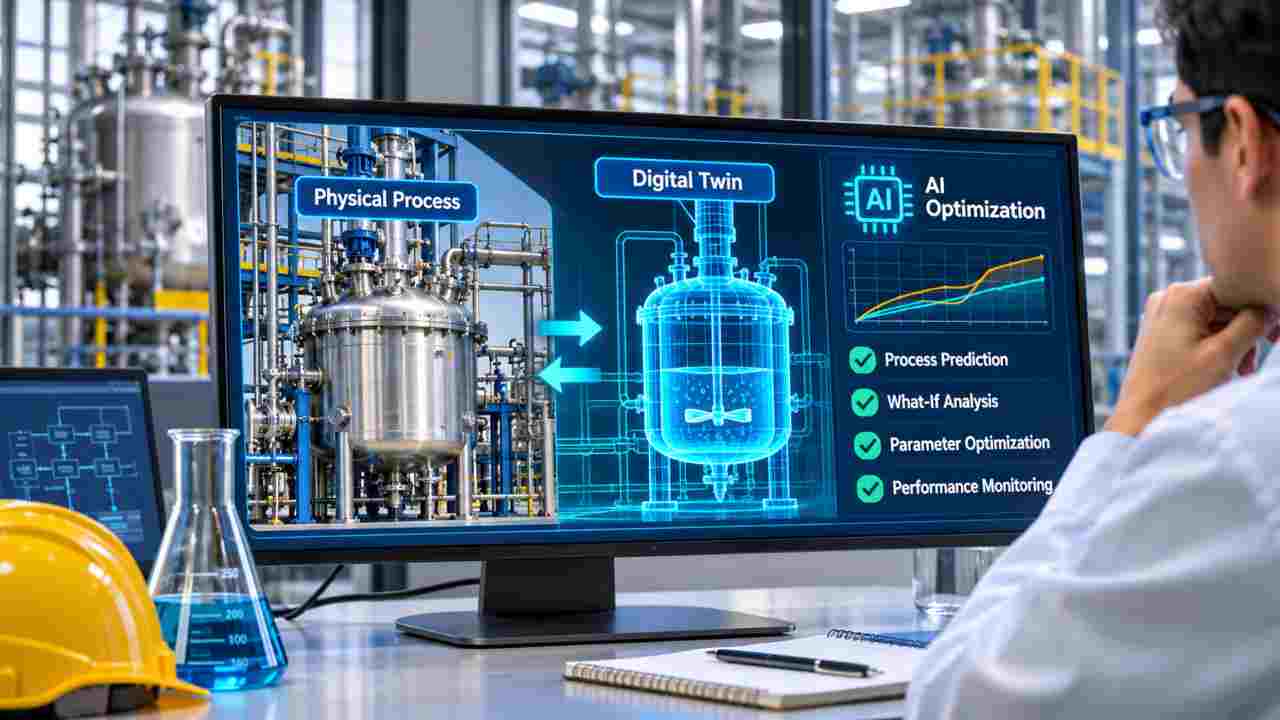
Chemical process development has always depended on mathematical models to predict reaction behavior, energy requirements, material balances and operating conditions. From laboratory-scale kinetic studies to detailed industrial flowsheet simulations, these models help engineers evaluate process alternatives and identify potential improvements before implementing them in production.
However, a conventional process model represents the assumptions and information available when it was developed. Actual processes evolve as feedstock properties change, equipment performance deteriorates, catalyst activity declines and operating conditions shift. Even a sophisticated simulation can become progressively less representative of the physical process unless it is maintained and recalibrated.
Digital twins address this limitation by connecting engineering models with current process information. When properly developed, they can estimate unmeasured process conditions, evaluate possible operating changes and support optimization decisions using a continuously updated representation of the physical system.
The technical challenge is not simply introducing artificial intelligence (AI). It is developing a reliable connection between physical process knowledge, measured information, predictive models and engineering decisions.
1. What Makes a Chemical Process Digital Twin Different From Conventional Simulation?
A chemical process simulator may calculate steady-state material balances, predict reactor conversion or evaluate distillation energy requirements. These calculations remain valuable, but they do not necessarily describe current operating conditions.
A digital twin extends traditional modelling by establishing a maintained connection between the physical process and its computational representation. Measurements from sensors, laboratory analyses and process historians can update model states or parameters, allowing predictions to reflect changing conditions.
The distinction is particularly important for dynamic operations. Consider a batch reactor in which feed composition, reaction rate and heat-transfer efficiency vary between production campaigns. A conventional simulation might predict an expected temperature profile using nominal parameters. A connected digital twin could incorporate actual temperature measurements, feed information and updated kinetic estimates to produce predictions specific to the current batch.
Not every digital twin requires continuous two-way automated control. An engineering decision-support twin may provide periodic predictions for human review, while more advanced implementations can connect with optimization and control systems. The required update frequency and integration level should be determined by the intended application.
This creates an important design principle: a useful digital twin is defined by the reliability of its predictions and decisions, not by the complexity of its visualization or software architecture.
2. Combining First-Principles Models With Machine Learning
Choosing the appropriate process representation is among the most consequential decisions in digital-twin development. Chemical processes involve physical and chemical constraints that cannot always be captured adequately using historical correlations alone.
First-principles models describe process behavior through conservation equations, reaction kinetics, thermodynamics, mass transfer and heat transfer. They are especially useful when engineers need to understand the physical consequences of operating changes. However, their accuracy depends on assumptions and parameters that may be difficult to establish experimentally.
Data-driven models, including machine-learning algorithms, can identify complex relationships within operational data. They may predict process outputs effectively within the conditions represented by the training dataset, but can behave unpredictably when confronted with unfamiliar conditions.
Hybrid modelling combines these complementary capabilities. A mechanistic reactor model, for example, may describe material and energy balances, while a machine-learning component estimates deviations associated with uncertain heat-transfer coefficients, reaction kinetics or equipment characteristics.
The objective is not to replace physical understanding with statistical predictions. It is to preserve essential engineering relationships while using measured information to improve predictive accuracy.
Hybrid models also require careful design. Machine-learning corrections should not permit negative concentrations, impossible material balances or operation outside established physical constraints.
Recent research on hybrid process modelling and digital twins demonstrates the potential of combining mechanistic and data-driven techniques, while emphasizing model identification, computational efficiency and uncertainty management.
3. Process Data, Soft Sensors and the Problem of Incomplete Measurements
Chemical plants generate substantial operational information, yet the variables most important for product quality and process performance are not always directly measurable.
Reactor temperature and pressure may be available continuously, while product composition, molecular weight, impurity concentration or conversion may only be determined through periodic laboratory analysis.
Soft sensors address this limitation by estimating difficult-to-measure variables from other process measurements and mathematical models.
For example, a soft sensor for a polymerization reactor might combine temperature history, feed rates, pressure and laboratory measurements to estimate an evolving quality characteristic. Such estimates can help identify emerging deviations before the next laboratory result becomes available.
However, the reliability of a soft sensor depends heavily on data quality and the conditions under which it was developed.
Important data-management considerations include:
Synchronizing sensor measurements with laboratory sampling times and process events.
Identifying sensor drift, calibration errors, missing observations and abnormal operating periods.
Distinguishing different recipes, production grades and operating regimes during model development.
Preventing future measurements from unintentionally entering historical model-training inputs.
A particular difficulty arises when laboratory results are delayed. The reported analytical value must be associated with the actual sampling time rather than simply the time at which the result becomes available.
Without appropriate data reconciliation and time alignment, even sophisticated machine-learning algorithms may learn misleading relationships.
A reliable digital twin therefore requires an engineered data foundation in which measurement quality, process context and model assumptions remain traceable.
4. Model Calibration, Real-Time Updating and Predictive Reliability
A model that accurately describes a process during commissioning may become less reliable as equipment and operating conditions change.
Heat-exchanger fouling, catalyst deactivation, sensor deterioration and feedstock variability can cause systematic differences between predictions and observations. Digital-twin maintenance must distinguish temporary measurement noise from genuine changes in process behavior.
State-estimation techniques, including Kalman filtering and moving-horizon estimation, can incorporate new measurements to update estimated process conditions. Parameter-estimation methods can also be used to recalibrate selected model characteristics when sufficient evidence supports a change.
These updates should not be indiscriminate. Constantly adjusting model parameters to match noisy measurements may improve apparent short-term accuracy while reducing the model's predictive capability.
A more reliable approach separates state updating from slower parameter recalibration and monitors prediction residuals over time.
For example, a persistent mismatch between predicted and measured reactor cooling demand might suggest changes in heat-transfer performance. Before recalibrating the model, engineers should examine sensor validity, operating changes and the possibility of unmodelled process disturbances.
Model versions, parameter changes and calibration datasets should be documented so that engineers can determine why predictions changed.
This becomes particularly important when digital-twin results influence production decisions, because the credibility of the prediction depends on both its numerical accuracy and the traceability of its assumptions.
5. Using Digital Twins for What-If Analysis and AI-Assisted Optimization
One of the most valuable applications of digital twins is evaluating potential operating changes before introducing them into a physical process.
For a chemical reactor, optimization may involve competing objectives such as increasing conversion, reducing by-product formation, minimizing energy consumption and maintaining temperature within allowable limits. Improving one objective can adversely affect another.
A digital twin can evaluate candidate operating conditions using the current process state rather than relying exclusively on nominal design assumptions.
Consider a temperature-sensitive reaction in which feed rate and cooling capacity limit achievable throughput. An optimization algorithm could evaluate alternative feed profiles and temperature trajectories while accounting for predicted reaction heat release, equipment constraints and product-quality requirements.
Machine learning may accelerate these calculations through surrogate models that approximate computationally expensive simulations. Such models can make repeated optimization studies more practical, particularly when the underlying process representation involves detailed nonlinear equations.
However, predicted improvements must be interpreted within the validated operating region. An optimization algorithm may identify apparently attractive conditions that are poorly represented in the available data or depend on uncertain parameters.
Engineering constraints, equipment limitations and process-safety requirements must therefore remain explicit.
AI-assisted optimization should provide transparent, technically defensible recommendations. Changes to production operating conditions require appropriate engineering review and established operational authorization, rather than unrestricted automated implementation.
6. Validation, Uncertainty and Deployment in Chemical Manufacturing
Digital-twin performance cannot be established from model-fitting accuracy alone. A model may reproduce historical information exceptionally well while performing poorly during new production campaigns or unfamiliar operating conditions.
Validation must therefore reflect the decisions the digital twin is expected to support.
For a reactor-quality prediction model, engineers might test performance across different raw-material batches, production rates, temperature profiles and operating periods. Validation should evaluate prediction error, bias, stability and response to disturbances, using independent datasets wherever possible.
Uncertainty quantification provides additional information about prediction credibility. Measurement uncertainty, uncertain kinetic parameters, model-structure limitations and changing operating conditions can all affect the reliability of predicted outcomes.
A digital twin used for process optimization should ideally distinguish between high-confidence predictions and conditions where additional measurements or engineering investigation are necessary.
Deployment introduces further requirements involving model execution speed, data connectivity, cybersecurity, access permissions and maintenance responsibilities. A computationally detailed model may be unsuitable for frequent updating unless reduced-order modelling or surrogate techniques can achieve acceptable accuracy.
Responsibility for model monitoring and recalibration must also be clearly assigned. Without ongoing technical ownership, a digital twin can become outdated despite initially successful implementation.
The National Institute of Standards and Technology has identified verification, validation, uncertainty quantification and interoperability as important areas for trustworthy manufacturing digital twins. These considerations are equally relevant when evaluating digital twins for chemical process engineering.
From Predictive Models to Better Process-Development Decisions
Digital twins offer chemical R&D and process-engineering teams an opportunity to make better use of existing process knowledge, laboratory measurements and operational data.
Their effectiveness depends on selecting appropriate mathematical representations, combining physical and data-driven models, developing dependable soft sensors and understanding the limitations of predicted results. Reliable implementation requires as much attention to calibration, uncertainty and engineering validation as to AI algorithms.
For professionals responsible for process development, scale-up, simulation or optimization, these capabilities are becoming increasingly relevant as chemical manufacturing adopts more connected and data-intensive operating methods.
Developing the technical judgment to select, construct and evaluate these systems is the focus of a dedicated OnlyTRAININGS advanced program.
ONLYTRAININGS | ADVANCED TECHNICAL TRAINING
Digital Twins for Chemical Process Development Training
Move From Static Process Models to Living Predictive Systems
Explore how engineering models, process measurements and AI can be integrated to support technically credible digital-twin applications.
The training covers:
Selecting suitable digital-twin architectures and process representations.
Building hybrid first-principles and machine-learning models.
Developing soft sensors and integrating process data.
Model calibration, updating and predictive optimization.
AI-assisted decision support, validation and uncertainty assessment.
Designed for chemical process engineers, R&D scientists, simulation specialists and process-optimization professionals.
EXPLORE THE TRAINING & REGISTER
Includes six-month training access, downloadable training materials, a verifiable certificate and expert interaction through the discussion forum.
Technical References
Peterson, L., Gosea, I. V., Benner, P., and Sundmacher, K. (2025). Digital Twins in Process Engineering: An Overview on Computational and Numerical Methods. Computers & Chemical Engineering, 193, 108917. Research article.
Mane, S., Dhote, R. R., Sinha, A., and Thirumalaiswamy, R. (2024). Digital Twin in the Chemical Industry: A Review. Digital Twins and Applications. Research article.
Digital Twins: Transforming the Chemical Process Industry—A Review. The Canadian Journal of Chemical Engineering, 2025. Research article.
Hybrid Modeling of First-Principles and Machine Learning: A Step-by-Step Tutorial Review for Practical Implementation. Computers & Chemical Engineering, 2025. Research article.
A Knowledge Graph Framework for Digital Twins of Chemical Processes. Nature Chemical Engineering, 2026. Research article.
National Institute of Standards and Technology (NIST). Digital Twins for Advanced Manufacturing. Guidance on digital-twin interoperability, verification, validation and uncertainty quantification. Official resource.