
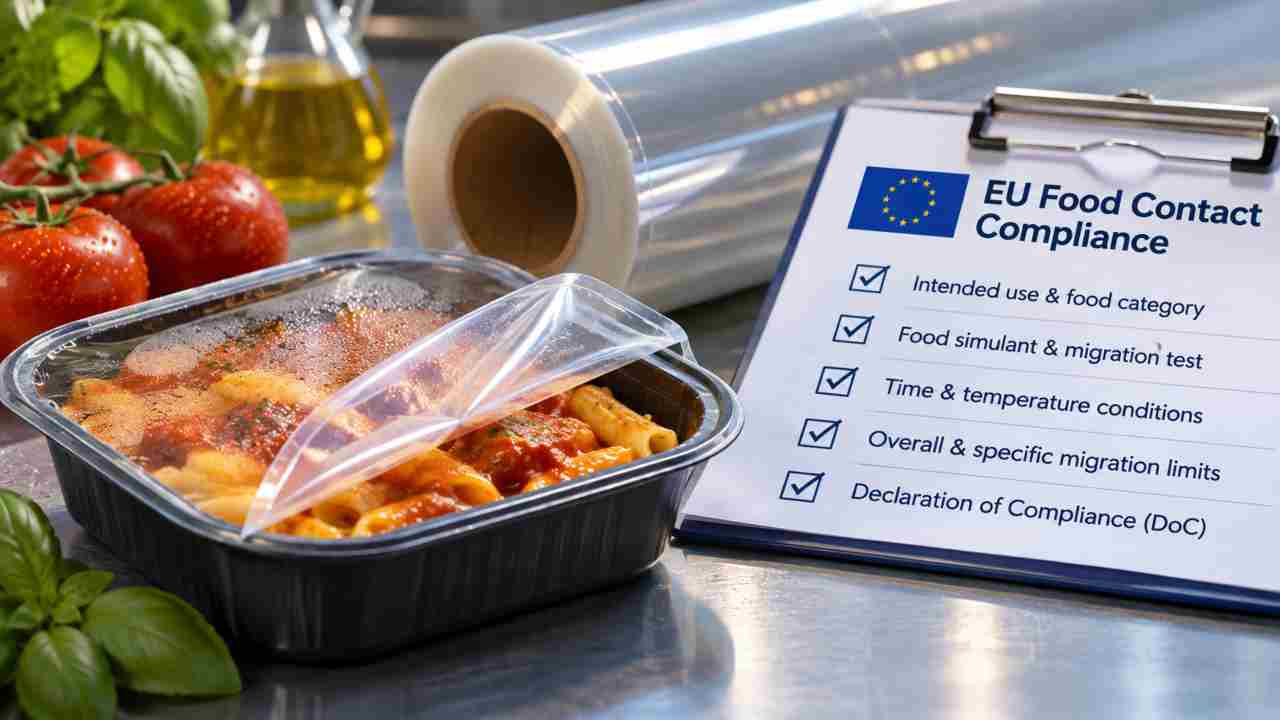
A packaging film can produce a satisfactory migration report, arrive with an apparently complete declaration of compliance, and still be inadequately assessed for the application a converter wants to launch. The laboratory may have performed every requested measurement correctly. The problem is that the request described a different food, temperature profile, contact duration, or package geometry from the intended commercial use.
For European Union food contact materials, compliance is not a permanent property conferred by one successful test. It is a conclusion supported by composition, manufacturing controls, migration evidence, and clearly defined conditions of use. When any of those conditions changes, the evidence may need to be reconsidered. The distinction matters when one formulation serves several customers.
COMPLIANCE INSIGHT
Before ordering tests, approve a written use profile covering food category, contact temperature, duration, and packaging geometry. Do not let a generic “suitable for food contact” request define the study.
1. The legal framework starts with the finished use, not the test report
Regulation (EC) No 1935/2004 sets the general safety principle: under normal or foreseeable conditions, food contact materials must not transfer constituents at levels that endanger health, unacceptably change food composition, or deteriorate its organoleptic characteristics. Commission Regulation (EC) No 2023/2006 adds good manufacturing practice requirements, including documented quality assurance and control systems.[1][2]
For plastic materials and articles, Regulation (EU) No 10/2011 introduces composition rules, substance restrictions, overall and specific migration limits, and detailed compliance verification procedures. Paper, inks, coatings, and adhesives may instead require additional EU or national provisions.[3][4]
Consider an illustrative polypropylene-based lidding structure originally evaluated for a refrigerated dairy product. A customer now proposes the same construction for a heat-treated acidic sauce. The existing assessment cannot simply be transferred. The food chemistry, thermal history, possible interaction with adjacent layers, and contact period must be checked against the evidence already available.
The starting question is therefore not “Has this film passed?” It is “Which exact uses does the available evidence support?”
2. Simulant selection and real use conditions can change the compliance question
Annex III to Regulation (EU) No 10/2011 assigns food simulants by food category and test purpose. Examples include 10% ethanol (A), 3% acetic acid (B), 20% ethanol (C), 50% ethanol (D1), vegetable oil (D2), and poly(2,6-diphenyl-p-phenylene oxide) (E). Exact assignments and test provisions govern their use.[3]
Food composition matters because the extraction behaviour of a migrant can differ between aqueous, acidic, alcoholic, and fatty environments. A result obtained with a simulant assigned to one product category may not establish compliance for another. Testing every simulant indiscriminately can also be unnecessary.
A good test brief identifies the intended foods first, checks the Annex III assignment, and documents any justified alternative or worst-case approach. If several food categories are covered, the technical rationale must show why the selected test programme addresses them. The manufacturer and downstream operator still need defensible use specifications.
Temperature affects diffusion, contact duration influences transfer, and food-contact surface area relative to volume changes reported concentration. The applicable EU verification rules therefore require test conditions representing the most extreme foreseeable use, with prescribed conventions and exceptions rather than arbitrary laboratory stress testing.[3]
A refrigerated package intended for a short shelf life is not necessarily covered by a report generated for a different storage scenario. Hot filling, microwave heating, repeated use, or extended room-temperature contact can change the assessment. Tests causing unrealistic physical damage require review under the regulation’s specific provisions.
Surface-to-volume assumptions deserve particular attention in small packages. Identical release per unit area can produce different concentrations in differently sized packs. Article 17 and the supporting annexes specify how the relevant ratio is treated; it should not be silently replaced by a convenient default when real-use conditions are known and the rules require their consideration.[3]
An effective report explains not only the numerical result but why the selected test conditions cover the marketed application.
3. An overall migration pass is not a substance-by-substance clearance
Overall migration and specific migration answer different questions. The general overall migration limit for plastic materials is 10 mg/dm², subject to regulatory exceptions, including a 60 mg/kg limit for certain articles intended for infants and young children. Specific migration limits apply to individual restricted substances or groups, frequently in mg/kg of food. Passing an overall test does not establish that every relevant specific migration limit has been met.[3][4]
Assessment must link restricted substances to supplier data, appropriate analyses, and regulatory reporting units. Screening data, calculation, migration modelling, and experimental measurements may each contribute where the regulation permits and the underlying assumptions are sound.
Non-intentionally added substances also require an appropriate risk assessment under the plastics rules. An overall-migration certificate alone cannot answer every chemical-safety question raised by the finished structure.
4. Multilayer construction turns one report into a chain of evidence
Food packaging is often a system of polymer layers, adhesives, coatings, inks, tie layers, and processing residues. A plastic layer's regulatory obligations do not mean that every neighbouring material is automatically harmonised at EU level. National provisions or other applicable EU measures may have to be considered for non-harmonised components, while the finished article must still satisfy the framework safety requirements.[1][4]
Transfer is not limited to direct diffusion. Printed reels can experience set-off from the exterior print to the food-contact side. The GMP regulation specifically addresses controls for printing inks used on the non-food-contact side.[2]
Converters should map each layer to supplier specifications, applicable restrictions, and evidence for the final application. A supplier declaration cannot replace assessment of lamination, curing, printing, and finished-article use.
A change of adhesive, an altered coat weight, a different cure schedule, or a new printing arrangement should trigger documented review. Retesting depends on change significance and existing evidence, not an automatic annual cycle.
5. A declaration of compliance must describe the limits of the claim
For plastics, Article 15 and Annex IV of Regulation (EU) No 10/2011 govern the declaration of compliance (DoC). Required information includes identification of the issuer and material, relevant restricted substances, and specifications for intended use. Those specifications cover the types of food, time and temperature conditions, and the food-contact surface-area-to-volume ratio used to establish compliance, or the equivalent information required by the current text.[3]
The DoC communicates conclusions; supporting documentation explains them. The European Commission explains that this underlying evidence must be available to enforcement authorities on request. The file can include composition, supplier data, tests, calculations, and the intended-use rationale.[4]
Compare customer specifications directly with the declared use envelope. If the customer intends hot filling but the evidence only supports ambient or refrigerated contact, the gap belongs in the release decision. A broad certificate statement cannot close that gap.
Review point | Decision that needs evidence |
|---|---|
Food type | Are the assigned food categories and simulants covered? |
Time and temperature | Does the test or justified assessment encompass the intended process and shelf life? |
Package geometry | Is the relevant surface-to-volume relationship properly accounted for? |
Construction | Are layers, inks, adhesives, and processing changes covered? |
Documentation | Does the DoC accurately reflect the supporting file and its restrictions? |
6. Regulatory changes make the approved use envelope a living document
Regulatory maintenance requires more than updating references. Commission Regulation (EU) 2025/351 amended the plastics, recycled-plastics, and GMP frameworks, including provisions relating to quality control and manufacturing. Regulation (EU) 2024/3190 introduced restrictions concerning BPA and certain other bisphenols in specified food contact materials, with corrections and transitional arrangements requiring careful case-by-case reading.[5][6]
More recently, Commission Regulation (EU) 2026/2412 of 28 October 2026 amended the Union list in Annex I to Regulation (EU) No 10/2011. Authorisations may have strict use conditions, compositional limits, and migration restrictions.[7]
Change control should track legal versions, substance inventories, approved uses, test assumptions, supplier data, and release decisions. Screen regulatory changes before revising a formulation, DoC, or testing programme. For recycled plastic, Regulation (EU) 2022/1616 adds a separate framework that cannot be replaced by virgin-resin documentation.[8]
A passing test still needs the right question
The practical lesson is that compliance attaches to a substantiated material-and-use combination. A passing laboratory result is valuable evidence, but only when it answers the question the commercial application actually poses. The best technical teams define that question before commissioning the test, and revisit it whenever the formulation, supply chain, legislation, or intended use changes.
ONLYTRAININGS | ADVANCED TECHNICAL TRAINING
EU Food Contact Materials Regulations & Compliance
Build stronger regulatory decisions by connecting EU legal requirements with migration evidence, intended-use conditions, and supplier documentation.
This expert-led training addresses:
EU food-contact regulations and obligations across the supply chain.
Food simulants and overall versus specific migration testing.
NIAS evaluation and interpretation of laboratory findings.
Declarations of Compliance and supporting technical documentation.
Regulatory decisions for materials and finished applications.
EXPLORE THE TRAINING & ACCESS THE TRAINING