
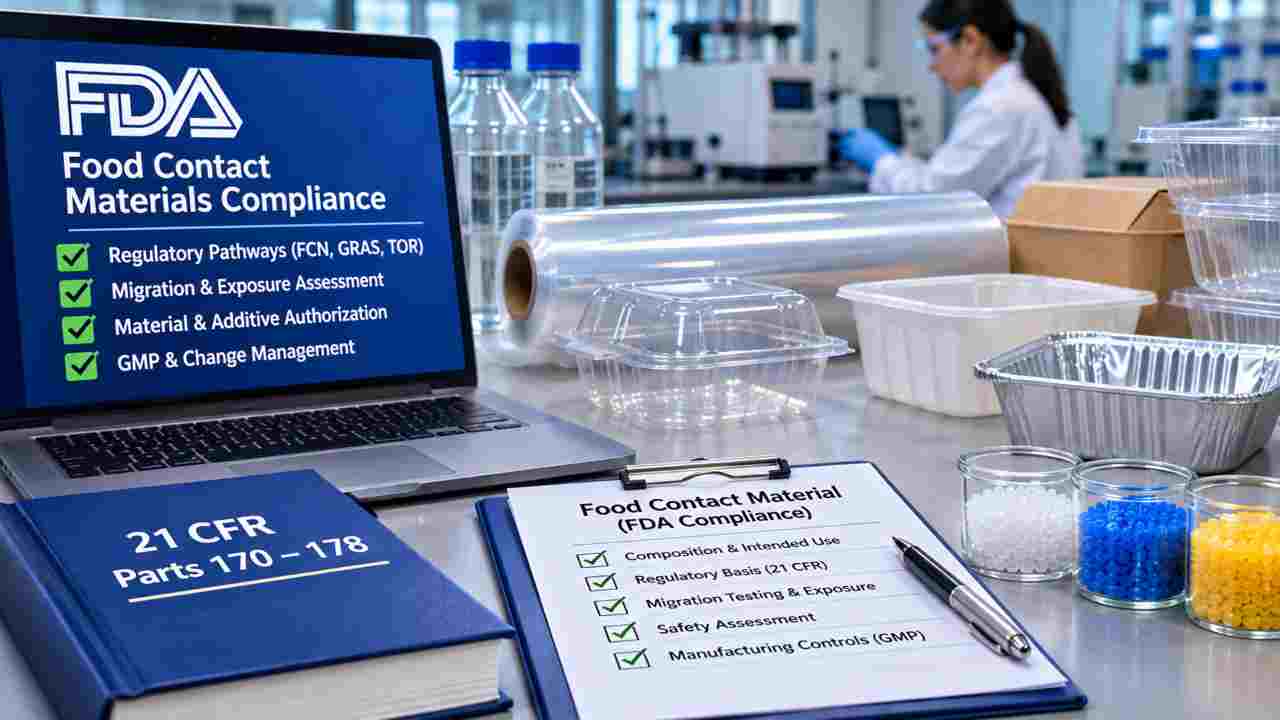
For manufacturers developing food packaging, polymer compounds, coatings, adhesives and other food-contact materials, demonstrating compliance with U.S. Food and Drug Administration (FDA) requirements involves more than finding an ingredient in a regulatory database.
A polymer resin may be permitted for certain food-contact applications while a particular additive, processing aid or modified formulation requires separate evaluation. A substance authorized for refrigerated food storage may not necessarily be suitable for high-temperature filling or microwave heating. Similarly, a supplier's regulatory declaration may not establish compliance for every application of the finished material.
These distinctions become increasingly important as manufacturers introduce recycled content, alternative additives, multilayer structures and new processing technologies.
FDA compliance decisions must connect material identity, authorization status, intended conditions of use, potential migration and consumer exposure. A defensible assessment begins with understanding how these elements interact, rather than treating regulatory clearance as an isolated documentation requirement.
1. FDA Authorization Depends on the Substance and Its Intended Use
The U.S. regulatory system evaluates food-contact substances within the framework of the Federal Food, Drug, and Cosmetic Act. Relevant authorizations include regulations in Title 21 of the Code of Federal Regulations (21 CFR), particularly provisions governing indirect food additives.
Parts 175–178 address various food-contact applications involving adhesives, coatings, paper, paperboard, polymers and other substances. However, locating an ingredient in one of these regulations does not establish unrestricted authorization.
Each applicable regulation must be examined for substance identity, specifications, permitted concentrations and conditions of use. Restrictions may concern food types, processing temperatures, contact duration or particular material applications.
Consider a polymer formulation developed for a flexible food-packaging film. The base resin may have an established regulatory basis, but the formulation also contains stabilizers, slip additives, processing aids and possibly pigments. Components reasonably expected to migrate must have an appropriate regulatory basis for their intended uses.
FDA emphasizes that the regulatory status of the complete material depends on its individual constituents and their applicable authorizations.
The initial compliance assessment should therefore identify the entire composition and establish the intended food-contact application before determining whether additional authorization or supporting evidence is necessary.
2. Choosing Between FCN, GRAS, Prior Sanction and TOR
One of the most consequential decisions in FDA food-contact compliance is selecting the appropriate regulatory pathway.
An effective Food Contact Substance Notification (FCN) can authorize a specified food-contact substance under defined conditions. Importantly, FCNs are manufacturer- or supplier-specific. A company cannot automatically rely on an FCN covering an equivalent substance produced by an unrelated manufacturer.
Existing regulations may provide an appropriate basis for some substances, while other uses may qualify through generally recognized as safe (GRAS) status or an applicable prior sanction. Such conclusions must be supported for the specific intended use; familiar chemical identity alone is insufficient.
The Threshold of Regulation (TOR) procedure under 21 CFR 170.39 offers another route for qualifying uses involving sufficiently low dietary exposure, subject to its eligibility and safety criteria. The commonly cited 0.5 parts-per-billion dietary concentration criterion should not be interpreted as a universal migration limit or an automatic exemption.
A new use may instead require an FCN or another appropriate regulatory submission where existing authorization cannot be established.
For development teams, the central question is not which pathway appears fastest. It is which pathway is legally applicable and scientifically supportable for the specific substance, manufacturer and proposed use.
Choosing incorrectly can invalidate subsequent assumptions about testing, documentation and commercialization.
3. Migration Testing Must Support Exposure and Safety Assessment
Migration testing provides essential information about the potential transfer of substances from food-contact materials into food. However, analytical results only become meaningful when interpreted against realistic or appropriately conservative conditions of use.
Food composition, contact temperature, duration, material thickness and substance concentration can influence migration behavior.
FDA's chemistry guidance describes approaches using appropriate food simulants, intended-use conditions and analytical measurements to estimate consumer exposure. In suitable circumstances, conservative calculations assuming complete migration may provide an alternative to experimental testing.
A critical distinction exists between regulatory extraction tests used to demonstrate compliance with an established regulation and migration studies designed to estimate exposure for a new food-contact substance.
These are not automatically interchangeable. FDA specifically cautions that certain existing regulatory end tests should not be treated as substitutes for exposure-oriented migration testing supporting a new submission.
Analytical method validation also matters. Reporting a substance as undetected does not establish that migration is zero. Detection limits, recovery, measurement uncertainty and analytical selectivity influence the reliability of the exposure estimate.
The resulting exposure assessment must be considered alongside relevant toxicological information. Low measured migration alone does not establish that a substance is safe, nor does a detectable amount necessarily indicate an unacceptable exposure.
Effective regulatory assessment connects the chemical measurement to the safety question it is intended to answer.
4. Multilayer Materials, Functional Barriers and Formulation Boundaries
Modern food packaging frequently incorporates multiple polymer layers, adhesives, coatings and functional additives. These structures introduce additional complexity because a substance does not necessarily require direct physical contact with food to raise migration questions.
A functional barrier may restrict transfer from an outer layer, but its effectiveness must be supported for the material structure and intended conditions of use.
Barrier performance can depend on polymer chemistry, layer thickness, temperature, contact duration and the migration characteristics of individual substances. A barrier effective for one compound may not provide equivalent protection against another.
Similarly, the regulatory status of a base resin does not automatically extend to every additive incorporated into a new formulation. Material modifications must be assessed against the applicable authorization conditions.
For example, replacing a stabilizer or increasing additive concentration in an otherwise established polymer formulation may create a new regulatory question even when the material's mechanical properties remain satisfactory.
Recycled plastics require particular attention. FDA identifies possible contamination, incorporation of unsuitable feedstock and use of noncompliant additives among its principal concerns. Its evaluation of recycling processes considers source controls, decontamination performance and the proposed food-contact application.
These examples illustrate why complete material construction and exposure assumptions must be evaluated rather than relying on simplified claims about an individual resin or barrier layer.
5. Good Manufacturing Practices and the Limits of FSMA Obligations
Regulatory authorization must be supported by manufacturing practices that preserve material suitability and compliance.
Under 21 CFR 174.5, indirect food additives must be used in accordance with good manufacturing practice, including appropriate purity and quantities reasonably necessary to achieve their intended technical effect.
Practical controls may include raw-material specifications, contamination prevention, traceability, processing consistency and change management.
The Food Safety Modernization Act (FSMA) creates additional questions for packaging manufacturers, but its requirements should not be generalized.
FDA clarifies that manufacturing food packaging, by itself, does not trigger food-facility registration or the preventive-controls food safety plan requirements applicable to certain food-manufacturing facilities. Nevertheless, relevant current good manufacturing practice provisions under 21 CFR Part 117, Subpart B apply to food-packaging manufacturing.
Companies undertaking additional activities, including packing food, may have different regulatory obligations.
Supplier declarations and letters of guaranty can support compliance assessments, but they must be evaluated against the material's actual composition and intended application. A generic statement that an ingredient is FDA-compliant does not establish that every downstream formulation is acceptable.
Maintaining the connection between supplier information, production controls and the finished food-contact article is essential for technically defensible documentation.
6. Managing Authorization Changes and Long-Term Compliance
Food-contact compliance requires continuing oversight because authorization status, material formulations and manufacturing arrangements can change.
In January 2025, FDA determined that 35 FCNs covering certain per- and polyfluoroalkyl substances used as grease-proofing agents in paper and paperboard packaging were no longer effective following abandonment of those uses.
This development illustrates the importance of monitoring regulatory status rather than relying indefinitely on historical authorization records.
Changes involving raw-material suppliers, substance specifications, processing conditions or finished-product applications should trigger proportionate regulatory review.
A structured compliance file should contain:
Complete material composition and documented regulatory bases for relevant constituents.
Applicable authorization limitations and supplier or manufacturer traceability.
Intended food types, temperatures, contact durations and use restrictions.
Supporting migration, exposure and toxicological assessments where necessary.
Manufacturing controls, supporting declarations and documented change assessments.
The purpose of this documentation is not simply to demonstrate that regulatory references have been collected. It is to explain why the finished material is suitable for the specific application under consideration.
Periodic reassessment should also address changes in regulatory authorizations, product design and available scientific information.
Developing Defensible FDA Compliance Decisions
Effective FDA compliance requires regulatory knowledge supported by chemical understanding, exposure assessment and practical manufacturing judgment.
The most challenging decisions often arise when existing authorizations must be interpreted for modified formulations, uncertain migration behavior or changing supply chains. Addressing these questions early can reduce avoidable testing, documentation gaps and late-stage commercialization problems.
For regulatory affairs professionals, formulation scientists and technical managers, the ability to evaluate clearance pathways and defend material-specific decisions is therefore increasingly important.
These applied regulatory challenges form the central focus of the advanced OnlyTRAININGS program on U.S. FDA compliance for food-contact materials.
ONLYTRAININGS | ADVANCED TECHNICAL TRAINING
US FDA Compliance Training for Food Contact Materials
Make Better FDA Clearance, Migration and Regulatory Risk Decisions
Move beyond basic regulatory listings and strengthen your ability to evaluate and defend food-contact compliance decisions.
The expert-led program covers:
FDA regulatory architecture and practical interpretation of 21 CFR.
FCN, GRAS, prior sanction and TOR pathway selection.
Migration data, dietary exposure and toxicological relevance.
Functional barriers, formulation boundaries and common exemption errors.
Good manufacturing practices, FSMA considerations and supplier documentation.
Advanced case studies, compliance failures and long-term regulatory strategy.
Designed for regulatory affairs professionals, R&D scientists, compliance managers, materials specialists and technical decision-makers.
EXPLORE THE TRAINING & REGISTER
Includes a shareable, verifiable certificate for your professional records, plus 6-month full training access, practical toolkits, downloadable materials and 24/7 expert connect.
Technical and Regulatory References
U.S. Food and Drug Administration. Determining the Regulatory Status of Components of a Food Contact Material. Official FDA guidance.
U.S. FDA. Preparation of Premarket Submissions for Food Contact Substances: Chemistry Recommendations. Revised December 2007. Official guidance.
U.S. FDA. Preparation of Food Contact Substance Notifications: Toxicology Recommendations. October 2021. Official guidance.
U.S. FDA. Inventory of Effective Food Contact Substance Notifications. Official database.
U.S. FDA. Submitting Requests Under 21 CFR 170.39 Threshold of Regulation for Substances Used in Food-Contact Articles. Official guidance.
U.S. FDA. Frequently Asked Questions on the Food Safety Modernization Act. Food Packaging Manufacturers, Questions FPM.1–FPM.3. Official FAQ.
U.S. FDA. Use of Recycled Plastics in Food Packaging: Chemistry Considerations. July 2021. Official guidance.
U.S. FDA. FDA Determines Authorization for 35 Food Contact Notifications Related to PFAS Are No Longer Effective. January 3, 2025. Official regulatory update.