
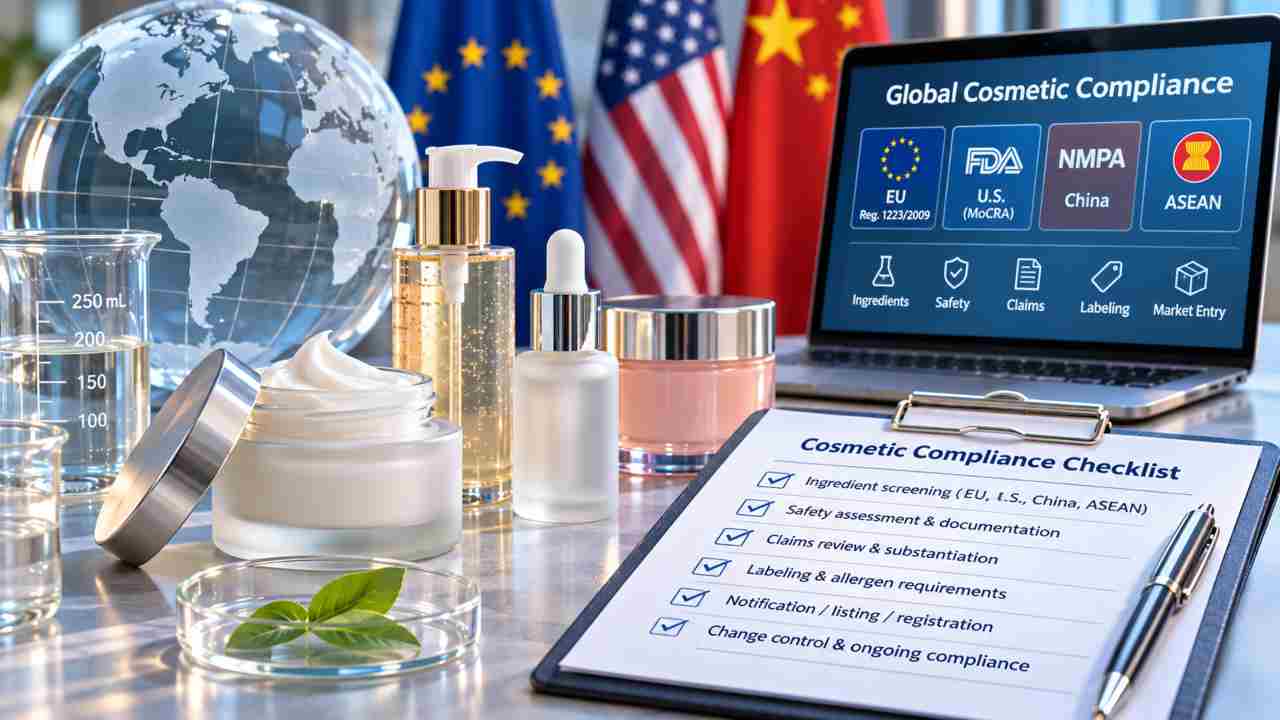
A moisturizer can satisfy the ingredient restrictions established for the European Union yet still encounter questions when its claims and labeling are reviewed for the United States. A fragrance blend can have adequate supplier documentation but require different allergen disclosures for a new EU launch. A formulation introduced into China may face additional filing or registration requirements that were never part of the original development plan.
These are not necessarily failures of product quality. They arise because cosmetic regulations govern different combinations of ingredients, intended uses, safety evidence, commercial responsibilities, and product claims. A single formula specification cannot establish compliance everywhere.
For cosmetic R&D teams, the question is whether the complete formulation, safety evidence, claims, and documentation remain defensible in each jurisdiction.
REGULATORY INSIGHT
A common ingredient list does not guarantee a common regulatory route. Market access must be evaluated for the finished product and intended claims, not the INCI names alone.
1. The EU and United States begin from different compliance structures
EU Regulation (EC) No 1223/2009 places defined obligations on the designated Responsible Person. Before a cosmetic is placed on the EU market, it must have an appropriate safety assessment and Cosmetic Product Safety Report (CPSR). A Product Information File (PIF) must be maintained, and required information is submitted through the Cosmetic Products Notification Portal (CPNP). Notification is not product approval.
In the United States, cosmetics generally do not require FDA premarket approval, with important exceptions such as certain color additives. The Modernization of Cosmetics Regulation Act of 2022 (MoCRA) introduced obligations including safety substantiation, serious adverse-event reporting, facility registration, and product listing, subject to applicable exemptions and implementation details.
A European CPSR does not automatically satisfy U.S. obligations. In September 2026, FDA clarified that registration and listing numbers are not indicators of FDA approval.
Responsibilities and evidence must be mapped separately by market, even for identical formulations.
2. Ingredient screening must examine restrictions, exposure, and emerging changes
An INCI name identifies an ingredient, not universal permission for its use. European formulators must review the applicable annex restrictions, including prohibited substances, restricted ingredients, preservatives, colorants, and UV filters. Conditions can depend on concentration, product type, and exposure route.
SCCS opinions inform EU decisions but are not themselves newly binding restrictions. Teams must monitor subsequent legal amendments.
Fragrance illustrates the importance of timing. Commission Regulation (EU) 2023/1545 expanded individual fragrance-allergen labeling requirements. From 31 July 2026, products newly placed on the EU market must comply with the updated provisions, while qualifying products placed on the market before that date may continue to be made available until 31 July 2028 under the transitional conditions. Existing stock and new launches require different checks.
IFRA Standards inform fragrance safety, but IFRA is not a regulator. Supplier conformity statements do not replace legal review.
DECISION POINT: When a fragrance changes
Recalculate final-product allergen concentrations, verify the updated EU declaration, review the supplier's composition and IFRA documentation, and check whether the modification affects safety assessments or claims in other markets.
3. Safety files must explain the product, not merely accumulate documents
Supplier certificates and safety data sheets cannot alone establish finished-product safety. Exposure depends on use amount, frequency, application site, rinse-off status, and user population.
Under the EU system, the CPSR and supporting PIF should describe the formulation, its physical and chemical characteristics, microbiological quality, impurities, packaging considerations, expected exposure, and the safety assessor's conclusion. Documentation must reflect the marketed formulation and its changes.
MoCRA requires adequate substantiation of safety and records supporting that conclusion, but it does not simply impose the EU CPSR format. A central evidence package can support market-specific assessments without assuming one document satisfies every system.
A useful change-control example is switching the supplier of a botanical extract. Even when the declared INCI name remains identical, extraction solvent, impurities, allergenic constituents, concentration, and batch variability may differ. The existing safety rationale may no longer apply.
4. Claims can change the regulatory classification of the same formulation
Claims can determine a product’s regulatory category. In the United States, claims to treat acne, prevent disease, or affect the structure or function of the body can bring a product within drug requirements. Some products are regulated as both cosmetics and drugs.
In the EU, cosmetic claims must be justified under Regulation (EU) No 655/2013 and remain consistent with evidence supporting the claimed effect. Words, graphics, implied benefits, and advertising context all matter. A consumer-test summary alone may be insufficient.
Translated claims need reassessment: an unchanged formula can acquire a different regulatory classification.
Cross-market decision snapshot
Decision area | European Union | United States | Development implication |
|---|---|---|---|
Product safety | CPSR and PIF under Regulation 1223/2009 | Adequate safety substantiation under MoCRA | Use common evidence, but separate compliance conclusions |
Market notification | CPNP notification; not approval | Registration/listing duties where applicable; not approval | Do not describe reference numbers as regulatory clearance |
Ingredient control | Detailed annex conditions and amendments | Applicable federal restrictions, including color-additive rules | Screen the actual use, concentration and product category |
Claims and classification | Cosmetic definition and justified claims | Cosmetic/drug distinction may be claim-driven | Approve claims before finalizing the global launch plan |
5. China and ASEAN add distinct market-entry decisions
Exporting requires more than translated labeling. China's regulatory system distinguishes general cosmetics from special cosmetics and provides different filing and registration pathways. Under NMPA rules, general cosmetics generally follow a filing process before marketing or import, while special cosmetics follow registration requirements. Ingredient status and documentation shape the pathway.
ASEAN's harmonized cosmetic framework offers regional common principles, but notification is carried out with the competent authority in each individual member state where the product will be marketed. National implementation still matters. An ASEAN-market notification should not be presented as a single regional license.
These differences are particularly consequential for sunscreen products, skin-treatment positioning, hair-color products, and novel ingredients, where product classification and ingredient controls may be decisive. Japan, South Korea, and Latin American markets add further national requirements and should be assessed individually rather than grouped under a generic “global compliance” approval.
Build a market-by-market launch matrix early; different classifications and exemptions prevent a universal “strictest rules” shortcut.
6. Regulatory change control should begin before formulation sign-off
Late failures often begin at handoffs between R&D, procurement, packaging, and marketing. A supplier may change a fragrance composition without triggering label review; marketing may introduce a new claim after product testing; or a new market may be added after the formula is frozen.
A robust review gate should link each proposed change to the affected decisions: ingredient status, impurity profile, product safety, claims, artwork, notification or listing, and supporting documentation. Assign owners and record approvals.
Record the source and date of legal interpretations, especially during EU labeling transitions or updated FDA guidance. Recheck compliance at defined milestones.
PRACTICAL TAKEAWAY
The most useful global compliance document is a living decision record connecting formulation version, market, intended claims, evidence, legal basis, responsible owner, and next review date.
Make regulatory strategy part of formulation development
Global compliance requires more than a master ingredient list. Differences in definitions, responsibilities and evidence must enter formulation planning early, before artwork or market entry.
Experienced teams need a systematic way to interpret requirements, anticipate changes, and defend cross-market decisions. That is the focus of the OnlyTRAININGS program.
ONLYTRAININGS | ADVANCED TECHNICAL TRAINING
Global Cosmetic Compliance Training | EU 1223, MoCRA, SCCS and GMP
Build a market-ready cosmetic compliance strategy before expensive reformulation or launch delays.
The expert-led program addresses:
EU Regulation 1223/2009, SCCS influence, CPSR/PIF weaknesses, and enforcement risks.
U.S. MoCRA obligations, FDA oversight, ingredient and product classification.
China CSAR, ASEAN, and other regional market-entry challenges.
Ingredient restrictions, supplier verification, allergens, and claims substantiation.
Compliance failure case studies, documentation controls, and risk-based global launch decisions.
EXPLORE THE TRAINING & REGISTER
The course page lists six-month access, downloadable training materials, a verifiable certificate, and expert discussion-forum access.
Technical and regulatory references
European Union, Regulation (EC) No 1223/2009 on cosmetic products. https://eur-lex.europa.eu/eli/reg/2009/1223/oj/eng
European Commission, Cosmetic Products Notification Portal. https://single-market-economy.ec.europa.eu/sectors/cosmetics/cosmetic-product-notification-portal_en
European Commission, Fragrance allergens labelling; Regulation (EU) 2023/1545. https://single-market-economy.ec.europa.eu/sectors/cosmetics/cosmetic-products-specific-topics/fragrance-allergens-labelling_en
European Union, Regulation (EU) No 655/2013 on cosmetic product claims. https://eur-lex.europa.eu/eli/reg/2013/655/oj/eng
U.S. FDA, Modernization of Cosmetics Regulation Act of 2022 (MoCRA). https://www.fda.gov/cosmetics/cosmetics-laws-regulations/modernization-cosmetics-regulation-act-2022-mocra
U.S. FDA, Facility registration and cosmetic product listing, updated September 2026. https://www.fda.gov/cosmetics/registration-listing-cosmetic-product-facilities-and-products
U.S. FDA, Cosmetics labeling claims. https://www.fda.gov/cosmetics/cosmetics-labeling/cosmetics-labeling-claims
China's NMPA, Provisions for Registration and Filing of Cosmetics. https://english.nmpa.gov.cn/2022-06/30/c_785637.htm
ASEAN, ASEAN Harmonized Cosmetic Regulatory Scheme / Cosmetic Directive. https://asean.org/wp-content/uploads/2024/11/Agreement-on-the-ASEAN-Harmonized-Cosmetic-Regulatory-Scheme.pdf
IFRA, About IFRA and industry standards. https://ifrafragrance.org/about-ifra