
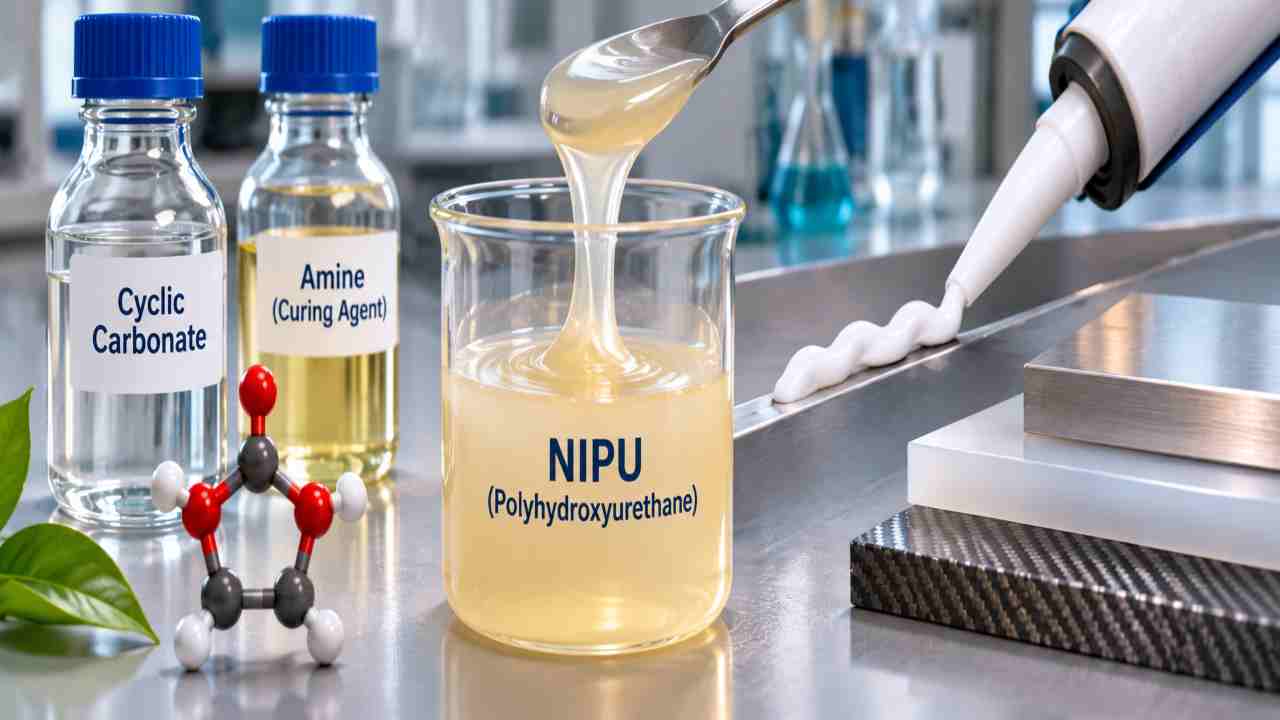
Isocyanate-free polyurethane (NIPU) technology is attracting growing interest among adhesive and sealant manufacturers seeking alternatives to conventional polyurethane chemistry. The appeal is understandable: eliminating isocyanate reactants from the formulation can address important occupational exposure concerns while opening possibilities for new polymer structures and renewable raw materials.
However, developing a successful NIPU adhesive involves considerably more than replacing isocyanates with another reactive component. Conventional polyurethanes owe their versatility to carefully controlled relationships between reaction kinetics, polymer structure, interfacial adhesion, and mechanical properties. Reproducing these characteristics through alternative chemistry introduces different formulation constraints.
Cyclic carbonate–amine systems, particularly those forming polyhydroxyurethanes (PHUs), are among the most promising approaches. Their potential is substantial, but slower curing, viscosity development, network rigidity, and moisture-related performance changes continue to influence their suitability for demanding adhesive and sealant applications.
1. What Makes NIPU Chemistry Different?
The most extensively investigated NIPU route involves the ring-opening reaction of cyclic carbonates with amines. Unlike conventional polyurethane formation, which typically involves isocyanates reacting with polyols, this approach produces urethane linkages without using isocyanate-functional reactants.
An important characteristic of the resulting polyhydroxyurethanes is the presence of hydroxyl groups alongside the urethane structures. These groups contribute to hydrogen bonding within the polymer and can influence cohesion, chain mobility, and adhesion to compatible substrates. Their effects are not exclusively beneficial, however, as they may also increase the material's affinity for moisture.
The reaction itself introduces another distinction. Common five-membered cyclic carbonates generally exhibit lower reactivity toward amines than isocyanates do in conventional polyurethane-forming reactions. Consequently, achieving satisfactory conversion at ambient temperature can be difficult, particularly as the developing polymer network restricts molecular movement.
For formulators, these differences have practical consequences. A NIPU formulation may demonstrate encouraging final mechanical properties but still be unsuitable because of excessive curing time, difficult processing, or inadequate environmental durability. Understanding these limitations early helps avoid unnecessary formulation trials.
2. Choosing Cyclic Carbonates and Amines for the Required Performance
Reactive component selection is central to NIPU formulation because molecular structure directly influences curing behaviour and the properties of the finished adhesive.
Multifunctional cyclic carbonates allow the development of crosslinked polymer networks, while the selection of amines influences flexibility, stiffness, and network architecture. Flexible aliphatic or polyether-based amines can help increase elongation and deformation capability. More rigid structures may improve stiffness and resistance to deformation but can also reduce toughness when the adhesive experiences impact or concentrated stresses.
The balance between functional groups is equally important. An inappropriate ratio of cyclic carbonate to reactive amine equivalents may leave residual functionality, limit network development, or produce mechanical properties that differ from expectations. Commercial raw materials may also contain functionality distributions or impurities that require consideration beyond nominal stoichiometric calculations.
These decisions become particularly important when comparing structural adhesives with elastic sealants. A structural bonding application may demand high cohesive strength and dimensional stability, whereas a construction sealant must accommodate repeated movement without losing adhesion. Increasing crosslink density to improve strength is not necessarily desirable when flexibility and elastic recovery are more important.
Rather than maximizing individual properties, formulators should begin with the intended application and select reactive building blocks capable of delivering the required performance balance.
3. The Cure-Speed Challenge: Reactivity Versus Working Time
One of the most persistent obstacles in NIPU adhesive development is achieving commercially acceptable curing without sacrificing processing flexibility.
Conventional cyclic carbonate–amine reactions may require extended curing periods or elevated temperatures to reach useful conversion. This creates difficulties for applications requiring ambient-temperature processing, rapid fixture strength, or short manufacturing cycles. Even when the final adhesive performs well, prolonged curing can significantly restrict its commercial attractiveness.
Increasing reaction temperature, modifying cyclic carbonate structure, selecting more reactive amines, and introducing suitable catalysts are among the approaches investigated to improve curing. However, increasing reaction speed does not automatically improve the formulation. Faster network development can reduce pot life and create viscosity problems during mixing, dispensing, or substrate wetting.
Consider a two-component adhesive designed for bonding metal assemblies. If the formulation becomes too viscous before sufficient wetting and positioning have occurred, improvements in ultimate strength may offer little practical value. Conversely, maintaining a long working time is not useful if the adhesive requires excessive time to develop handling strength.
The critical task is therefore to balance chemical conversion with practical application requirements. Rheological monitoring, differential scanning calorimetry, and spectroscopic analysis can help characterize network development, while mechanical testing establishes when useful bond strength has actually developed.
4. Developing Adhesion, Flexibility, and Cohesive Strength
The hydroxyl and urethane functionalities in PHU structures can contribute to favourable interactions with certain substrates, particularly polar surfaces. Yet the presence of these groups alone does not guarantee strong or durable adhesion. Surface preparation, wetting, contamination, substrate chemistry, and stress distribution remain decisive factors.
A formulation that performs well in lap-shear testing may behave very differently under peel forces, impact, or repeated joint movement. Increasing polymer rigidity can improve resistance to deformation but may also concentrate stresses near the bonded interface. Introducing flexible segments can improve toughness while potentially reducing stiffness or resistance to sustained loads.
Understanding the location of failure provides valuable information during development. Cohesive failure within the adhesive may indicate that the interface is stronger than the polymer itself, while adhesive failure at the substrate interface suggests that surface compatibility or interfacial bonding requires attention. Neither observation should be interpreted without considering the test conditions and required application performance.
For elastic sealants, the formulation challenge extends further. Movement accommodation, recovery after deformation, and adhesion retention under repeated strain may be more important than achieving maximum tensile strength. These requirements explain why a NIPU composition suitable for rigid bonding cannot simply be adapted to flexible sealing by adjusting a single component.
5. Moisture Resistance and Long-Term Durability
Moisture-related performance remains an important consideration for many polyhydroxyurethane systems. The hydroxyl groups generated during cyclic carbonate–amine reactions can influence water uptake and interactions within the polymer network. Depending on formulation chemistry, absorbed moisture may alter stiffness, flexibility, dimensional stability, or adhesion under wet conditions.
The extent of these changes varies with molecular architecture and material composition. Increasing hydrophobic character through suitable building blocks or hybrid components may reduce water affinity, but it can also influence substrate wetting, compatibility, and curing behaviour.
These interactions make environmental durability testing particularly important. Initial adhesion measurements provide limited information about performance after humidity exposure, thermal cycling, prolonged heat, or repeated deformation.
For practical development, the evaluation should focus on how properties change during exposure rather than relying exclusively on whether a bonded specimen survives a particular test. Strength retention, changes in failure mode, and recovery following conditioning often provide a clearer indication of long-term suitability.
Recent research on CO₂-derived PHU adhesives has demonstrated how amine selection can influence water uptake and adhesion performance, reinforcing the importance of treating moisture resistance as a formulation-dependent property rather than a fixed characteristic of NIPU chemistry.
6. Can Hybrid NIPU Systems Overcome Current Limitations?
Hybrid formulations offer additional possibilities when conventional PHU networks cannot simultaneously meet curing and mechanical requirements.
Epoxy–NIPU chemistry is one area of considerable interest. Combining cyclic carbonate–amine reactions with suitable epoxy reactions can modify network development and, depending on component selection, improve curing behaviour or mechanical performance. However, the resulting material must be evaluated as a combined reactive system rather than assuming that improvements associated with either chemistry will automatically be retained.
Siloxane-modified structures offer opportunities to adjust flexibility and water resistance, while waterborne NIPU technologies are being investigated for applications where reducing conventional organic solvent use is desirable. Waterborne systems introduce additional challenges involving dispersion stability, film formation, and curing after water removal.
Renewable cyclic carbonate precursors represent another promising development. Nevertheless, isocyanate-free chemistry should not automatically be described as non-toxic or environmentally superior. The safety and environmental characteristics of the complete formulation, including amines, catalysts, solvents, processing requirements, and service life, still require evaluation.
Ultimately, the most useful hybrid chemistry is the one that addresses a clearly identified performance deficiency without introducing unacceptable processing or durability compromises.
7. What Should Formulators Evaluate Before Commercial Development?
An effective NIPU development program should compare candidate formulations against a relevant conventional polyurethane benchmark under representative application conditions.
Performance parameter | Critical evaluation |
|---|---|
Cure behaviour | Working time, fixture time, conversion, and viscosity development |
Adhesion | Substrate compatibility, wetting, bond strength, and failure mode |
Mechanical properties | Strength, flexibility, elongation, and toughness |
Environmental resistance | Moisture absorption, thermal ageing, and property retention |
Processing suitability | Mixing, dispensing, storage stability, and application conditions |
These measurements become more useful when interpreted together. A formulation with excellent initial adhesion but inadequate humidity resistance may require a different molecular design, while one that delivers acceptable durability but cures too slowly may need modifications to its reactive components or curing mechanism.
This is where NIPU development becomes particularly demanding. The challenge is not identifying one promising ingredient or reaction, but understanding how changes throughout the formulation influence the finished adhesive or sealant. Reliable performance requires decisions that consider chemistry, processing, and application requirements together.
Take NIPU Formulation Further with OnlyTRAININGS
The technical considerations discussed here illustrate why successful NIPU development requires more than an understanding of cyclic carbonate–amine reactions. Formulators must be able to select suitable raw materials, control cure kinetics, manage network structure, troubleshoot adhesion problems, and evaluate whether proposed modifications genuinely improve performance.
For professionals working on isocyanate-free alternatives, developing this knowledge in greater depth can make the difference between an interesting experimental formulation and a technically viable adhesive or sealant.
ONLYTRAININGS | ADVANCED EXPERT-LED TRAINING
Isocyanate-Free Polyurethane Adhesives & Sealants: NIPU Formulation
Move beyond understanding NIPU chemistry to making informed formulation decisions. This dedicated technical training explores the relationships between cyclic carbonate and amine selection, stoichiometry, cure kinetics, network architecture, adhesion performance, and environmental durability.
The program also examines epoxy-hybrid systems, waterborne and bio-based approaches, practical troubleshooting, and the performance limitations that must be addressed when developing NIPU adhesives and sealants.
Designed for adhesive formulators, polymer R&D scientists, resin developers, and technical professionals seeking to develop and evaluate isocyanate-free polyurethane technologies.
EXPLORE THE NIPU FORMULATION TRAINING & REGISTER →
Includes six-month training access, downloadable training materials, a verifiable certificate, and expert discussion support.
Technical References
Chatterjee, A. et al. (2026). Non-isocyanate polyurethane (NIPU) adhesives: Chemistry to interface engineering and applications. Springer
Al Hussein, F. et al. (2026). Poly(hydroxy urethane) adhesive based on CO₂ derived cyclic carbonate. International Journal of Adhesion and Adhesives, 146, 104256. ScienceDirect
Poly(hydroxyurethane) Adhesives and Coatings: State-of-the-Art and Future Directions. ACS Sustainable Chemistry & Engineering (2021). Full article
Non-isocyanate polyurethanes at room temperature – a dream becoming reality. Progress in Polymer Science (2025). ScienceDirect
Technical note: Material behaviour depends on formulation composition, processing history, substrates, and exposure conditions. Application suitability should be confirmed through representative testing.