
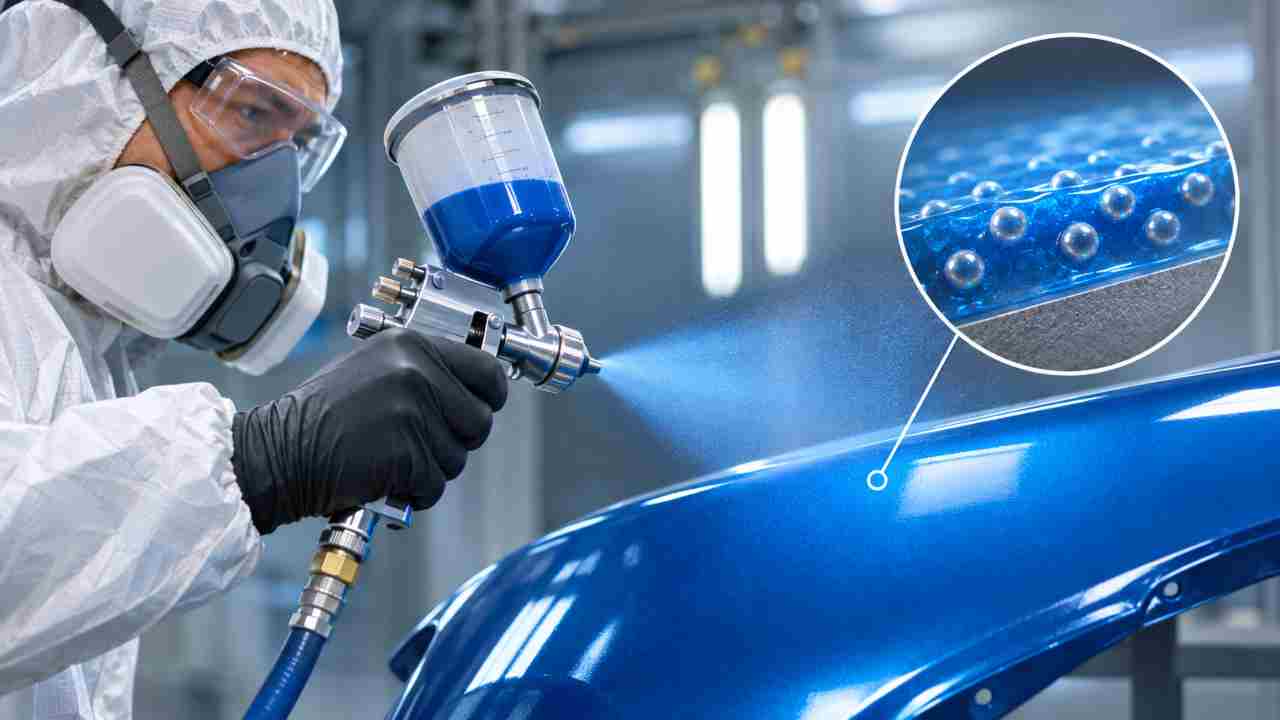
A nano-enabled industrial coating survives an abrasion trial with little visible damage. The panel retains its appearance, the binder has cured, and a small addition of engineered particles appears to have delivered the intended performance gain. Then a maintenance team prepares to sand the same finish before recoating. What, exactly, will enter the air when the film is disturbed?
The question is not whether all nanocoatings are dangerous or whether nanoparticles always escape intact. Neither assumption is defensible. The practical problem is that the coating's performance, its manufacturing exposure profile and the material released during later operations are different technical questions. A formulation can satisfy the first while leaving insufficient evidence for the other two. That is where nanotechnology decisions become industrial engineering decisions.
IMPLEMENTATION INSIGHT
Include the intended application and likely maintenance operations in the test brief before approving a nano-additive. A successful abrasion rating does not characterize airborne debris.
1. The useful particle is not always the particle delivered to the film
Silica, titanium dioxide, zinc oxide, graphene-derived materials and other engineered fillers can modify hardness, barrier behaviour, conductivity or other properties when incorporated into an appropriate coating. But their contribution depends on more than the supplier's nominal primary-particle size. Agglomeration, surface chemistry and interaction with the binder determine the structure actually formed in the wet paint and cured film.
A concentrated dry powder may arrive as clusters far larger than its individual particles. High-shear mixing can break some agglomerates, but it does not guarantee a stable dispersion. Dispersants, surface treatments, solvent or water chemistry, and the order of ingredient addition can all change how particles distribute. The 2024 ChemistrySelect review of nanoparticle dispersion in coatings addresses wetting, particle separation and stabilization as distinct requirements.
For development, record the supplied material form, solids content, surface treatment, incorporation point, mixing energy and storage history. A dried film with useful hardness can still contain uneven particle-rich regions. Conversely, a well-dispersed formulation may offer limited incremental performance if the chosen filler does not address the application's failure mechanism. Characterize the structure that the process actually creates, not only the ingredient listed on the bill of materials.
2. A dispersion specification must cover more than appearance
The attractive appearance of a drawdown is a weak test for nanoparticle stability. Sedimentation, changes in rheology, agglomerate growth and interactions with conventional pigments may become apparent only after holding or processing. A high-surface-area additive can also interact with wetting agents or rheology modifiers and change application behaviour without causing visible phase separation.
Choose measurements to match the system. Microscopy or suitable scattering methods can support particle-size and distribution analysis, provided dilution and sample preparation do not disturb the structure being measured. Rheology, filtration behaviour and production-representative spray trials may reveal agglomerates missed by a small laboratory drawdown. Where a functional claim depends on a particular particle orientation or network, include evidence for that architecture.
More nanomaterial is not automatically better. Beyond a useful loading window, clustering can increase roughness, create film defects or make processing less predictable. Compare against the base coating with consistent film thickness and curing. A claimed improvement is meaningful only when the control and the nano-enabled material experience comparable conditions.
3. Worker exposure changes as the material changes form
Nanomaterial handling does not present a single exposure scenario. Opening a dry powder package, preparing a liquid dispersion, spraying wet paint and handling a cured article involve different opportunities for airborne material and contact. Inhalation risk depends on the task, particle form, emission, ventilation and the hazardous properties of the relevant material, not on the word “nano” alone.
A published occupational study of graphene nanoplatelet-containing waterborne polyurethane coatings measured emissions during production and spray application. It identified potential release near the operator and reported that ventilated containment reduced measured particle concentrations. Research on nano-titanium-dioxide paint similarly identified a potential for exposure during spraying, reinforcing the need for task-specific assessment rather than assuming that a liquid formulation eliminates airborne exposure.
NIOSH recommends prioritizing engineering controls and work practices. Where feasible, enclosed transfer, appropriately designed local exhaust ventilation, lower-dust feedstocks and controlled cleaning may reduce exposure opportunities. Protective equipment remains important according to the assessed risk but should not replace effective source controls. The paint maker's safety assessment must follow the material through the operation that can generate exposure.
4. Abrasion may release fragments, not neat nanoparticles
It is equally misleading to assume that sanding a cured nanocomposite always produces free individual nanoparticles. Depending on film chemistry and the mechanical operation, particles may remain embedded in polymer-rich fragments. Released material can include coarse dust, fine matrix fragments and, in some circumstances, free or exposed engineered nanomaterial.
A 2024 study of single-wall carbon nanotubes in epoxy flooring examined material collected after accelerated abrasive wear using microscopy and Raman spectroscopy. The researchers characterized nanotube-containing fragments and found measured respirable nanotube quantities below their method's quantification limit under the investigated conditions. This result does not prove zero release in other products or operations; it shows why chemical identification and detection limits matter alongside particle counts.
An abrasion-resistance number is not a release assessment. ISO 7784-2:2023 specifies a method for comparing coating abrasion resistance with rotating abrasive rubber wheels. It does not establish the composition or inhalation hazard of collected dust. If foreseeable use involves sanding, grinding or drilling, design a separate task-relevant sampling and characterization plan, including background controls and suitable analytical methods.
5. Qualification must join functional testing with exposure evidence
The right test programme starts from the benefit the nanomaterial is meant to deliver, then identifies the operations that could change the material or create exposure. A formulation marketed for improved wear resistance needs relevant wear testing. An anticorrosion system needs appropriate barrier and corrosion evidence. Neither benefit excuses omitting worker-exposure and waste-handling questions for significant manufacturing or maintenance tasks.
Engineering decision | Performance evidence | Exposure or lifecycle evidence |
|---|---|---|
Change from powder to pre-dispersion | Comparable dispersion and final film properties | Dust generation during feed and transfer; altered handling controls |
Increase nanoparticle loading | Dose–response benefit versus a matched control | Emissions during mixing, spraying and equipment cleaning |
Approve abrasive maintenance | Retained or restored coating function | Airborne and settled debris composition under representative abrasion |
Substitute a new nano-additive grade | Film consistency, compatibility and durability | Updated particle identity, material form and task-specific risk review |
This is not a proposal to use one universal dust test for every coating. OECD Test Guideline 127 (2026) standardizes dustiness determination for powders containing nano-objects and their aggregates or agglomerates; it does not automatically characterize emissions from sanding a cured film. Likewise, the OECD's 2025 sample-preparation and dosimetry guidance supports more reliable nanomaterial safety testing, but must be applied within a suitable study design. Select methods for the physical form and exposure question actually being investigated.
6. Make safe implementation part of formulation change control
The most effective approval process treats formulation, application and safety documentation as connected records. Capture the nanomaterial's identity, supplier characterization, dispersion route, application method, curing conditions, film performance, foreseeable maintenance operations and waste streams. Revisit the assessment after changes in feedstock, mixing scale, spray equipment or sanding procedure.
An illustrative pilot study could compare a conventional coating and a nano-enabled variant on matched substrates at the same dry-film thickness. Alongside property retention and abrasion behaviour, observe emissions during powder introduction or liquid handling, spray application and controlled surface preparation. Select exposure methods with qualified occupational hygiene support; background aerosols, ventilation and equipment-generated particles can otherwise distort interpretation.
Safety controls should be proportionate to the actual hazard and exposure potential. A sealed, cured article in normal service is not equivalent to open dry-powder handling or powered sanding. Relevant local occupational and chemical requirements still apply, and there is no single global nanomaterial rule that substitutes for a jurisdiction- and substance-specific review. The aim is repeatable functional performance supported by a defensible process and lifecycle exposure assessment.
A useful nanocoating has to survive more than a laboratory test
Nanotechnology can deliver genuine coating improvements, but an impressive panel result is only one part of the qualification evidence. Dispersion determines what reaches the film. Application determines what workers may encounter. Wear and maintenance determine what the material can become later.
Specify performance, processing conditions and exposure scenarios together. That produces a stronger decision than either rejecting nano-enabled systems categorically or treating a good abrasion result as proof that every later operation is controlled.
ONLYTRAININGS | ADVANCED TECHNICAL TRAININGS
Smart Coatings & Nanotechnology in Paint Manufacturing — Part 1 and Part 2
Connect formulation design with testing, industrial implementation and responsible nanomaterial handling. These two complementary expert-led trainings address different stages of nano-enabled coating development.
Part 1 — Smart Coatings & Nanotechnology in Paint Manufacturing: Core coating ingredients and manufacturing methods; responsive coating categories; nanomaterial selection, integration, dispersion challenges, VOC considerations and formulation-process compatibility.
Part 2 — Smart Coatings Implementation & Nano Safety: Application and curing methods; physical and chemical characterization; industrial applications; nanomaterial hazard identification, exposure assessment, risk reduction, regulatory considerations and responsible handling and disposal.
Both training pages list six-month access, downloadable training materials, a verifiable training certificate and expert discussion access. Enrollment is available through the respective training pages.
Technical references
OnlyTRAININGS, Smart Coatings & Nanotechnology in Paint Manufacturing — Part 1.
OnlyTRAININGS, Smart Coatings Implementation & Nano Safety — Part 2.
CPWR/NIOSH, Potential Worker Exposure to Nano-Size Titanium Dioxide When Spraying Paint (2019).
ISO 7784-2:2023, Determination of Resistance to Abrasion of Paints and Varnishes.
OECD Test Guideline 127 (2026), Dustiness Determination of Materials Containing Nano-Objects.
OECD, Guidance on Sample Preparation and Dosimetry for Manufactured Nanomaterials (2025).
NIOSH, Nanotechnology Frequently Asked Questions and Exposure Considerations.