
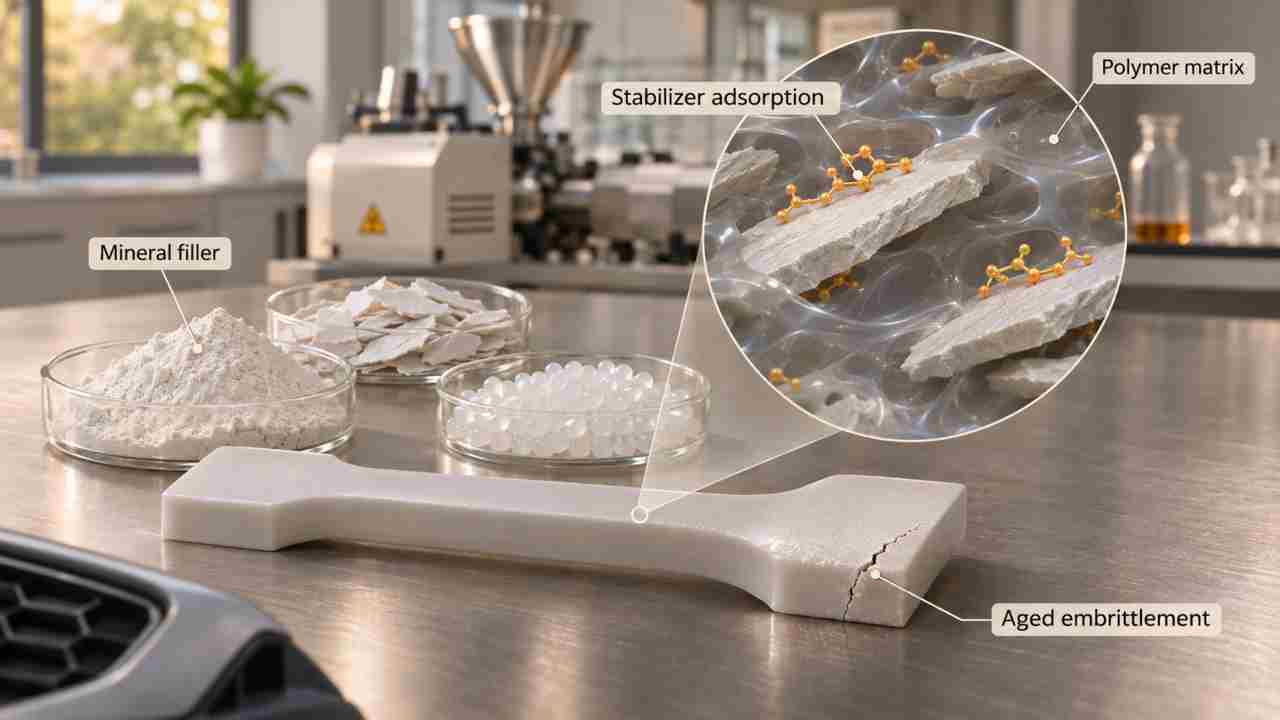
A talc-filled polypropylene compound passes its stiffness target. The molded specimens look sound, the extrusion line runs within its established torque range, and the first set of mechanical results supports release. Months later, parts exposed to prolonged heat become brittle sooner than expected. An unfilled control using a comparable polymer and stabilizer system retains more ductility. Its interaction with the protection package may have been overlooked.
Mineral selection often starts with elastic modulus, dimensional response, cost and melt processability. Stabilizer selection follows as a separate exercise. In a filled polymer, those decisions cannot always be separated. Particle surfaces may bind stabilizer molecules, impurities can contribute to oxidation, and processing can consume some of the remaining protection before the product reaches service. A compound can meet every immediate mechanical target while carrying less effective resistance to aging.
FORMULATION INSIGHT
Qualify filler and stabilizer changes together. Compare the finished compound after controlled aging, not just the freshly molded specimens.
1. Stiffness and durability measure different achievements
Talc, calcium carbonate, mica and other mineral fillers can change rigidity, shrinkage, dimensional stability and price. The outcome depends on particle geometry, orientation, loading, interfacial adhesion and dispersion. A higher flexural modulus may be valuable for a housing or automotive component, but it says little by itself about oxidation resistance during long exposure to heat or sunlight.
Mechanical reinforcement and chemical protection are different mechanisms. An initially stiff compound can lose impact strength or elongation after oxidative chain scission. Filler agglomerates may also act as local stress concentrators, making a chemically aged matrix more vulnerable to crack initiation. Conversely, a properly selected mineral can contribute to a robust system. The risk is not that all fillers accelerate degradation; it is that their effect cannot be predicted from stiffness alone.
Define service exposures and the properties that must survive them. For an under-hood part, retained ductility after thermal aging can matter more than as-molded modulus. Exterior components also require weathering and appearance criteria.
2. The filler surface can remove protection from the polymer phase
Certain antioxidants and light stabilizers have an affinity for mineral surfaces. During compounding, molecules may adsorb onto talc, calcium carbonate or silica rather than remain available where they are needed in the polymer. This does not necessarily destroy them chemically, but surface binding can reduce effective stabilizer availability. The result depends on filler and stabilizer chemistry.
Published investigations of filled polypropylene found reduced photostabilizer effectiveness with particular talc and calcium carbonate systems. A separate study of talc-filled polypropylene examined how surface-associated stabilizer losses influenced long-term heat stability and how selected modifiers could help. These results explain why replacing one mineral grade with another is not merely a change in particle size distribution.
Surface area deserves scrutiny. A finer mineral can offer valuable reinforcement or nucleation while providing more interfacial area for adsorption, depending on its morphology. Surface hydroxyls, treatments and impurities further affect the interaction. Do not assume that an unchanged antioxidant addition rate means unchanged antioxidant availability. A supplier substitution should trigger a controlled stability comparison as well as routine incoming inspection.
3. Different degradation routes require different protection
Thermal oxidation, repeated melt processing and outdoor weathering do not impose identical stresses. Hindered phenolic antioxidants commonly help interrupt oxidative radical propagation. Phosphites or related secondary antioxidants can decompose hydroperoxides, often complementing phenolic systems during processing. Hindered amine light stabilizers, or HALS, operate through different radical-control pathways and are widely used for photo-oxidative protection.
A satisfactory melt-stability result does not establish protection against long-term hot-air aging. A strong thermal package may still require a light-stabilization strategy for outdoor exposure. Some acidic species and other formulation components can interfere with particular HALS chemistries; compatibility must be assessed for the actual package.
Metal-containing impurities introduce another variable. Certain transition-metal residues can promote hydroperoxide decomposition and accelerate oxidation. An appropriate metal deactivator may help in a specific system, but it is not a universal substitute for filler purity, surface characterization or adequate antioxidants. The first decision is to identify whether the weakness is stabilizer adsorption, catalysed degradation, insufficient dosage or the wrong stabilization mechanism.
4. Surface treatment can solve one problem and create another
Mineral coatings and coupling additives may improve wetting, dispersion or polymer–filler interaction. Depending on their chemistry, they can also reduce the number of sites that bind stabilizers. Reviews of filled polymers describe successful use of selected filler deactivators, coupling agents and surface coatings to restore thermal or light stability in particular formulations.
However, a surface treatment should not be accepted simply because it improves dispersion. A stearate-treated calcium carbonate, an untreated mineral and a functionalized filler are not interchangeable ingredients. Their influence on melt flow, interface strength, additive distribution and aging can differ. The treatment itself may also introduce components whose thermal stability needs verification at the intended processing temperature.
A useful comparison isolates three effects: untreated filler at a controlled loading, a surface-modified grade under matching conditions, and an unfilled reference. Keep base polymer, stabilizer formulation and processing history comparable. If surface treatment improves aging without a corresponding change in dispersion, adsorption or impurity-related mechanisms deserve further study. If it improves impact resistance but not chemical stability, a separate protection adjustment may still be necessary.
5. Compounding may spend the stabilizer before service begins
A polymer experiences heat, oxygen and shear while passing through a compounder, injection molding machine or recycling operation. Higher mineral loading can change torque, residence-time distribution and heat generation. Poorly dispersed particles can produce inconsistent local flow conditions. The resulting oxidation burden depends on the equipment and operating window.
The processing history matters because stabilizers have finite capacity or availability. A formulation that survives one extrusion pass may behave differently after repeated passes or long residence at elevated temperature. A stable melt-flow reading does not prove that the residual stabilization package is sufficient for the intended lifetime. Compare melt-flow changes with oxidation indicators and retained properties rather than relying on one number.
Supplier variation can amplify the issue. Moisture, mineral impurities, surface treatment level and particle distribution may shift between lots even when the product name remains unchanged. A technically useful purchase specification may therefore need more than mean particle size and whiteness. Incoming controls should reflect demonstrated risks.
6. Make the aging test capable of rejecting a false winner
A screening plan should preserve an unfilled stabilized control and compare filled systems at identical base-polymer and stabilizer levels before optimization. Record filler identity, surface treatment, ash content, dispersion, compounding temperature, melt history and specimen conditioning. Then measure both the immediate target and the properties most sensitive to the relevant aging mechanism.
Fresh-compound observation | Hidden explanation to test | Discriminating evidence |
|---|---|---|
Higher stiffness, faster heat-aging embrittlement | Antioxidant adsorption, metal-catalysed oxidation, processing damage | Controlled oven aging, retained impact or elongation, antioxidant assessment |
Acceptable melt flow, lower oxidation induction time | Stabilizer consumption or altered effective availability | Matched-history DSC oxidation induction time and chemical analysis |
Good heat aging, poor exterior weatherability | Inadequate light protection or filler–HALS interaction | Relevant xenon-arc exposure, color, cracking and retained mechanical properties |
Large variability after changing filler supplier | Different impurities, coating, morphology or moisture | Side-by-side lot characterization and replicated compounding |
ISO 11357-6:2025 describes DSC measurement of oxidation induction time or temperature. These can help compare oxidative resistance under prescribed conditions, but they are not automatic predictions of service life. ISO 4892-2:2013, including its amendment, addresses xenon-arc laboratory exposure; test conditions must reflect the intended exposure and be paired with meaningful property retention.
For an illustrative decision trial, compare an unfilled control, two mineral grades and one surface-treated variant, using an otherwise matched stabilizer package. Add a second stabilizer strategy only after identifying the principal failure mode. Repeat critical comparisons across representative batches. A credible formulation decision considers retained function, variability and total processing cost, not the lowest price per kilogram of mineral.
Specify the protection system as part of the filled compound
Fillers can improve valuable properties without automatically preserving the chemistry that delivers long service life. A mineral's surface can change stabilizer availability, its impurities may affect oxidation, and its behavior in the extruder can modify the damage already accumulated before use.
Approve the filler and stabilizer as an interacting system, not two independent ingredients. When mechanical performance, processing history and aging evidence are assessed together, cost and stiffness improvements are less likely to conceal a durability problem.
ONLYTRAININGS | ADVANCED TECHNICAL TRAINING
Polymer Fillers & Stabilizers: Advanced Selection for Performance and Durability
Make informed filler and stabilizer choices without trading away processability, mechanical performance or long-term protection.
This expert-led training addresses:
Filler morphology, dispersion, loading and surface-treatment effects on polymer performance.
Processing and rheology instability from filler–stabilizer interactions and compounding conditions.
Mechanical-property conflicts and thermal or UV degradation failure modes.
Supplier variability, cost-driven substitutions and scale-up risks.
Practical testing decisions, failure scenarios and formulation troubleshooting.
EXPLORE THE TRAINING & ACCESS NOW
The training page lists six-month access, downloadable presentation and practical learning materials, a verifiable training certificate and access to an expert discussion forum.
Technical references
OnlyTRAININGS, Polymer Fillers & Stabilizers: Advanced Selection for Performance and Durability.
Influence of Fillers on the Effectiveness of Stabilizers, Polymer Degradation and Stability (1994).
ISO 11357-6:2025, Oxidation Induction Time and Temperature by DSC.
ISO 4892-2:2013, Plastics Exposure to Xenon-Arc Laboratory Light Sources.