
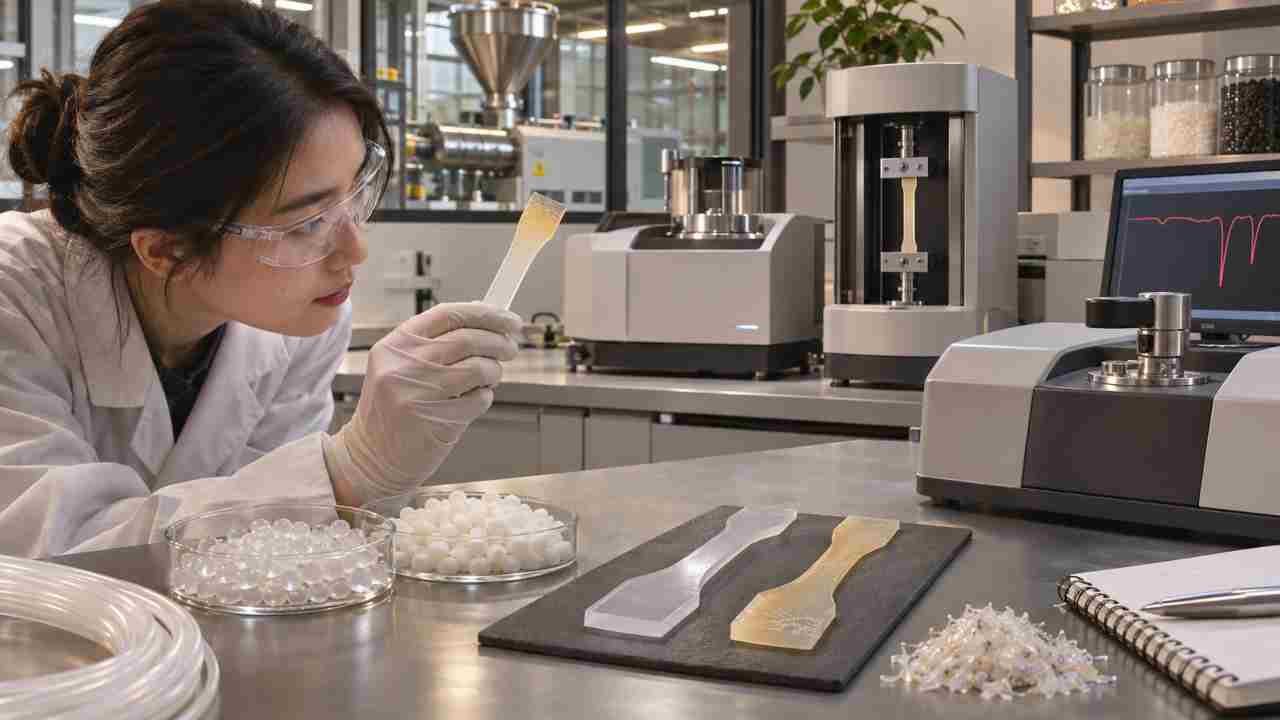
An extrusion trial can deliver acceptable colour, stable dimensions and a thermogravimetric curve that appears reassuring. Yet the moulded part may become brittle, its melt flow may drift after another heat cycle, or its impact resistance may deteriorate. The contradiction is only apparent: a polymer can undergo consequential molecular or morphological changes before a conventional TGA scan registers substantial mass loss.
The difficulty is deciding whether heat has changed the molecules, rearranged the morphology, altered the additive package or merely exposed a processing inconsistency. Differential scanning calorimetry (DSC), thermogravimetric analysis (TGA), dynamic mechanical analysis (DMA) and Fourier-transform infrared spectroscopy (FTIR) can contribute evidence, but they do not answer interchangeable questions. The most informative investigation reconstructs what the material actually experienced, then chooses measurements capable of separating plausible causes.
PROCESS INSIGHT
A TGA onset temperature is a result of one heating programme and atmosphere. It is not, by itself, the highest safe extrusion or moulding temperature.
1. The laboratory temperature ramp is not the production history
A polymer might spend seconds in a hot runner, minutes in an extruder and much longer in a poorly purged hold-up zone. The thermal record includes temperature, residence-time distribution, oxygen exposure, moisture, shear and repeated passes, not simply the displayed barrel set point. Local melt temperatures can also diverge from sensor readings when viscous dissipation or stagnant regions are significant.
Standard dynamic thermal analyses often impose controlled heating rates on milligram-scale specimens. Industrial processing instead exposes a larger material stream to coupled flow, heat transfer and sometimes oxygen or hydrolysis. A high decomposition onset obtained under nitrogen cannot establish stability during a long hot hold in air; equally, an aggressive oxidative ramp may exaggerate the relevance of a pathway absent in a closed system.
Begin with a traceable comparison: virgin pellets, dried feed, material after one pass, a later-pass sample and, where possible, resin recovered near the defect. Record actual melt temperature, moisture-control conditions, nominal and abnormal residence times, and feedstock identity. Without this history, analytical differences may be attributed to the formulation when they actually reflect sampling or processing.
2. DSC separates processing memory from permanent damage
DSC measures heat-flow changes associated with transitions and reactions. In semicrystalline polymers it can reveal melting, cooling crystallization and cold crystallization; in suitable materials it also detects glass-transition behaviour. ASTM D3418-21 covers polymer transition temperatures and fusion or crystallization enthalpies [1]. However, a changed DSC curve does not automatically mean chemical degradation.
Imagine injection-moulded parts with different cooling rates. Their first-heating traces may show different enthalpies or melting features because the crystalline populations developed differently. A controlled cooling and second-heating programme can help distinguish as-processed morphology from behaviour under a common imposed thermal history. The first heating remains valuable precisely because it preserves evidence of the original article.
There are important qualifications. A second heating does not harmlessly erase every history: some materials react, reorganize or degrade during the scan. Crystallinity calculations require an appropriate reference enthalpy and, where relevant, correction for cold crystallization and nonpolymer content. A small transition shift may also be sensitive to pan contact, specimen mass or heating rate. DSC should therefore test a defined morphology or reaction hypothesis rather than serve as an all-purpose degradation detector [1, 2].
3. TGA needs a processing-relevant clock and atmosphere
TGA reports mass as a function of temperature or time. It is powerful for separating volatile loss, decomposition steps and residual inorganic content, and is described in ISO 11358-1:2022 and ASTM E1131-25 [3, 4]. Nevertheless, substantial chain scission, branching or early oxidation need not produce an easily detectable mass-loss signal. TGA is not a direct molecular-weight measurement.
When the question concerns a prolonged process hold, compare dynamic scans with isothermal exposure near credible melt conditions. Select nitrogen and oxidative atmospheres when each is relevant, and report gas flow, pan type, sample mass, heating rate and exposure duration. Weight loss at low temperature may be absorbed water or residual volatiles rather than polymer-backbone decomposition. Conversely, a filled compound may leave more residue without its organic phase becoming more durable.
One useful investigation compares two lots that show similar high-temperature onset values but different time-dependent behaviour at a lower temperature. That contrast can expose a stability difference hidden by rapid scanning. Even then, translate the observation only after considering transport, oxygen availability and the very different shear conditions in production. No single temperature at five-percent mass loss should become an unqualified processing limit.
4. DMA exposes the mechanical cost of structural change
DMA follows a polymer's viscoelastic response with temperature and frequency. Storage modulus, loss modulus and tan delta can reveal stiffness retention, relaxation behaviour and the temperature region in which a product loses mechanical margin. ISO 6721-1:2019 explains why deformation mode and linear-viscoelastic conditions matter when comparing measurements [5].
Suppose a heat-treated component shows a higher room-temperature modulus but fails impact testing. A plausible explanation is increased crystallinity or embrittlement, not necessarily improved thermal endurance. If its relaxation profile or modulus-temperature curve has changed, DMA can help establish whether the material's usable mechanical window has narrowed. But sample thickness, clamp geometry, orientation, frequency and strain amplitude must be controlled before interpreting a difference as chemistry.
DMA does not directly identify broken polymer chains. Pair it with DSC for morphology and with chemical or molecular-weight evidence for degradation. Time-temperature superposition may be useful for suitable thermorheologically simple systems, but it should not be extrapolated unquestioningly across crystallization, curing or irreversible degradation regimes.
5. FTIR can challenge a degradation hypothesis, not prove it alone
FTIR supplies information about functional groups and can reveal chemical changes compatible with oxidation, hydrolysis or other reactions. A new or strengthened carbonyl region may be informative for an initially low-carbonyl polyolefin, while the same observation is harder to interpret in a polyester whose virgin structure already contains carbonyl groups. ASTM E1252-98(2021) provides general guidance on obtaining spectra for qualitative analysis [6].
Comparisons require the same sampling mode and sensible normalization. ATR-FTIR preferentially interrogates a shallow region, so an oxidized surface may differ from an unaffected core. Fillers, stabilizers, pigments and specimen contact can complicate band assignment. A new peak is evidence to investigate, not automatic proof that mechanical failure arose from chain scission.
Where molecular-weight change is central, complement spectroscopy with an appropriate size-exclusion chromatography, solution-viscosity or validated melt-flow measurement, recognizing each method's limitations. In some systems, chain scission increases melt flow while crosslinking or branching can have the opposite effect. Using FTIR alongside molecular and mechanical evidence helps prevent an oxidation signal from becoming a complete but unsupported failure explanation [7].
6. Make the next experiment discriminate between competing causes
The strongest workflow begins with an observed failure and constructs rival explanations. For brittle mouldings, consider thermal oxidation, hydrolysis, excess crystallinity, inadequate drying, contamination and an unusual residence-time distribution. Then choose measurements that produce different predictions for those hypotheses, rather than commissioning every instrument by default.
Production observation | Competing explanations | Next discriminating evidence |
|---|---|---|
Higher melt flow after a second extrusion pass | Chain scission, moisture-assisted degradation, lot variation | Controlled drying and reprocessing; molecular-weight or solution-viscosity comparison; FTIR where relevant |
Brittle part with little TGA mass loss | Morphology change, molecular damage, orientation effects | First-/second-heat DSC; DMA at defined frequency; impact results and fracture inspection |
Colour or odour drift after an extended hot hold | Oxidation, additive loss, residual volatiles | Matched isothermal TGA in relevant atmospheres; targeted chemical analysis; process-hold trial |
Warpage despite an unchanged resin identification | Cooling-dependent crystallinity, residual stress, moulding conditions | Site-specific DSC, dimensional ageing and controlled cooling trials |
The table identifies test pathways, not confirmed diagnoses; results depend on polymer family, formulation and processing conditions.
A practical study uses matched feedstock, replicates and intentionally varied residence or temperature conditions. Distinguish reversible thermal-history effects from changes that persist after controlled reconditioning, while avoiding additional damage during the analytical test itself. Report effect size against measurement repeatability, not merely whether two curves look different.
The decision should end in a process or material action: tighten drying controls, shorten maximum hold time, verify antioxidant retention, adjust cooling, reconsider stabilizer choice, or reject a contaminated lot. Re-run the relevant property and process trial after the change. A convincing root cause is one that predicts the correction, not simply one that fits the original graph.
When four techniques become one defensible decision
DSC, TGA, DMA and FTIR are most valuable when their results are interpreted together with processing records and product performance. One describes transitions and morphology; another tracks mass change; a third probes temperature-dependent mechanics; the fourth tests chemical identity and change. None independently certifies a safe processing window.
The goal is not to accumulate four attractive plots. It is to determine what changed, under which exposure, whether the change matters in service, and which controlled adjustment prevents recurrence. That is how thermal characterization becomes a tool for polymer-development decisions rather than a retrospective explanation of scrap.
ONLYTRAININGS | ADVANCED TECHNICAL TRAINING
Thermal Processing in Polymer Development | DSC, TGA, DMA and FTIR
Translate thermal-analysis measurements into practical polymer-processing decisions through expert-led training covering:
Connect DSC transitions and crystallization effects to polymer-processing decisions.
Interpret dynamic and isothermal TGA, including temperature programmes and purge atmospheres.
Use DMA and FTIR to investigate stiffness changes, thermal history and degradation hypotheses.
Design experiments around residence time, temperature, material preparation and industrial failure evidence.
EXPLORE THE TRAINING & ACCESS NOW
The training page lists six-month access, presentation materials, expert-prepared FAQs and Q&A, a verifiable training certificate, and expert discussion access.
Technical references
RSC Polymer Chemistry, Educational Series on Characterizing Crosslinked Polymer Networks (2024)
ISO 11358-1:2022, Plastics — Thermogravimetry of Polymers — General Principles
ASTM E1131-25, Standard Test Method for Compositional Analysis by Thermogravimetry
ISO 6721-1:2019, Plastics — Determination of Dynamic Mechanical Properties — General Principles
ASTM E1252-98(2021), General Techniques for Obtaining Infrared Spectra for Qualitative Analysis
ASTM E2105, General Techniques for TGA Coupled With Infrared Analysis
OnlyTRAININGS, Thermal Processing in Polymer Development | DSC, TGA, DMA and FTIR