
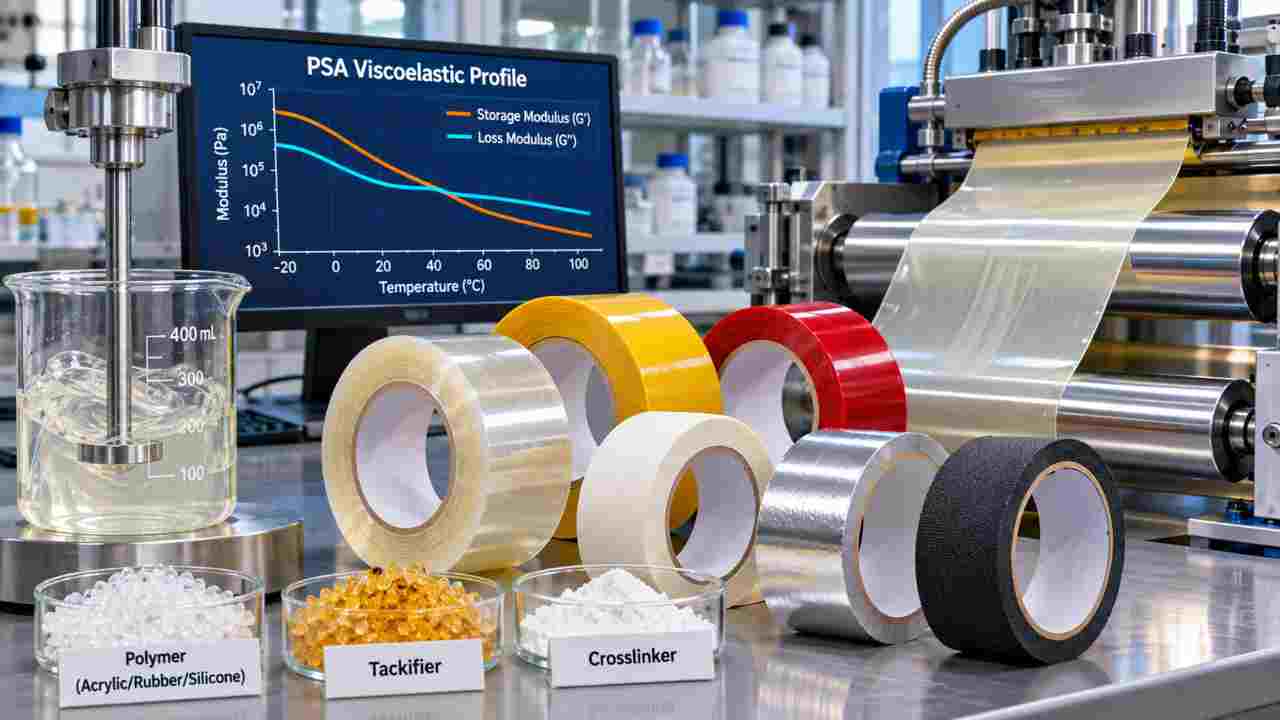
Pressure-sensitive adhesive (PSA) tapes are used in applications ranging from packaging and protective films to electronic assembly, automotive components, industrial bonding and medical products. Their apparent simplicity conceals a demanding formulation requirement: the adhesive must establish contact under relatively light pressure while maintaining sufficient internal strength throughout its intended service life.
Unlike conventional reactive adhesives, PSAs generally develop their bond without requiring a chemical curing reaction during application. Their performance depends on a carefully controlled combination of viscous flow and elastic resistance, allowing the adhesive to conform to a surface without continuously deforming under load.
This creates important formulation trade-offs. Increasing initial tack may reduce holding power, while improving cohesive strength can compromise wetting and peel adhesion. Backing materials, coating thickness, substrate characteristics and environmental exposure further influence the performance of the finished tape.
For formulators, developing a reliable PSA therefore requires more than optimizing adhesive chemistry. It demands coordinated control of polymer architecture, additive selection, coating conditions and application-specific performance testing.
1. Understanding the Viscoelastic Balance Behind PSA Performance
Pressure-sensitive adhesion depends on the ability of an adhesive to deform sufficiently during application and resist separation under subsequent mechanical loading.
When a PSA contacts a substrate, its viscous response facilitates surface wetting and intimate contact. During removal or sustained loading, its elastic and cohesive properties influence resistance to deformation and bond failure.
This behavior is commonly evaluated through three performance characteristics: tack, peel adhesion and shear resistance. Although closely related, these measurements represent different loading conditions and cannot be optimized independently.
Dynamic mechanical analysis provides additional insight by measuring the storage modulus (G′), loss modulus (G″) and their variation with temperature and frequency. These parameters help characterize the relationship between elastic energy storage and viscous dissipation.
For example, a softer adhesive may develop excellent initial contact but exhibit excessive creep under sustained loading. Greater crosslinking can improve cohesive strength while reducing the molecular mobility needed for rapid wetting.
Research on ultraviolet-crosslinked hot-melt PSAs has demonstrated how changes in viscoelastic behavior can improve shear resistance while reducing tack and peel performance.
The practical objective is not to maximize all three properties simultaneously. It is to establish the appropriate viscoelastic response for the substrate, application pressure, loading conditions and expected service temperature.
2. Selecting Acrylic, Rubber and Silicone Adhesive Systems
Different PSA chemistries provide distinct combinations of adhesion, processing behavior and environmental resistance.
Acrylic PSAs offer considerable formulation flexibility through the selection of soft acrylate monomers, harder comonomers and functional groups. Polymer composition, molecular weight and crosslinking influence glass-transition behavior, cohesive strength and adhesion characteristics. Acrylic systems are widely considered where aging resistance, optical properties or controlled removability are important.
Rubber-based PSAs, including natural rubber and synthetic elastomer systems, commonly rely on tackifying resins to achieve the desired adhesion characteristics. They can deliver strong initial tack and useful adhesion to challenging surfaces, although thermal stability and oxidative aging depend on the selected polymer and stabilizer package.
Silicone PSAs are valuable in applications requiring elevated-temperature performance, low-temperature flexibility or compatibility with particular difficult-to-bond surfaces. Their distinctive chemistry also introduces considerations involving cost, curing and processing compatibility.
Specialty formulations may incorporate modified elastomers, hybrid polymer structures or functional additives to address specific industrial requirements.
Selecting between these chemistries should begin with the expected operating conditions rather than a general assumption that one polymer family offers superior performance. Required adhesion, removability, environmental resistance, substrate compatibility and manufacturing constraints must all influence the decision.
3. How Tackifiers, Crosslinkers and Additives Change Performance
The base polymer establishes the principal mechanical characteristics of a PSA, but formulation additives can substantially modify its behavior.
Tackifying resins are particularly important in many rubber-based systems. Their compatibility with the polymer affects tack development, viscoelastic response, phase behavior and thermal performance. Resin softening point and molecular structure influence the resulting adhesive properties, but the relationship is not determined by these parameters alone.
Excessive or poorly matched tackifier addition can reduce cohesive strength, encourage migration or change aging behavior. Compatibility and performance should therefore be assessed across the expected temperature range.
Crosslinking provides another means of modifying adhesive properties. Increasing crosslink density generally restricts molecular mobility and can improve resistance to creep and cohesive failure. However, excessive crosslinking may reduce substrate wetting or produce inadequate peel adhesion.
Acrylic formulations may employ different chemical or radiation-activated crosslinking approaches depending on the polymer design and manufacturing process.
Other ingredients, including antioxidants, stabilizers, processing aids and specialty functional additives, require careful evaluation for interactions with polymer chemistry.
Formulation development is most effective when changes in raw-material composition are linked to measured rheological behavior, adhesive performance and aging stability rather than judged from initial tack alone.
4. Why Backing Materials and Substrate Surfaces Matter
An adhesive cannot be evaluated independently of the tape construction in which it is used.
Paper, polymer films, metal foils and woven or nonwoven fabrics provide different combinations of stiffness, elongation, conformability and dimensional stability. These properties influence how applied forces are transferred through the adhesive layer.
A flexible film backing may conform readily to a curved component, while a comparatively rigid backing can alter peel mechanics and stress distribution. Foil-backed tapes introduce different requirements involving surface preparation, flexibility and environmental exposure.
Backing surface treatments and primers may also be necessary to achieve adequate anchorage between the adhesive and its carrier. Inadequate anchorage can produce adhesive transfer or separation at the backing interface even when adhesion to the intended substrate is satisfactory.
Substrate surface energy introduces further complexity. Polyethylene and polypropylene typically present different wetting challenges from clean metal or glass surfaces. Surface roughness, contamination, coatings and migrating additives may further influence adhesion.
A formulation showing high peel strength on standardized stainless steel should not automatically be assumed suitable for a low-surface-energy polymer.
Qualification should therefore include representative backing materials, actual application substrates and relevant surface conditions. For removable tapes, acceptable adhesion must also be balanced against the risk of residue, surface damage and unwanted adhesive transfer.
5. Controlling Coating Rheology, Drying and Film Formation
Even a well-designed PSA formulation can deliver inconsistent results if its manufacturing process produces an uneven adhesive layer.
Waterborne dispersions, solvent-based systems and hot-melt PSAs introduce different coating and drying or curing requirements. Viscosity, solids content, coating speed and equipment configuration influence coat-weight distribution and surface quality.
For waterborne acrylic PSAs, drying must remove water while allowing adequate film formation. Incomplete drying or unsuitable drying conditions may introduce defects, affect cohesion or alter subsequent adhesive performance.
Solvent-based systems require appropriate solvent-removal control and safety measures, while hot-melt formulations depend on controlled melt temperature, coating uniformity and thermal stability.
Coat weight is particularly significant because it influences surface contact, adhesive deformation and the amount of material available to accommodate substrate irregularities. Increasing coating thickness may improve performance in some applications but can also increase creep, cost or residue risk.
Manufacturing qualification should examine coating uniformity across the web and throughout production, together with adhesive anchorage, surface defects and winding behavior.
Release liners and release coatings must also be compatible with the adhesive. Excessive release force can complicate converting and application, while excessively low release force may create handling problems.
Consequently, coating-process development and formulation optimization should proceed together, using finished-tape measurements rather than relying exclusively on bulk adhesive properties.
6. Designing a Meaningful PSA Testing Program
Reliable tape development requires tests that reproduce the mechanical and environmental demands of the intended application.
ASTM D3330/D3330M provides methods for measuring peel adhesion under defined conditions, while ASTM D3654/D3654M addresses shear adhesion under sustained loading. FINAT methods provide additional procedures for evaluating peel adhesion, shear resistance and loop tack.
The following measurements serve different purposes:
Tack testing evaluates rapid adhesion development after brief contact.
Peel testing measures separation resistance under specified geometry, speed and conditioning.
Shear testing assesses resistance to sustained loading and time-dependent deformation.
These measurements must be interpreted with attention to substrate, application pressure, dwell time, temperature and backing properties.
A high peel value does not necessarily indicate superior long-term holding power. Likewise, a PSA demonstrating excellent static shear resistance may fail to establish adequate contact under low application pressure.
Laboratory evaluations should include failure-mode observations, distinguishing interfacial separation from cohesive splitting, adhesive transfer or backing failure.
For demanding applications, standardized testing should be supplemented with representative service simulations. These may include elevated-temperature exposure, humidity conditioning, cyclic loading, controlled removal and adhesion measurements following aging.
The objective is to identify a reproducible performance range that corresponds to actual application requirements.
7. Addressing Aging, Edge Lifting and Long-Term Removability
PSA performance changes over time because both the adhesive and the bonded construction respond to environmental and mechanical exposure.
Temperature changes influence viscoelastic behavior, while ultraviolet exposure, oxidation, humidity and contact with migrating substances can alter adhesive properties depending on the chemistry involved.
Edge lifting may arise from inadequate wetting, backing recovery forces, substrate contamination or differential dimensional movement. Residue formation may indicate insufficient cohesive strength, aging-related changes or poor compatibility between the adhesive and substrate.
These problems cannot always be resolved by increasing tackifier content or crosslink density. Corrective action requires identifying the actual failure mechanism.
A useful investigation combines examination of the failure surface with relevant rheological measurements, adhesion tests and controlled environmental conditioning.
For removable industrial tapes, performance must be assessed after the intended dwell period and environmental exposure, not only immediately after application.
Emerging interest in bio-based components, waterborne technologies and controlled-debonding adhesives introduces additional possibilities. However, alternative materials must still demonstrate suitable processing stability, adhesive performance and durability. Environmental claims require their own supporting evidence.
The central development requirement remains consistent: formulation choices must be evaluated against the behavior of the complete adhesive tape throughout its intended use.
Translating PSA Chemistry Into Reliable Tape Performance
Successful pressure-sensitive tape development depends on understanding how polymer selection, tackifier compatibility, crosslinking, backing properties and coating conditions influence measurable performance.
For R&D chemists, formulators and technical managers, this requires connecting material design with practical testing and troubleshooting. The most effective formulation is not necessarily the one with the highest initial adhesion, but the one that satisfies the complete application specification under relevant conditions.
These are the technical decisions addressed in the OnlyTRAININGS program dedicated to pressure-sensitive adhesive tape formulations and innovations.
ONLYTRAININGS | ADVANCED TECHNICAL TRAINING
PSA (Pressure Sensitive Adhesive) Tape Training | Formulations & Innovations
Develop PSA Formulations With Better Control Over Tack, Peel, Shear and Long-Term Performance
Strengthen your understanding of the formulation and processing decisions that determine pressure-sensitive tape reliability.
The expert-led training covers:
Acrylic, rubber, silicone and specialty PSA formulation strategies.
Polymer architecture, tackifier selection and crosslink-density control.
Paper, film, foil and fabric backing selection.
Coating rheology, coat-weight consistency, drying and film formation.
Testing, troubleshooting and performance qualification for demanding applications.
Developed for R&D scientists, adhesive formulators, product developers, technical service specialists and materials professionals.
EXPLORE THE TRAINING & REGISTER
Includes six-month full training access, downloadable training materials, a verifiable certificate and 24/7 expert connect through the discussion forum.
Technical References
Czech, Z. (2024). Pressure-Sensitive Acrylic Adhesives (PSAs): How It Began and the Present State of Art. ChemTexts, 10, Article 6. Research article.
Guder, M., et al. (2024). Revealing the Impact of Viscoelastic Characteristics on Performance Parameters of UV-Crosslinked Hotmelt Pressure-Sensitive Adhesives. Polymers, 16(15), 2123. Research article.
Understanding the Role of Crosslink Density and Linear Viscoelasticity on the Shear Failure of Pressure-Sensitive-Adhesives. Soft Matter, 2023. Research article.
ASTM International. ASTM D3330/D3330M-04(2025): Standard Test Method for Peel Adhesion of Pressure-Sensitive Tape. Official standard.
ASTM International. ASTM D3654/D3654M-06(2024): Standard Test Methods for Shear Adhesion of Pressure-Sensitive Tapes. Official standard.
FINAT. Technical Handbook: FINAT Test Methods for Self-Adhesive Materials. Peel adhesion, shear resistance and loop tack testing procedures. Technical methods.