
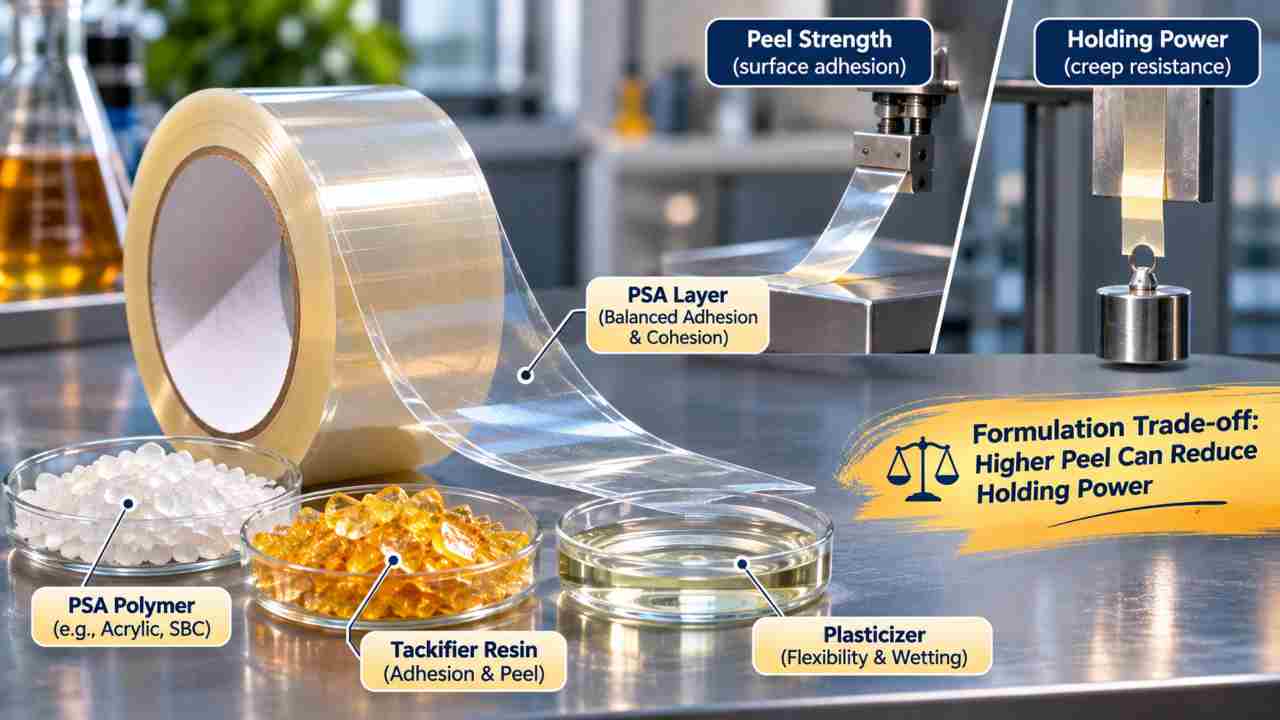
A pressure-sensitive adhesive can look better after a tackifier change. The label grips more decisively, a peel test returns a higher value, and the formulation seems closer to approval. Then a vertical label slowly slips, an assembly tape creeps under load, or an adhesive that removed cleanly in screening starts leaving residue after warm storage. The peel measurement was not wrong; it answered a different question.
Tackifiers are powerful formulation tools precisely because they change how a polymer deforms, wets a surface and dissipates energy during separation. The problem begins when higher peel is interpreted as a general improvement in bond performance. An ingredient can help a PSA resist rapid debonding while making it less capable of supporting sustained stress. That tension belongs at the centre of ingredient selection.
FORMULATION INSIGHT
Compare each tackifier candidate at the same dry coat weight, conditioning history and test temperature. A larger peel number is not a substitute for a holding-power result.
1. Peel and holding power interrogate different behaviours
A PSA must flow sufficiently under modest application pressure to develop intimate contact, yet retain enough internal strength to resist deformation after bonding. During a peel test, the adhesive experiences relatively rapid deformation concentrated near a moving separation front. During a shear holding test, it is subjected to a sustained load and has time to creep. Their rankings can differ even under nominally identical conditions.
This is the practical meaning of the adhesion–cohesion balance. Initial tack reflects bond formation during brief contact. Peel resistance combines interfacial interactions with energy lost through stretching, cavitation and other deformation mechanisms. Static shear probes resistance to time-dependent movement and eventual failure. No single measurement describes its service envelope.
For example, a candidate label adhesive may resist fast removal from stainless steel but move progressively when a loaded label is stored vertically at elevated temperature. Higher peel can conceal the actual requirement. The correct specification names the load, temperature, duration, adherend and acceptable displacement or failure mode.
2. Tackifier addition shifts the viscoelastic window
A tackifier is not simply a sticky ingredient added to a non-sticky polymer. Depending on its compatibility and concentration, a low-molecular-weight resin can alter segmental mobility, the apparent glass-transition region, storage modulus and mechanical loss. Both wetting and removal behaviour change.
In a technical study presented through the Pressure Sensitive Tape Council, tackifier addition to an acrylic PSA reduced modulus around room temperature and increased the glass-transition response, improving peel over the examined range. At higher temperatures and longer test times, the same changes were associated with reduced shear holding power. This is a documented example of a trade-off, not a rule that every tackifier necessarily reduces shear.
A useful formulation target is therefore a temperature- and frequency-dependent response, not a single nominal glass-transition temperature or resin softening point. A formulation can wet rapidly yet creep under load; excessive stiffness can reverse that balance.
Increasing resin loading is especially risky when the last useful increment in peel is smaller than the loss in cohesion. The curve may also turn over: excessive stiffening of the relevant relaxation can reduce tack or produce unstable, stick-slip peel.
3. Compatibility decides where the resin actually works
The same tackifier may behave differently in a soft acrylic, a styrenic block copolymer and a rubber-rich PSA. Chemical affinity, resin molecular weight, aromaticity, polarity and polymer architecture influence whether the resin mixes with the adhesive phase, associates preferentially with one block, or forms resin-rich domains. A tackifier selected solely by softening point can miss the property that determines its behaviour in the blend.
In an acrylic block-copolymer study, rosin ester tackifier was observed in dissolved and nanometre-scale aggregated states. The distribution changed with molecular weight and miscibility. Such findings help explain why two formulations with nominally similar additive levels can produce different relaxation behaviour and adhesion results. Clarity does not prove molecular compatibility.
For a new resin, dynamic mechanical analysis can reveal whether the principal relaxation shifts systematically or whether separated features appear. DSC may complement that assessment, while microscopy or other structural analysis becomes useful when phase behaviour remains uncertain. No single transition establishes miscibility.
Compatibility also has a manufacturing dimension. In a waterborne acrylic system, introducing a resin dispersion can change colloidal stability and coating behaviour. In a hot-melt block-copolymer PSA, changing resin affinity may redistribute material between soft and hard domains. Manufacturability remains part of the selection.
4. The base polymer sets limits that additive selection cannot erase
Tackifier trials are often repeated when the real constraint sits inside the base polymer. Molecular weight, distribution, branching, functional monomers, entanglement and gel content set the starting balance of flow and cohesion. A low-molecular-weight acrylic may provide excellent short-contact wetting but lack the network strength needed for long holding times. More resin cannot reliably create missing chain entanglements.
An open-access study of water-based acrylic PSAs compared physical blending with different in-situ polymerization routes while keeping the underlying monomer composition constant. Preparation route affected gel, molecular characteristics and the final combination of tack, peel and shear. It demonstrated that the process used to build a polymer can matter even when the ingredient list appears similar.
Before adding tackifier, identify whether wetting, peel dissipation or cohesion is deficient. If a candidate repeatedly fails in shear, examine polymer design and crosslinking options alongside tackifier identity. If it fails only on one substrate, inspect surface chemistry and contact conditions before reformulating the entire adhesive.
5. Crosslinking and plasticization can reverse the apparent gain
Crosslinking can provide additional resistance to creep, heat exposure and cohesive rupture, but the added constraints on chain movement may reduce tack and peel. A 2024 study of UV-crosslinkable hot-melt PSAs found improved cohesion and heat resistance after irradiation, accompanied by a substantial reduction in tack and peel in its model adhesive. Results remain chemistry- and cure-dependent.
Plasticizers and low-molecular-weight components introduce a different risk. They may increase flexibility and contact formation but can also reduce holding power, change aging behaviour or contribute to transfer and residue. In applications with migration or skin-contact requirements, composition screening and the relevant regulatory or safety assessment must accompany mechanical optimization.
A trial should distinguish cohesive failure inside the adhesive, clean interfacial release and transfer to the substrate. Each suggests a different investigation. For removable products, high initial peel is undesirable when aged removal creates residue. The best recipe is the one that satisfies its defined removal and retention conditions, not the one with the greatest immediate grip.
6. Design the screening plan to expose false winners
The experimental design should separate ingredient effects from application effects. Hold dry coat weight, backing, substrate preparation, roller pressure, dwell time, conditioning and test geometry constant when comparing resin levels. Then challenge the best candidates under the actual temperature, load and removal requirements. ASTM D3330/D3330M provides established peel methods; ASTM D3654/D3654M covers shear adhesion under constant load, and ASTM D6195 addresses loop tack. Use the current applicable method and state its conditions rather than reporting a bare number.
Observed formulation change | Competing explanations | Next discriminating test |
|---|---|---|
Higher peel, earlier shear failure | Greater dissipation but insufficient creep resistance | Controlled-load shear at service temperature; low-frequency DMA |
Better tack, more residue after aging | Excessive flow, migration or cohesive weakness | Aged removal, transfer inspection and failure-mode assessment |
Lower peel on one substrate only | Wetting or interfacial compatibility limitation | Matched-dwell peel on defined surface treatments |
Similar peel, different holding power | Polymer architecture, crosslink density or phase structure | Gel content, DMA and temperature-dependent shear |
For an illustrative trial, compare two tackifiers across three loadings and at least two relevant service temperatures, while retaining an untackified control. Do not treat those levels as a universal formulation recipe. Confirm promising conditions with replicate specimens and production-representative coating and aging. A decision-grade result includes failure mode, variability and the service constraint that matters most.
The successful formulation is not the one with the highest peel
Pressure-sensitive adhesion is a carefully engineered compromise between contact formation, energy dissipation and resistance to creep. Tackifier chemistry can improve one part of that compromise while weakening another, particularly when resin compatibility and polymer structure are poorly matched.
Set the performance envelope before adjusting the ingredient package. When peel, tack, shear and aged removal are interpreted together, the most useful ingredient change becomes easier to identify, and a persuasive laboratory improvement is less likely to become a costly field failure.
ONLYTRAININGS | ADVANCED TECHNICAL TRAINING
PSA Adhesive Design: Advanced Ingredient Interactions & Performance Optimization
Build pressure-sensitive adhesive formulations around controlled polymer–tackifier interactions, balanced tack, peel and shear, and evidence-led ingredient selection.
This expert-led training addresses:
Polymer chemistry, glass transition and the rheological basis of pressure-sensitive adhesion.
Tackifier and plasticizer selection, compatibility and the consequences of ingredient interactions.
The balance between cohesion and adhesion in practical PSA formulation.
Peel, tack and shear measurements, including the interpretation of formulation trade-offs.
Applications across tapes, labels, films and medical products, with formulation tips and a case study.
EXPLORE THE TRAINING & ACCESS THE TRAINING
The course page lists six-month access, downloadable training materials, a training certificate and an expert discussion forum.