
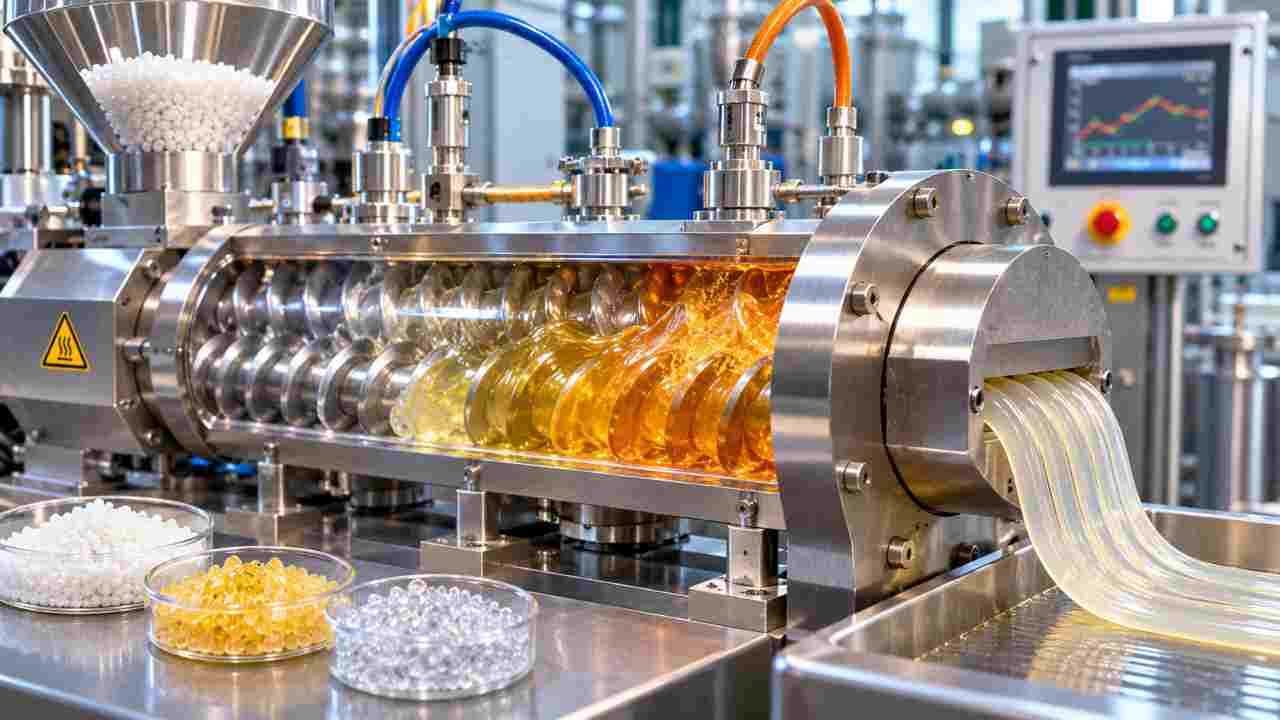
Reactive extrusion can transform an ordinary polymer into a functionalized, compatibilized or higher-performance material within a continuous manufacturing operation. Yet two extrusion runs using identical raw materials and additive concentrations can produce substantially different molecular structures, melt properties and mechanical performance.
The explanation lies in a critical distinction. Unlike conventional compounding, reactive extrusion combines chemical reactions with melting, mixing, conveying and heat transfer. Every processing decision potentially influences the chemical environment in which the polymer is modified.
A small change in screw configuration, feed location or throughput can alter when reactive components encounter one another, how rapidly reactions proceed and which side reactions become dominant. The resulting differences may not be obvious from the formulation sheet or even from the appearance of the extrudate.
For polymer scientists and process engineers, successful reactive extrusion requires understanding the interactions between chemical kinetics and processing conditions rather than optimizing them independently.
1. An Extruder Is Not a Uniform Chemical Reactor
Reactive extrusion uses the extruder as a continuous reactor, but the material does not experience one uniform temperature, mixing intensity or reaction time.
Polymer melt moves through conveying and mixing zones with different flow characteristics. Some material elements may pass through relatively quickly, while others experience longer residence times and more extensive deformation.
This residence time distribution becomes particularly important when reactions compete with polymer degradation.
For example, a peroxide-initiated functionalization reaction requires sufficient time for radical generation, contact between reactive species and subsequent chemical modification. However, prolonged exposure can also increase thermal degradation or unwanted crosslinking.
Average residence time alone cannot fully describe these competing outcomes. The distribution of residence times influences the proportion of material receiving insufficient or excessive reaction exposure.
Processing conditions also interact. Changing throughput modifies filling behavior, residence time and heat generation, while screw speed affects mixing and shear history.
Consequently, replicating a barrel-temperature profile and screw speed does not necessarily reproduce the same polymer chemistry when extruder geometry or operating conditions change.
2. Radical Chemistry Can Improve Functionality While Damaging Polymer Chains
Free-radical grafting is an established reactive extrusion approach for introducing functional groups onto otherwise relatively nonpolar polymers.
Maleic anhydride grafting onto polypropylene or polyethylene, for example, can improve interactions with polar materials and enable the production of compatibilizers for polymer blends and filled compounds.
Organic peroxides are commonly used to generate radicals that facilitate grafting reactions. Their decomposition behavior depends on temperature and exposure time, making initiator selection closely connected to the processing conditions.
However, radical chemistry is not perfectly selective.
In polypropylene, radical reactions can promote chain scission, reducing molecular weight and changing melt viscosity. In polyethylene, branching and crosslinking may become important competing reactions.
A formulation that achieves increased functional-group incorporation may therefore exhibit undesirable melt-flow changes, reduced mechanical performance or gel formation.
Increasing initiator or grafting-agent concentration is not automatically an effective solution. Higher reactivity can intensify side reactions and create additional challenges in residual-component removal.
Development should assess grafting efficiency alongside molecular-weight preservation, melt rheology and the extent of unwanted reactions.
3. Mixing Sequence Can Change the Final Polymer Structure
One of the most revealing aspects of reactive extrusion is that the sequence of component addition can alter product performance even when the overall formulation remains unchanged.
A 2026 study published in the International Journal of Molecular Sciences investigated reactive compatibilization of poly(butylene terephthalate)/acrylonitrile-butadiene-styrene (PBT/ABS) blends using an epoxy-functional styrene-acrylonitrile compatibilizer.
Researchers evaluated different mixing sequences while maintaining the same nominal blend composition and compatibilizer loading.
The results demonstrated that the incorporation route influenced dispersed-phase morphology, rheological behavior and mechanical performance. Compatibilization substantially refined the dispersed ABS phase, but the different mixing protocols did not produce identical outcomes.
This finding has practical implications for reactive blending.
When a compatibilizer encounters one polymer phase before the other, the opportunity for interfacial reaction and molecular redistribution may differ from simultaneous feeding.
The location of reactive species also matters. An additive concentrated within one phase may not reach the intended interface efficiently, regardless of its theoretical chemical compatibility.
Thus, successful compatibilization requires more than selecting suitable functional groups. The process must distribute those groups where the desired reactions can contribute to morphology stabilization.
4. Screw Configuration Determines the Chemical Environment
Twin-screw extrusion provides considerable flexibility through modular conveying, kneading and mixing elements.
These elements influence distributive mixing, which redistributes material throughout the melt, and dispersive mixing, which subjects agglomerates or dispersed domains to stresses that can promote their breakup.
Both mechanisms affect reactive extrusion, but they do not serve identical purposes.
Distributive mixing helps bring reactive components into contact throughout the polymer melt. Dispersive mixing can influence phase morphology and the accessibility of reactive interfaces.
A 2024 computational study published in Polymers demonstrated that screw-element geometry and rotational speed significantly affected both distributive and dispersive mixing characteristics.
Greater mixing intensity, however, is not universally beneficial.
Additional kneading elements may increase energy input, alter pressure development and extend exposure to mechanically and thermally demanding conditions. In sensitive polymers, these changes can increase degradation risk.
Screw design must therefore reflect the required reaction mechanism, melt viscosity and acceptable processing window.
For rapid reactions, effective early-stage mixing may be particularly important. For systems requiring controlled reaction development, the distribution of mixing zones along the barrel may deserve greater attention.
5. Reaction Kinetics and Heat Generation Must Remain Balanced
Reactive extrusion becomes especially challenging when polymer viscosity changes substantially during processing.
Chain extension, branching and crosslinking can increase molecular weight or network formation. These changes may increase melt viscosity and torque, affecting conveying behavior and mechanical energy dissipation.
At the same time, viscous heating and exothermic reactions may cause the actual melt temperature to differ from the barrel-temperature setpoints.
The resulting temperature changes can accelerate reaction kinetics, sometimes creating additional viscosity growth or degradation.
Consider reactive chain extension of polyesters such as polyethylene terephthalate (PET) or polylactic acid (PLA). Suitable multifunctional chain extenders may improve melt strength through molecular-weight growth or branching.
However, excessive reaction can produce high viscosity, gel formation or processing instability. Moisture-sensitive polyesters may simultaneously undergo hydrolytic degradation if feedstock drying is inadequate.
A useful process assessment therefore combines melt-temperature measurements, torque behavior, residence-time information and product-property testing.
The objective is not simply maximum chemical conversion. It is achieving the required molecular architecture while maintaining stable continuous processing.
6. Feeding, Liquid Injection and Devolatilization Influence Product Quality
Reactive additives do not always enter extrusion systems as dry, uniformly mixed solids.
Some processes require liquid injection, side feeding or the introduction of reactive components at selected barrel locations. These decisions influence the timing of chemical contact and the amount of processing time available afterward.
Introducing a reactive liquid too early may create unwanted reaction exposure or handling difficulties. Introducing it too late may leave insufficient time for mixing and conversion.
Liquid injection also requires suitable pressure control, metering accuracy and distribution within the polymer melt.
Volatile components introduce another challenge.
Residual monomers, moisture, reaction by-products and other volatile materials may require removal through atmospheric or vacuum devolatilization, depending on the chemistry and processing conditions.
Inadequate devolatilization can affect odor, product consistency and downstream processing. Excessive vent-zone disturbance or poor melt-seal control can create operational problems.
Feedstock moisture must be evaluated separately because its effects are polymer- and reaction-specific.
For moisture-sensitive polyesters, hydrolytic molecular-weight reduction may compete with intended chain-extension reactions.
These examples demonstrate why reliable reactive extrusion cannot be achieved by controlling temperature and screw speed alone.
7. Product Verification Must Connect Chemistry With Process Performance
Melt-flow measurements provide valuable information about processability, but they cannot independently establish the extent or selectivity of chemical modification.
A change in melt viscosity may result from chain extension, branching, degradation, phase interactions or other structural changes.
Additional analytical methods are necessary to understand the actual outcome.
Fourier-transform infrared spectroscopy can help assess chemical functionality when suitable diagnostic bands are available. Size-exclusion chromatography can characterize soluble molecular-weight distributions, while rheological measurements provide information about melt response and potential branching.
For polymer blends, microscopy and mechanical testing help establish whether reactive compatibilization has produced useful morphological changes.
Development objective | Useful evaluation methods |
|---|---|
Confirm chemical functionalization | FTIR, chemical titration or suitable compositional analysis |
Assess molecular-weight changes | Size-exclusion chromatography and melt rheology |
Detect excessive crosslinking | Gel-content testing, solubility analysis and rheology |
Evaluate blend compatibilization | Microscopy, phase morphology and mechanical testing |
Monitor process consistency | Torque, melt pressure, melt temperature and throughput trends |
These methods should be selected according to the polymer system and expected reaction mechanism rather than applied as a universal test package.
In-line or online analytical technologies can provide additional insight. Published work describes the use of near-infrared spectroscopy, Raman spectroscopy and rheometric measurements to monitor reactive polymer processing.
Scale-up adds another level of uncertainty. Larger equipment may have different mixing-element geometries, melt filling, heat-transfer characteristics and residence-time distributions.
Matching nominal screw speed or specific mechanical energy does not guarantee matching chemical conversion or morphology.
A more reliable scale-up strategy compares the relevant material histories, reaction indicators and final properties across equipment sizes.
Ultimately, reactive extrusion succeeds when the formulation, reaction mechanism and processing conditions produce the required polymer structure consistently. That demands a development approach connecting chemistry, extrusion engineering, analytical testing and practical manufacturing limitations.
ONLYTRAININGS | ADVANCED TECHNICAL TRAINING
Reactive Extrusion Training | Advanced Polymer Functionalization and Process Control
Reactive extrusion requires more than understanding polymer chemistry or operating a twin-screw extruder. Successful development depends on controlling both simultaneously.
This specialized OnlyTRAININGS program addresses the formulation and processing decisions behind reactive polymer modification, with particular attention to reaction control, industrial reliability and practical troubleshooting.
Key technical areas covered in this training
Reactive process design: Understand process configurations, twin-screw design, mixing arrangements and liquid-injection principles.
Reaction chemistry: Examine free-radical reactions, grafting, functionalization, polymerization, crosslinking and degradative reactions.
Mixing and reaction control: Evaluate how screw configuration, heat transfer, temperature and residence time influence reaction outcomes.
Polymer performance: Connect chemical modification, compatibilization and reactive blending with material properties.
Industrial troubleshooting: Address degradation, gel formation, inconsistent conversion and process instability.
Applied development: Explore case studies involving polymer blending, functionalized polymers and reactive crosslinking.
Training benefits: Six-month full training access, a verifiable certificate, downloadable presentation slides and practical toolkits, plus 24/7 expert discussion forum access.
EXPLORE THE TRAINING & REGISTER
Technical References
Experimental Methods in Chemical Engineering — Reactive Extrusion. The Canadian Journal of Chemical Engineering, 2023. Read the publication
Controlling the Mixing Sequence of the Reactive Compatibilizer SAN-g-Epoxy in PBT/ABS Blends. International Journal of Molecular Sciences, 2026. Read the research
Analysis of the Dispersive and Distributive Mixing Effect of Screw Elements on the Co-Rotating Twin-Screw Extruder with Particle Tracking. Polymers, 2024. Read the research
A Review on the Free Radical Grafting of Vinyl Monomers onto Polyethylene and Polypropylene by Reactive Extrusion. Polymer, 2023. Read the review
Review on the Degradation of Poly(lactic acid) During Melt Processing. Polymers, 2023. Read the review
Rheology of Recycled PET. Polymers, 2023. Read the publication
In-Process Measurements for Reactive Extrusion Monitoring and Control. In Reactive Extrusion — Principles and Applications, Wiley, 2018. Technical chapter
Reactive Extrusion of Vitrimers — A Short Review. Sustainable Materials and Technologies, 2025. Read the research