
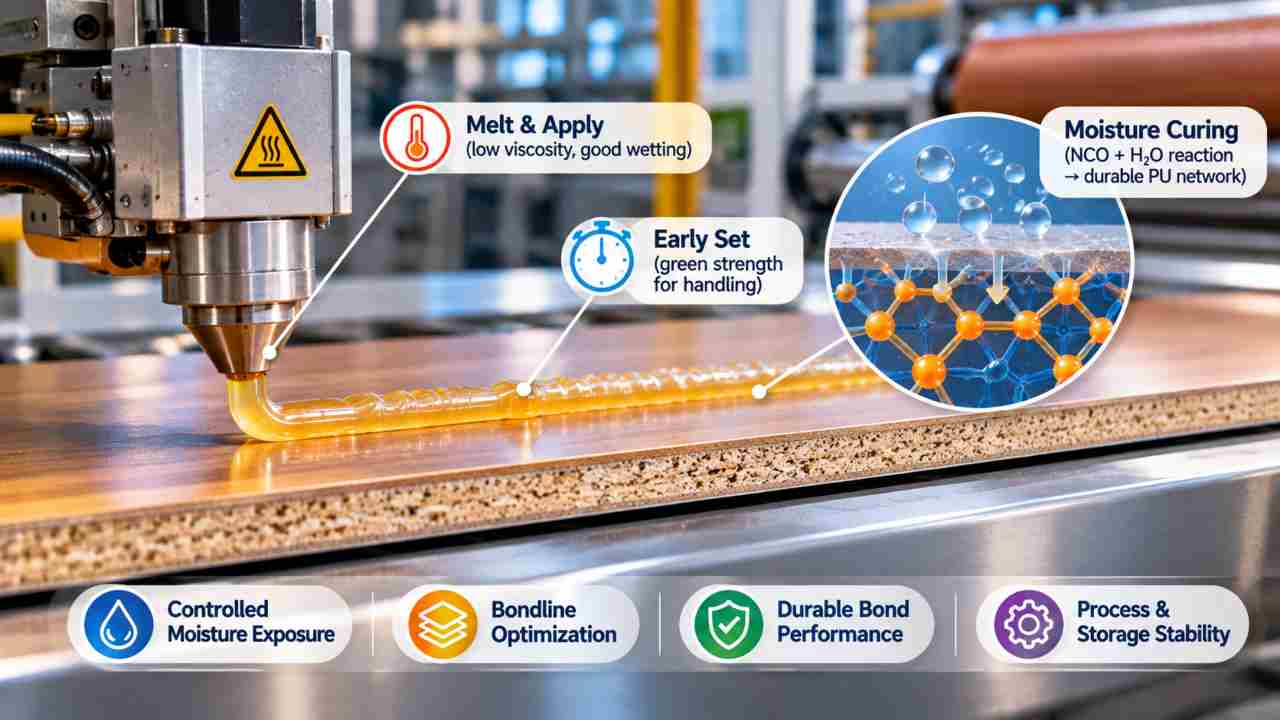
A polyurethane hot melt can leave an applicator with excellent flow, grip a surface within minutes and still be chemically unfinished. That is not a flaw in the technology. It is the reason reactive polyurethane (PUR) hot melts are useful in fast-moving lamination, furniture, footwear and assembly operations: the line benefits from physical setting before the final adhesive properties develop.
The complication is that the same moisture needed for subsequent curing can become a contaminant inside the melting equipment, or create voids if reaction gases cannot escape. A reactive PUR hot melt must be protected from moisture during storage and processing, then receive sufficient moisture in the assembled joint. Those are two different engineering requirements.
PROCESS INSIGHT
A faster set does not demonstrate a faster chemical cure. Evaluate the physical bond-building step and moisture-driven reaction separately before changing the formulation.
1. Two strength-building processes run on different schedules
Unlike a conventional nonreactive hot melt, a typical one-component PUR hot melt contains an isocyanate-terminated polyurethane prepolymer. Heating reduces viscosity so the material can wet the adherends. Cooling then increases cohesion through solidification, chain association and, where present, crystallization of suitable segments. This early green strength lets production move or handle the assembly before its full chemical cure.
The subsequent chemistry depends on water reaching residual NCO groups. Isocyanate reaction with water generates an amine intermediate and carbon dioxide; the resulting amine can react with another NCO group to form a urea linkage. The extent of chain extension or network formation depends on functionality and formulation architecture.
Open time, setting time and final cure time therefore describe different events. A bond may become difficult to reposition because the melt has cooled, not because moisture curing is complete. Similarly, a joint that survives an early handling test may still lack the heat resistance, creep performance or durability expected after conditioning.
2. Polyol architecture can buy speed at the expense of working time
The prepolymer backbone shapes both stages of performance. Crystalline polyester segments can accelerate physical strength development as the applied melt cools. More amorphous components may help preserve wetting and assembly time, but can also delay the buildup of green strength. Polyether segments and alternative polyols alter flexibility, polarity, water interactions and the properties of the cured adhesive.
The choice is not simply between a fast and a slow polymer. Changing the crystalline-to-amorphous balance changes viscosity, crystallization rate, wetting window and final morphology at once. Thermoplastic polyurethane modifiers and selected compatible tackifiers may improve early strength, but can also shift melt viscosity, compatibility, stiffness or low-temperature performance.
A 2024 study of polyurethane reactive hot melts found that TPU addition improved green strength in its tested formulations; increasing the amount also introduced flexibility trade-offs. That result is useful evidence for targeted experimentation, not a universal TPU loading prescription.
Prepolymer NCO content, molecular weight, isocyanate selection and catalyst package further affect the downstream reaction. An NCO measurement alone is not a final-performance specification, and an additive that improves early grab cannot be judged without testing cured joints.
3. Moisture needs a route into the bondline
Moisture-curing performance depends on how much water is available, where it enters and how far it must travel. A porous wood-based adherend may provide a different moisture pathway from a low-permeability metal or plastic laminate. Bondline thickness, temperature, relative humidity, surface preparation and assembly geometry can all change the cure profile.
The chemistry also produces carbon dioxide. Under conditions where gas generation outpaces escape, the adhesive can foam or develop voids. Excess substrate moisture is therefore not the same as controlled curing. On the other hand, very dry conditions or poorly accessible bondlines can delay conversion in interior regions.
For difficult structures, measure performance at defined depths or locations and after specified conditioning intervals. A hard surface does not prove that the center of a thick or moisture-isolated adhesive layer has reacted adequately.
The test question is whether the assembled product receives a controlled moisture exposure, not whether the workshop has a nominal humidity number. Any proposed pre-humidification or water-misting procedure must be justified for the particular adhesive and adherends, following supplier guidance.
4. Substrate heat flow can change the usable open time
Even before water enters the picture, the adherends control how quickly the molten film loses heat. A metal component can draw heat from the adhesive much faster than an insulating wood or foam surface. In the same formulation, that can shorten the available time to achieve wetting and intimate contact. Henkel's TECHNOMELT PUR 513C technical data explicitly notes this dependence of open time on substrate thermal conductivity.
Contact pressure, coat weight and application pattern also matter. Too little contact can leave poorly wetted regions; excessive delay before joining can create a skin or reduce available flow. Raising application temperature to compensate may improve wetting temporarily but also changes residence-time and stability risks.
An informative production comparison holds the adhesive formulation constant while varying substrate temperature, contact delay and assembly pressure in a controlled design. Measure transfer and wetting along with early strength. Otherwise a process mismatch may be mistaken for a defective resin or an inappropriate NCO level.
5. The melter can become an unintended curing vessel
Inside a sealed cartridge, drum, hose or heated reservoir, reactive hot melt needs protection from atmospheric moisture. Once moisture enters, premature reaction can raise viscosity, cause skinning, introduce gels or obstruct filters and nozzles. Prolonged thermal exposure can create additional stability problems, even without deliberate water addition.
This is why melt viscosity must be interpreted together with temperature, hold time and material history. Comparing one fresh sample against adhesive that has remained heated for several hours may tell more about the applicator than the original formulation.
Control points include dry handling, closed delivery systems, appropriate moisture protection, validated temperature limits and a defined maximum idle or residence period. A supplier's equipment guidance is product-specific; the correct response to a prolonged shutdown is not automatically to increase heat or add thinner.
Any hot-melt trial must also follow the product safety data sheet and ventilation requirements, because heated reactive systems may present chemical-exposure hazards.
6. Qualify the transition from melt to finished joint
A robust reactive PUR development plan does not rely on a single lap-shear result taken at an arbitrary age. It follows the adhesive through application, physical setting, chemical cure and relevant service exposure. The measurements should answer distinct questions and use comparable specimens.
Observation | Plausible mechanisms to separate | Useful next evidence |
|---|---|---|
Strong initial grip, weak aged bond | Incomplete cure, deficient wetting, unsuitable final network | Conditioned strength over time, failure mode, NCO trend where appropriate |
Shorter open time on metal | Rapid cooling, low contact temperature, excessive delay | Surface temperature, contact-delay trial, wetting inspection |
Bubbles or porous bondline | Moisture excess, trapped gas, excessive reactive exposure | Substrate moisture, cross-section inspection, controlled conditioning |
Rising viscosity during production | Moisture ingress, thermal history, incompatibility or gelation | Time–temperature log, sealed-sample comparison, melt rheology |
For metal-to-metal qualification, ASTM D1002-26 provides a standardized apparent single-lap shear method, but a joint on wood, foam or flexible laminate needs testing suited to its own substrates and loading. Record specimen preparation, bondline geometry, conditioning, test age and the location of failure. Add peel, creep, heat exposure or environmental cycling when those are the actual application risks.
Use a staged decision rule: change the formulation only after the process and cure-access explanations have been examined. That discipline can prevent a more reactive recipe from masking a moisture-management problem.
A good bond must survive both clocks
Reactive PUR hot melts are valuable because they combine early handling capability with evolving chemical performance. Their most consequential variables do not act independently: polyol crystallization influences open time, substrate heat flow changes wetting, and moisture availability governs how the bond develops after the line has moved on.
The practical specification should define when the joint must hold, when it must finish curing, and what it must survive afterward. Formulators who separate these questions can make better decisions about chemistry, application conditions and production controls.
ONLYTRAININGS | ADVANCED TECHNICAL TRAINING
Reactive Hotmelt PU Adhesives: Formulation, Curing and Performance Optimization
Control green strength, open time and moisture curing without sacrificing process stability or long-term bond performance.
This expert-led training addresses:
Moisture-curing chemistry, isocyanates, polyols and structure–property relationships.
Formulation optimization involving NCO balance, catalysts, tackifiers, fillers and stabilizers.
Open time, initial setting, green strength and the development of cured properties.
Troubleshooting foaming, brittle bonds, premature gelling, viscosity drift and inconsistent curing.
Application and production best practices, practical case studies and technical decision-making.
EXPLORE THE TRAINING & ACCESS THE COURSE
The course page lists six-month access, downloadable presentation, Q&A and FAQ materials, a training certificate and access to an expert discussion forum.
Technical references
OnlyTRAININGS, Reactive Hotmelt PU Adhesives: Formulation, Curing and Performance Optimization.
H.M. Royal / Rain Carbon, Reactive Polyurethane Hotmelt Adhesives, Technical Bulletin (2020).
ResinLab, Moisture Contamination in Polyurethane Systems, Technical Bulletin.
ASTM D1002-26, Apparent Shear Strength of Single-Lap-Joint Adhesively Bonded Metal Specimens.