
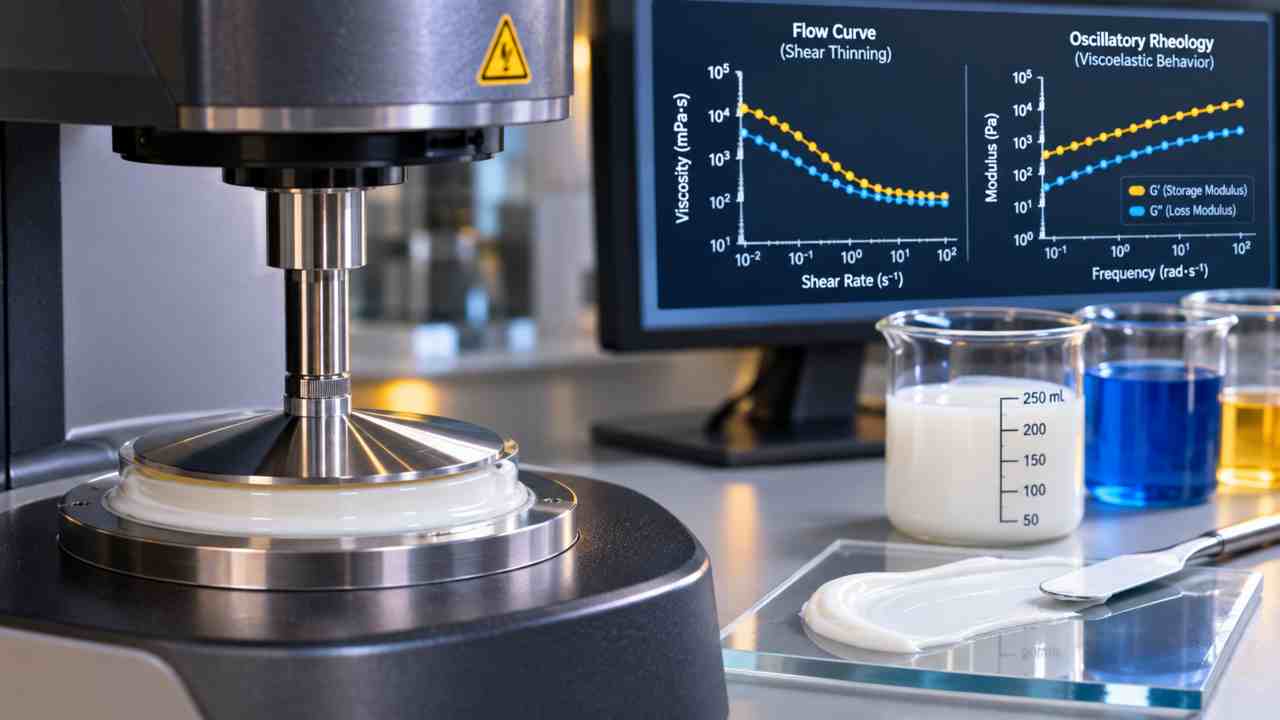
A coating passes its viscosity check but sags on a vertical panel. A filled sealant pumps cleanly during a laboratory trial yet develops excessive line pressure in production. Two pigment dispersions report nearly identical viscosity, although one settles during storage and the other remains uniform. These are not contradictions. They expose the limits of treating viscosity as a single material property.
Most formulated products are structured fluids. Their response depends on how quickly they are deformed, how long a force acts, the temperature, and what happened to their internal structure before the measurement. A viscosity specification taken under one set of conditions may therefore miss the mechanism that controls real performance.
The question for an experienced formulator is not simply whether a material is “too thick” or “too thin.” It is which rheological response matters at the point where the product fails.
1. A viscosity number is not a complete flow profile
A Newtonian liquid has a viscosity that is independent of shear rate at a fixed temperature. Coatings, inks, adhesives and personal-care systems frequently behave differently. As shear increases, particle networks may break down, associative structures can rearrange, and polymer chains may become more oriented. The measured apparent viscosity changes with the imposed conditions.
Imagine two hypothetical coatings that both meet the same routine QC viscosity target. The first has modest shear thinning; the second has a strong low-shear structure that rapidly weakens during application. They can produce different pumping resistance, leveling and sagging despite identical readings at one spindle setting. This comparison is illustrative.
A rotational viscometer supports batch consistency, but spindle speed is not a universally defined shear rate; the relationship depends on geometry and material behavior. When developing a new formulation, a properly measured flow curve often reveals far more than a single-point release value.
TECHNICAL INSIGHT — The test condition is part of the result.
A viscosity value without temperature, geometry, sample preparation and measurement history is difficult to interpret or reproduce.
2. Yield behavior separates storage stability from easy application
Some structured fluids resist movement until a sufficient stress is applied. This is commonly described as yield behavior, although the measured yield point depends on the test method and observation timescale. The distinction matters for pigment suspensions, filled adhesives and vertical-applied coatings.
A network strong enough to resist slow gravity-driven movement may help reduce settling or sagging. But if the same network is excessively resistant to deformation, the formulation may be difficult to pump or spread. The objective is a useful balance between stability at rest and flow under the conditions of use.
Static and dynamic yield estimates can differ because a material initially at rest is not structurally identical to one that has already experienced shear. Wall slip can complicate interpretation further: if material slides at a smooth measuring surface, the instrument may report behavior that does not represent deformation through the bulk sample.
Roughened surfaces or vane geometries may help. A high fitted yield-stress value is not, by itself, proof that a suspension will remain stable over its intended shelf life.
3. The recovery window determines leveling versus sagging
Shear thinning and thixotropy are not interchangeable. Shear thinning describes a change in apparent viscosity with shear rate. Thixotropy refers to a reversible, time-dependent loss of structure under a specified deformation history, followed by recovery when the conditions change.
During spraying, brushing or dispensing, a formulation may lose part of its internal structure. After application, it needs enough mobility to wet the surface and smooth out marks, but it must develop resistance before gravity creates runs or slump. Recovery that is too fast can hinder leveling. Recovery that is too slow can leave a coating vulnerable to sagging.
A three-interval thixotropy test (3ITT) can examine this sequence: the initial state, structure breakdown under stronger shear, and rebuilding afterward. The shape and timing of the recovery response can be more informative than a viscosity reading obtained after an arbitrary rest period. ISO/TR 20659-2:2024 discusses methods for evaluating these time-dependent changes.
R&D DECISION POINT — Measure the useful recovery window.
For a vertical coating, compare the recovery timescale with the period available for leveling and the onset of visible sag. Faster recovery is not always better.
4. Oscillatory testing reveals the network behind the flow
A formulation may have the same apparent viscosity as another while possessing a different elastic structure. Oscillatory rheometry can help distinguish them by measuring the storage modulus (G′) and loss modulus (G″), which describe elastic and viscous contributions under specified conditions.
An amplitude sweep helps identify a linear viscoelastic region where the response is approximately proportional to the applied deformation. A frequency sweep within that region can then reveal timescale-dependent behavior. Such measurements are useful when investigating associative thickeners, polymer networks, gels or concentrated dispersions.
However, the interpretation should remain disciplined. A high G′ does not automatically mean better shelf stability, and the crossover of G′ and G″ does not supply a universal performance threshold. Instrument geometry, sample loading, temperature and strain history can influence the result. ISO 3219-2:2021 and ISO 3219-3:2026 provide current guidance on rotational and oscillatory rheometry and the selection of suitable measuring arrangements.
Oscillatory measurements become valuable when they explain a performance change that a flow test missed.
5. Rheology modifiers reshape the entire response
Associative polyurethane thickeners, cellulosic polymers, alkali-swellable systems and mineral rheology modifiers do not build structure in the same way. Their interactions with binders, surfactants, pigments, salts and water can shift different regions of the flow curve independently.
For instance, changing an associative thickener may improve high-shear application viscosity while reducing low-shear resistance. A mineral network may support anti-settling behavior yet introduce poor leveling or an undesirable response to mixing. Matching QC viscosity does not ensure matching yield behavior or recovery.
Adding more thickener is therefore an unreliable first response to every flow-related defect. Better experiments hold the processing and conditioning method constant, change one structural variable at a time, and track both rheological signatures and the corresponding application outcome.
6. Choose the measurement that answers the failure
A useful rheology program begins with the process or product problem, not with the instruments available in the laboratory. Settling during storage, line-pressure fluctuations, poor film leveling and dispensing stringiness occur under different stresses and timescales. They should not automatically be investigated with the same test.
Observed problem | Useful rheological investigation | Interpretation caution |
|---|---|---|
Pigment settling | Low-stress creep, yield response and structural stability | Yield stress alone does not prove long-term shelf life |
Vertical sagging | Recovery after shear and low-shear flow | Drying and wet-film thickness also matter |
Poor leveling | Recovery kinetics and relevant application-range viscosity | Surface tension and substrate wetting also matter |
Pumping variability | Flow curve versus temperature and shear history | Line geometry and actual process conditions matter |
Batch-to-batch inconsistency | Controlled conditioning and repeat flow/oscillation tests | Sampling and instrument setup can create false differences |
A defensible method records sample age, pre-shear, rest time, temperature, measurement geometry, gap, and the relevant stress or shear-rate range. For structured dispersions, it should also address evaporation, edge effects and possible wall slip. Data fitting may be useful, but a model such as Herschel–Bulkley should only be applied where its assumptions and fitted range are appropriate.
Finally, laboratory results need to be checked against meaningful manufacturing or application trials. A rheometer cannot reproduce every industrial flow condition. The goal is to discover a measurable signature that reliably tracks the problem and supports a targeted formulation decision.
From a viscosity specification to a performance specification
The most valuable rheological method is not necessarily the most elaborate one. It is the method that identifies why a formulation settles, sags, pumps poorly or fails to recover when the routine viscosity value looks acceptable. Linking flow, yield behavior, viscoelasticity and processing history turns rheology from a batch-release number into a development tool.
That practical translation from structure to flow to performance is the focus of the OnlyTRAININGS program for experienced formulators and process engineers.
ONLYTRAININGS | EXPERT-LED TECHNICAL TRAINING
Advanced Rheology Training for Formulators | Flow Behavior and Performance Control
Move beyond viscosity numbers and make better formulation decisions.
The program examines non-Newtonian flow, yield behavior, viscoelasticity, thixotropy, leveling, sagging, settling, and the effects of temperature and shear history. It connects rheometer data with formulation variables and practical troubleshooting across coatings, adhesives, inks, sealants, polymers and personal-care systems.
EXPLORE THE TRAINING & REGISTER
Training page lists six-month access, downloadable materials, a verifiable certificate and discussion-forum access to the expert.
Technical references
ISO 3219-2:2021, Rheology — Part 2: General principles of rotational and oscillatory rheometry. https://www.iso.org/standard/76033.html
ISO 3219-3:2026, Rheology — Part 3: Test procedure and examples for the evaluation of results when using rotational and oscillatory rheometry. https://www.iso.org/standard/88798.html
ISO/TR 20659-2:2024, Rheological test methods — Determination of the time-dependent structural change (thixotropy). https://www.iso.org/standard/86378.html
ASTM D2196-20(2026), Rheological Properties of Non-Newtonian Materials by Rotational Viscometer. https://store.astm.org/standards/d2196
Zheng and Chen, Correlations of rheological methods to coatings' performance, Progress in Organic Coatings (2023). https://www.sciencedirect.com/science/article/pii/S0300944022007007
Anton Paar, 3iTT test, technical explanation of structural breakdown and recovery. https://wiki.anton-paar.com/se-en/3itt-test/