
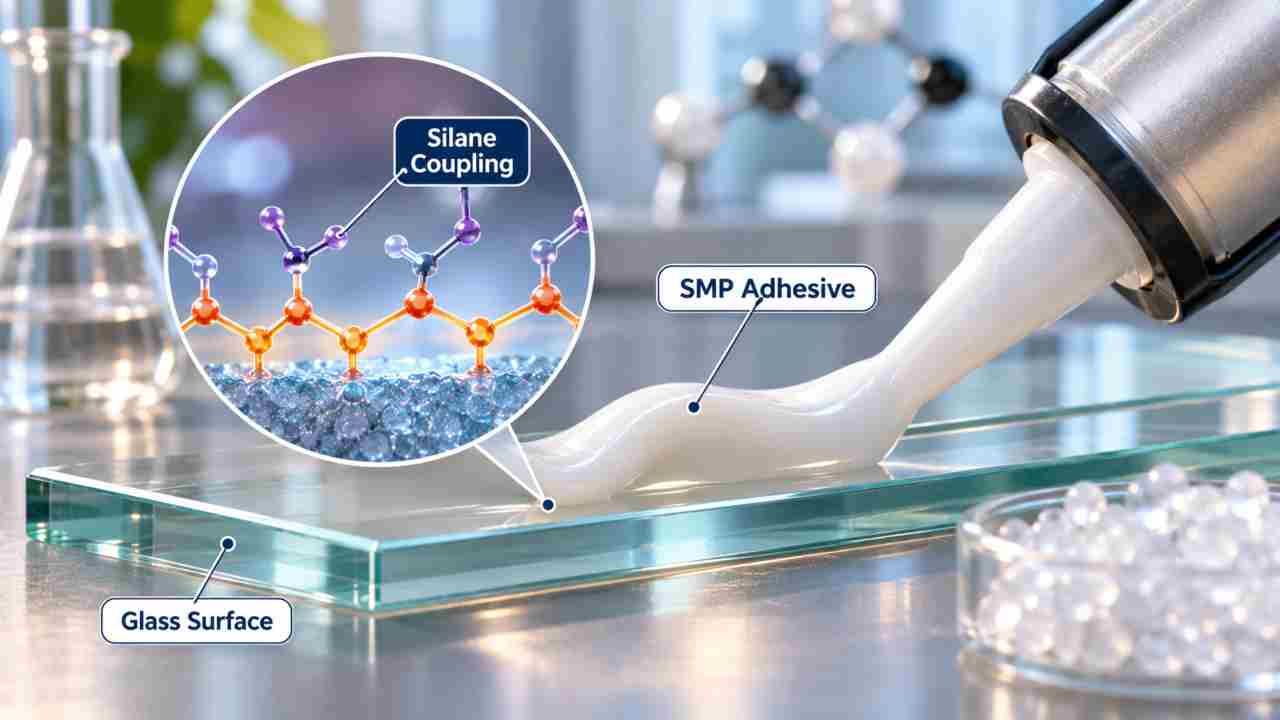
A formulator adds an organofunctional silane to improve the bond between a filled polymer and glass. Early specimens show encouraging adhesion, but later batches give inconsistent results. The silane concentration is unchanged, and the raw-material specifications appear acceptable. One clue emerges: premix viscosity has risen before application.
Silane chemistry presents a deceptively simple promise. A molecule with an inorganic-reactive end and an organic-compatible end can connect materials that otherwise interact poorly. But reactivity is only useful when it occurs at the right location and stage. Hydrolysis can prepare a silane for bonding, while condensation can attach it to a substrate, form siloxane networks, or consume it in the formulation before it reaches the interface. The outcome depends on water exposure and processing sequence.
FORMULATION INSIGHT
Do not treat silane dosage as the only variable. Record where, when and under what moisture conditions the silane first becomes reactive.
1. A coupling agent and a silane-modified polymer do different jobs
An organofunctional coupling agent typically combines hydrolysable groups attached to silicon with an organic group selected for the surrounding polymer. On a suitable hydroxylated glass, silica or metal-oxide surface, hydrolysis can form silanols that participate in interfacial attachment. The organic group may react chemically with the resin or improve its compatibility. The interphase may involve covalent or weaker interactions, depending on the substrate.
A silane-modified polymer (SMP) is a different formulation component. Its organic polymer backbone, often polyether- or polyurethane-derived, carries reactive silane functionality that enables moisture-driven crosslinking. A free coupling agent may be used alongside an SMP as an adhesion promoter, but it should not be confused with the polymer's own cure sites.
Selection must therefore begin with a role: promoting adhesion to a particular surface, modifying a mineral filler, controlling crosslinking, or supplying the principal binder. A methacrylate-functional silane suited to a compatible radical-curing system is not automatically interchangeable with an epoxy- or amino-functional silane. Matching the functional group to the resin chemistry is as important as selecting the hydrolysable group.
2. Hydrolysis creates opportunity and condensation can close it
Alkoxysilanes usually require water to convert silicon-bound alkoxy groups into silanols. These species can interact with surface hydroxyl groups and subsequently form siloxane linkages. They can also react with each other, creating oligomers or larger condensed structures in the liquid phase. The competing pathways are sensitive to water-to-silane ratio, pH, catalyst, solvent, temperature and concentration. Published kinetic reviews caution against assuming one universal hydrolysis or condensation rate.
Prehydrolysis is not the same as unlimited working life. For example, Evonik's information for methacryloxy-functional Dynasylan MEMO describes an acidified aqueous preparation and a limited recommended use period for the resulting hydrolysate. That supplier-specific guidance illustrates why a clear freshly prepared solution should not be assumed equally suitable after prolonged standing.
Adding more water or a stronger catalyst may accelerate activation, but it can also increase unwanted self-condensation. Applying an excessively condensed or thick silane-rich layer may create a weak interphase rather than a stronger molecular bridge. The correct condition depends on the particular product and substrate; there is no defensible universal prehydrolysis time or pH for every silane family.
3. Fillers and pigments can compete with the intended interface
In a mineral-filled sealant or coating, reactive surface area may be dominated by the filler rather than the external substrate. Silica, glass and other hydroxylated surfaces can consume available silane through adsorption and condensation. A formulation containing a high filler loading may therefore behave differently from an unfilled resin, even when the added silane percentage is identical.
Filler moisture is equally important. Adsorbed water can promote early hydrolysis, while local alkalinity, acidic species or surface treatments can change reaction behaviour. The consequences may appear as drifting viscosity, altered dispersion, reduced storage stability or inconsistent cured properties. Calcium carbonate, silica and treated mineral fillers should not be assumed to have equivalent surface chemistry or coupling requirements.
Consider whether the silane belongs in a controlled filler pretreatment, an in-formulation addition or a dedicated substrate primer. Evonik's technical guidance describes both pretreatment and additive approaches and emphasizes resin compatibility in the latter. The best method is the one that leaves an effective, stable interphase in the finished material, not simply the one that makes compounding easiest.
Compare addition sequences at fixed silane loading, controlling filler moisture, mixing temperature and hold time.
4. SMP cure chemistry introduces a second reaction clock
In moisture-curing SMP adhesives and sealants, hydrolysis and subsequent condensation build a crosslinked network from reactive silane groups attached to the polymer. The polymer backbone sets much of the flexibility and strength, while end-group functionality, catalyst package, moisture transport and formulation architecture influence cure development. Methoxy- or ethoxy-functional groups can release corresponding alcohols during hydrolysis, requiring appropriate safety and emissions assessment.
The formulator has to protect a one-component product against premature exposure during manufacture and storage, yet enable reliable curing after application. Moist fillers, unsuitable processing conditions and excessive catalytic activity may shorten storage life. Conversely, limited moisture access through a thick bead or a low-permeability assembly can delay through-cure even when the surface has skinned.
A faster skin is not evidence of complete bulk crosslinking. Compare depth-dependent cure, tensile response and application behaviour after defined conditioning periods. Do not assume that increasing catalyst concentration solves a moisture-transport constraint. Two-component water-supplied SMP designs create a different process window, so their cure assumptions should not be transferred directly to one-component products.
5. Initial bond strength can conceal an unstable silane interphase
Even a promising dry adhesion result is incomplete evidence of durable coupling. Water can enter the interface, compete for polar sites and, under some conditions, contribute to hydrolysis or reorganization of siloxane linkages. Research on silane-modified inorganic surfaces shows that interface structure and molecular architecture influence hydrolytic durability. The extent of vulnerability depends on the specific silane, substrate and environmental exposure.
For a glass-to-polymer assembly, distinguish failure at the glass–silane interface, within a silane-rich boundary region, inside the adhesive, or through substrate damage. These are not interchangeable outcomes. Surface-energy measurements may show improved wetting without proving that the organic functionality became incorporated into the polymer network; similarly, high initial lap shear does not guarantee satisfactory humid aging.
Qualification should pair dry adhesion with justified humidity exposure and fracture-surface inspection. Surface analysis can test unresolved interfacial hypotheses. The question is whether the intended interface survives service, not whether a silane was present in the formulation record.
6. Diagnose where the silane was consumed before changing its level
A practical investigation separates premature reaction, misplaced reaction and insufficient reaction. A stable premix with poor adhesion demands different tests from a thickening package. Increasing dosage without this distinction can add cost, increase by-products and make the failure harder to interpret.
Observation | Mechanisms worth separating | Next useful evidence |
|---|---|---|
Premix viscosity rises during storage | Moisture ingress, early condensation, filler interactions | Water content, sealed control, time-resolved viscosity and chemical analysis |
More silane gives no further bond improvement | Site saturation, incompatible functionality, condensed interphase | Dose series, failure-location inspection, controlled primer comparison |
Strong dry bond loses strength after humid aging | Interfacial hydrolysis, water ingress, inadequate network attachment | Conditioned adhesion, fracture analysis, substrate-specific surface study |
SMP skins quickly but remains soft inside | Moisture-transport limitation, uneven catalysis or thick geometry | Through-cure profile, bead geometry, catalyst and humidity controls |
For an illustrative screening design, compare a no-silane control with two chemically appropriate silanes and a modest, justified loading range. Evaluate fresh versus deliberately aged premixes, alongside substrate pretreatment where relevant. Keep coating thickness or bondline geometry, cure conditions and test age consistent. Repeat key trials with production-representative filler lots and packaging conditions.
If fresh mixtures outperform aged ones, investigate preparation and storage. If a primer outperforms direct addition, investigate competition for the silane. If dry strength is acceptable but humid durability fails, investigate interface chemistry and water exposure before choosing a more reactive grade.
Make silane placement part of the formulation specification
Silanes connect surface chemistry and polymer crosslinking, but reaction location matters. A coupling agent may be consumed by a filler, an activated primer may self-condense before application, or an SMP may develop a surface skin while its interior continues curing.
Specify the silane's job, activation conditions, addition sequence and evidence of durable performance together. That turns a promising ingredient into a controlled formulation strategy and helps prevent unwanted reaction from masquerading as successful coupling.
ONLYTRAININGS | ADVANCED TECHNICAL TRAINING
Silanes & Silane-Modified Polymers (SMP): Boost Your Formulation Performance
Control hydrolysis, condensation, coupling and SMP cure through better ingredient selection and processing decisions.
This expert-led training addresses:
Silane structure and the practical consequences of organic and silicon-functional groups.
Hydrolysis and condensation mechanisms and the conditions that govern their reactivity.
Silane selection by application, intended role and compatibility with the formulation system.
Silane-modified polymer chemistry, formulation ingredients and final property development.
Premature reactions, dosage trade-offs, storage stability, scale-up failures and troubleshooting.
EXPLORE THE TRAINING & ACCESS NOW
The training page lists six-month on-demand access, downloadable presentation, Q&A and FAQ materials, a training certificate and an expert discussion forum.
Technical references
OnlyTRAININGS, Silanes & Silane-Modified Polymers (SMP): Boost Your Formulation Performance.
Issa and Luyt, Kinetics of Alkoxysilanes and Organoalkoxysilanes Polymerization, Polymers (2019).
Organosilicon Compounds in Hot-Melt Adhesive Technologies, Polymers (2023).
Silane Coatings for Corrosion Resistance of Mild Steel: A Review, Materials (2022).
Evonik, Dynasylan MEMO: Functional Silane Application and Hydrolysis Guidance.
Enhanced Hydrolytic Stability of Siliceous Surfaces Modified with Pendant Dipodal Silanes (2014).
Evonik, Dynasylan 1122: Amino-Functional Silane Properties and Applications.