
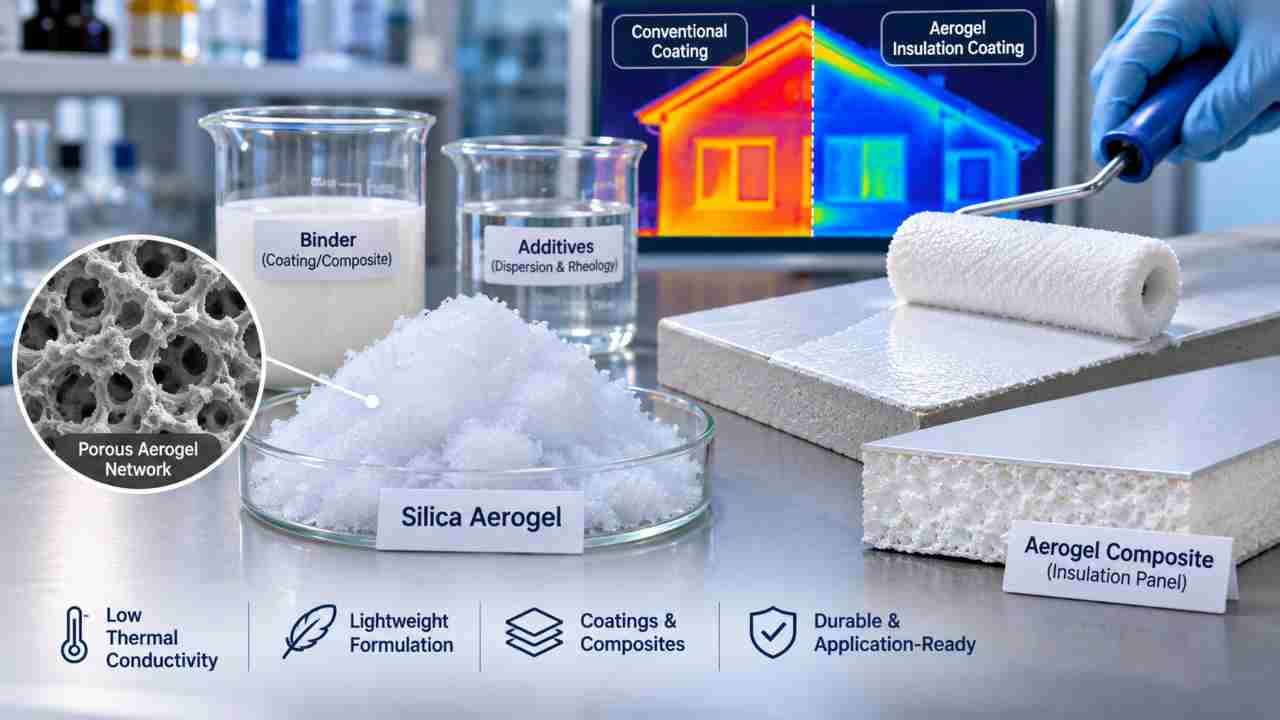
Silica aerogels are among the most promising materials for developing lightweight thermal-insulation coatings and composites. Their exceptionally high porosity, low density, and ability to restrict heat transfer make them attractive for applications ranging from building envelopes and industrial equipment to transportation and specialized thermal-management systems.
However, the thermal performance of an individual aerogel particle is not necessarily representative of the finished coating or composite. Once aerogel is incorporated into a binder, the resulting material behaves as a new system whose properties depend on particle characteristics, binder chemistry, dispersion, processing conditions, and final microstructure.
This distinction presents an important challenge for formulators. Increasing aerogel loading may improve insulation but compromise adhesion, mechanical strength, and application properties. Similarly, improving dispersion or binder compatibility may unintentionally alter the porous structure responsible for low thermal conductivity.
Developing effective aerogel-based products therefore requires careful control of the relationship between insulation efficiency, formulation stability, processing, and long-term durability.
1. Why Silica Aerogel Delivers Exceptional Thermal Insulation
The insulation performance of silica aerogel originates primarily from its highly porous structure. Its interconnected network of nanoscale pores restricts gaseous heat conduction, while the low-density silica skeleton limits solid-phase conduction. Radiative heat transfer also contributes to total thermal conductivity, particularly at elevated temperatures.
The small pore dimensions are especially important. When the characteristic pore size approaches or falls below the mean free path of gas molecules, gas-phase heat transport becomes restricted through the Knudsen effect. This contributes to the unusually low thermal conductivity associated with many silica aerogels.
These characteristics, however, are sensitive to changes in pore structure. If liquid formulation components penetrate the aerogel pores, or if the porous skeleton becomes damaged during processing, the original insulation benefit may be reduced.
The effect becomes more pronounced when an aerogel is incorporated into a comparatively conductive polymer matrix. Binder-rich regions, particle contacts, and other solid pathways can increase heat transfer through the finished composite.
For this reason, successful thermal-insulation formulation depends not simply on adding aerogel, but on preserving the microstructure that makes it effective.
2. Selecting the Right Aerogel Grade for Coatings and Composites
Silica aerogels are available in different particle sizes, densities, pore structures, and surface treatments. These characteristics influence processing behaviour as much as final thermal performance.
Hydrophobic aerogels are often attractive for moisture-resistant insulation systems because their modified surfaces reduce affinity for water. However, hydrophobicity can also create difficulties when incorporating the particles into waterborne coatings. Poor wetting may produce floating particles, agglomeration, inconsistent dispersion, and unstable viscosity.
Particle-size distribution introduces further considerations. Fine particles can support smoother coatings and more uniform distribution, but their large surface area may increase binder demand and complicate rheological control. Coarser particles may retain useful porous structures while creating challenges involving surface finish, film uniformity, or mechanical reinforcement.
Aerogel selection should therefore reflect the intended product architecture. A thin architectural coating, a high-build industrial insulation layer, and a fibre-reinforced composite blanket may require substantially different particle characteristics.
Evaluating aerogels only through supplier-reported thermal conductivity can be misleading. Bulk density, surface chemistry, mechanical fragility, and compatibility with the selected formulation system are equally important development parameters.
3. Binder Compatibility: The Hidden Influence on Thermal Performance
The binder must provide adhesion, film integrity, and mechanical durability without unnecessarily compromising the insulating function of the aerogel.
Acrylic, silicone, epoxy, and other polymer systems offer different combinations of flexibility, temperature resistance, moisture protection, and processing behaviour. However, their interaction with aerogel particles determines how successfully the porous structure is retained in the finished material.
One particularly important mechanism is binder penetration into aerogel pores. When resin enters the internal pore network, it replaces part of the gas-filled volume with a material that generally conducts heat more effectively. The resulting composite may therefore exhibit higher thermal conductivity than expected from the properties of its individual ingredients.
Research published in the Journal of Materials Research and Technology in 2025 demonstrated this effect in hydrophobic silica aerogel–waterborne acrylic coatings. Although increasing aerogel content reduced thermal conductivity, partial resin intrusion into the pores limited the insulation benefit.
Binder concentration presents a related trade-off. Insufficient binder can produce weak, powdery coatings with poor adhesion, while excessive binder increases the proportion of solid material and may strengthen thermal conduction pathways.
The objective is to achieve sufficient particle bonding and structural integrity while minimizing unnecessary occupation of the aerogel's insulating pore volume.
4. Managing Wetting, Dispersion, and Rheology
Dispersing silica aerogel is more complicated than incorporating conventional mineral fillers. Its low density, porous structure, and often hydrophobic surface can create unexpected behaviour during mixing.
Agglomeration may produce local variations in aerogel concentration, while excessive mechanical energy can damage fragile particles or alter their structure. In waterborne systems, floating or poorly wetted aerogel can prevent uniform incorporation. Solventborne formulations introduce different concerns, including solvent penetration into the pore network.
Dispersant selection and mixing conditions must therefore be considered together. Surfactants can improve wetting and distribution, but inappropriate selection may increase liquid penetration, affect coating stability, or introduce undesirable moisture sensitivity.
A controlled mixing procedure generally requires evaluating the sequence of ingredient addition, mixing intensity, dispersion time, and the point at which aerogel is introduced. A high-shear process suitable for pigments is not automatically appropriate for fragile aerogel particles.
Rheology becomes increasingly important at higher aerogel concentrations. Excessive viscosity may restrict spray application or film leveling, while inadequate low-shear structure can contribute to settling, floating, or inconsistent film thickness.
The most useful formulation is not necessarily the one with the finest apparent dispersion. It is the one that provides a stable, processable distribution while retaining the desired porous architecture.
5. Balancing Aerogel Loading with Mechanical Strength
Increasing aerogel content can reduce the effective thermal conductivity of a coating, but the relationship is rarely linear over the complete formulation range.
At higher loading levels, the amount of binder available to connect particles and maintain adhesion may become insufficient. The coating can develop cracks, weak cohesive regions, poor abrasion resistance, or increased sensitivity to moisture.
A 2025 study published in Gels investigated waterborne acrylic thermal-insulation coatings containing silica aerogel and hollow glass microspheres. The researchers reported an optimum in the investigated formulations rather than continuous improvement with increasing aerogel content. Excessive aerogel negatively affected wear resistance, adhesion, and water absorption.
This illustrates why maximum filler loading should not automatically be the formulation target.
For composite systems, reinforcement with fibres or other structural components may improve handling and mechanical integrity. However, these materials can introduce additional solid conduction pathways, making the thermal and mechanical benefits dependent on their geometry, distribution, and interaction with the aerogel.
The practical objective is to identify an operating range where insulation, adhesion, flexibility, and durability remain acceptable together.
6. Measuring Thermal Performance Without Misleading Conclusions
Thermal-insulation performance must be evaluated using methods appropriate for the final material and its intended application.
Thermal conductivity is a fundamental property, but it does not independently describe the insulation provided by an installed coating. Thickness, substrate properties, contact resistance, moisture content, ambient conditions, and heat-transfer mechanisms all influence the measured result.
For a homogeneous layer under steady one-dimensional conduction, thermal resistance is proportional to thickness divided by thermal conductivity. Consequently, even a material with relatively low conductivity may provide limited additional resistance when applied as a very thin coating.
A lower surface temperature observed during laboratory testing does not automatically establish equivalent energy savings in service. Surface emissivity, convection, radiation, and substrate conditions can influence the temperature difference.
ASTM C518 provides a recognized approach for measuring steady-state thermal transmission properties using a heat-flow-meter apparatus. However, its specimen and thermal-resistance requirements must be considered; very thin coatings may require alternative validated methods or suitable composite test specimens.
Formulators should distinguish between intrinsic material conductivity, the thermal resistance of the complete applied layer, and actual application-level performance. These measurements answer different questions and should not be used interchangeably.
7. Designing for Moisture Resistance and Long-Term Durability
The insulation efficiency of an aerogel-containing system can deteriorate if moisture enters the structure, particle bonding weakens, or the coating develops cracks during service.
Hydrophobic aerogel grades can reduce water affinity, but the moisture resistance of the complete formulation also depends on binder chemistry, coating defects, interfaces, and environmental exposure. A hydrophobic filler does not automatically produce a waterproof coating.
Durability becomes particularly important in exterior building applications, industrial equipment insulation, and transportation materials. Thermal cycling, condensation, mechanical vibration, abrasion, and prolonged humidity exposure may progressively affect the integrity of the coating or composite.
These considerations should influence formulation development from the beginning rather than being addressed only after thermal performance has been optimized.
Development parameter | Key technical consideration |
|---|---|
Aerogel selection | Particle size, density, porosity, and surface chemistry |
Binder compatibility | Wetting, resin penetration, adhesion, and film formation |
Dispersion | Agglomeration, particle damage, and mixing conditions |
Thermal performance | Effective conductivity, thickness, and testing conditions |
Durability | Moisture resistance, cracking, abrasion, and ageing |
A successful development program should evaluate these parameters together. Improving moisture resistance may require changes that affect dispersion, while increasing binder content to improve mechanical strength may reduce insulation efficiency.
The commercial challenge is therefore to establish a formulation that preserves thermal performance without sacrificing the processing and durability characteristics required by its intended application.
Take Silica Aerogel Formulation Further with OnlyTRAININGS
Developing an effective silica aerogel coating or composite requires more than understanding the material's exceptional thermal properties. The real formulation challenge lies in selecting suitable aerogel grades, controlling binder interactions, maintaining stable dispersion, and preserving porosity while achieving adequate mechanical strength and durability.
These variables are closely connected, and changes intended to improve one property can undermine another. Formulators therefore benefit from examining the complete relationship between raw material selection, processing conditions, final microstructure, and product performance.
ONLYTRAININGS | ADVANCED EXPERT-LED TRAINING
Silica Aerogel Thermal-Insulation Coatings & Composites
Develop better-performing aerogel insulation systems through informed formulation and processing decisions.
This specialized OnlyTRAININGS program explores aerogel grade selection, binder compatibility, dispersion strategies, rheology control, and techniques for preserving pore structure during formulation and processing.
The training also addresses thermal conductivity optimization, moisture resistance, mechanical durability, composite design, and practical troubleshooting of problems such as poor wetting, viscosity instability, cracking, and unexpected losses in insulation performance.
Designed for coating formulators, polymer scientists, composite-material developers, thermal-insulation R&D teams, and specialty-material suppliers working with silica aerogel technologies.
EXPLORE THE SILICA AEROGEL TRAINING & REGISTER
Includes six-month training access, downloadable training materials, practical resources, a verifiable certificate, and expert discussion support.
Technical References
Raoufi, F. et al. (2025). Optimizing thermal insulation of waterborne acrylic coatings through controlled integration of hydrophobic silica aerogel: Experimental insights and advanced modeling. Journal of Materials Research and Technology, 38, 5630–5638. Read research
Effects of Silica Aerogel Content on the Properties of Waterborne Organic Thermal Insulation Coatings. Gels, 11(7), 547 (2025). Read research
Li, Z. et al. (2025). A review of silica aerogel based thermal insulation coatings: Preparation, properties and applications. Progress in Organic Coatings, 208, 109449. Read review
Insulating materials based on silica aerogel composites: Synthesis, properties and application. RSC Advances, 14, 34690–34707 (2024). Read review
ASTM International. ASTM C518-21: Standard Test Method for Steady-State Thermal Transmission Properties by Means of the Heat Flow Meter Apparatus. Standard information
Technical note: Reported thermal performance depends on formulation composition, specimen geometry, test conditions, and service environment. Product-specific claims should be supported by representative testing.