
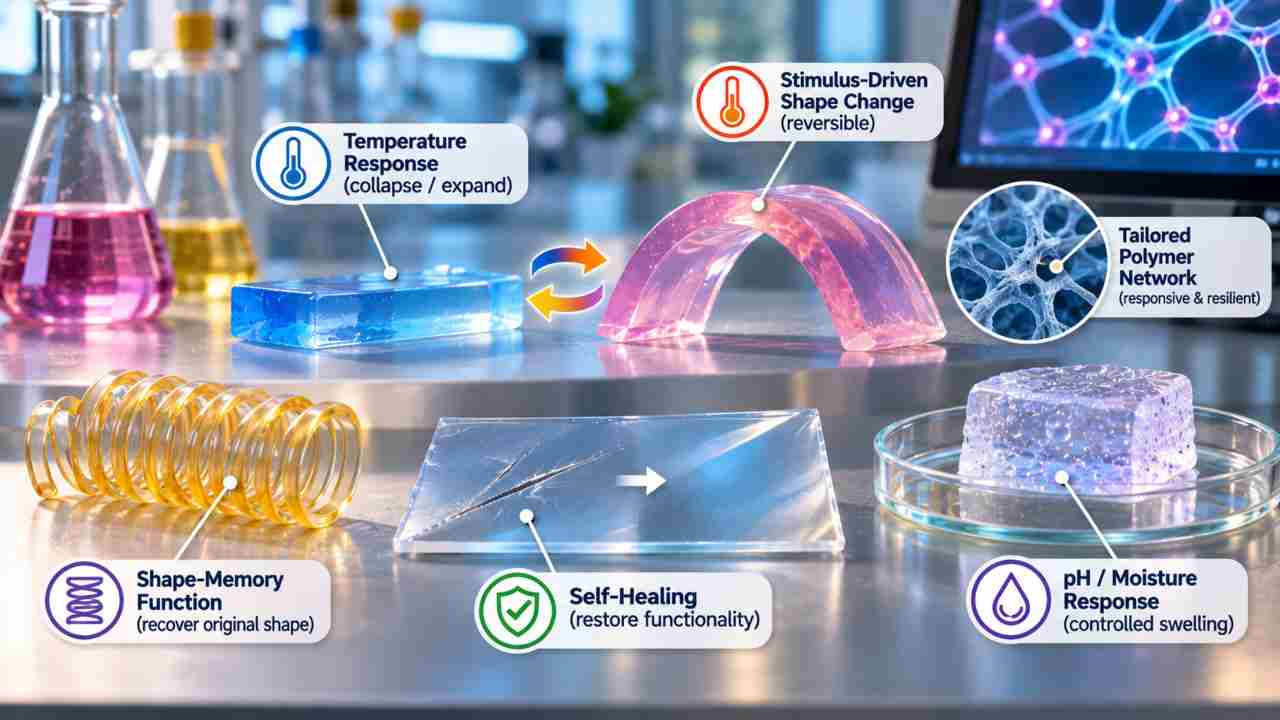
A thermally responsive strip bends as designed. A hydrogel contracts on heating and swells again on cooling. Neither demonstration answers the essential product question: will the response remain useful after storage, cycling, loading, and exposure to the operating medium?
Smart polymers translate temperature, pH, moisture, light, or other stimuli into changes in shape, volume, transport, or mechanical properties. The challenge is connecting that response to a dependable service requirement. Amplitude, threshold, speed, reversibility, and strength must be designed together.
DESIGN INSIGHT
A large first-cycle response is not necessarily a better formulation. The important result is the useful response remaining inside the application window after realistic conditioning and cycling.
1. A transition temperature is not a product specification
Thermoresponsive polymers illustrate how a familiar property can become misleading when removed from its test environment. Poly(N-isopropylacrylamide) (PNIPAM) is often described as having a lower critical solution temperature near 32°C in water. That is a useful reference for particular compositions and solution conditions, not a guaranteed switching temperature in every formulation. Copolymer composition, salts, concentration, network constraints, and the surrounding medium can alter the observed transition.
For a crosslinked hydrogel, the volume phase transition temperature observed through swelling may differ from a solution cloud point. A pH-responsive network has a similar problem: ionization and swelling depend on both pH and ionic strength, not on the quoted pKa of one functional group alone.
Specify an operating window, not just a nominal trigger: when should response begin, how much change is required, and how far must normal fluctuations remain from unintended activation? The heating and cooling paths should both be tested because they may not coincide.
2. Architecture decides what moves and what stays strong
A smart polymer needs molecular mobility to respond, but its structure must also retain enough mechanical integrity to do useful work. Crosslink density, hard and soft segments, crystallinity, chain composition, and reversible interactions distribute these competing responsibilities.
In a thermally activated shape-memory polymer, the temporary shape is stabilized by a switching transition while a network or stable phase helps preserve the permanent reference shape. Shape fixity, recovery force, recovery time, and residual strain matter differently for a deployable fitting, a soft actuator, or a component that must remain dimensionally accurate between activations.
Hydrogels balance osmotic swelling forces against network elasticity. Increasing network constraint may improve dimensional integrity but restrict swelling or slow transport. Dynamic bonds can facilitate repair or rearrangement, yet the relaxation needed for reversibility may also contribute to creep under sustained load.
The practical formulation target is therefore not maximum responsiveness. It is enough response without surrendering the mechanical property that makes the product usable.
3. Speed, hysteresis, and fatigue are connected trade-offs
A sharp transition looks impressive on a laboratory plot, but response speed often depends on how fast heat, solvent, ions, or another signal can reach the active region. A thick hydrogel may contain highly responsive chemistry while changing volume too slowly for a valve, sensor, or actuator. A thinner part may respond faster but become more vulnerable.
Hysteresis means that the response during stimulus increase differs from the return path. It can arise from phase changes, transport delay, viscoelastic relaxation, or other history-dependent effects. Hysteresis can resist nuisance switching but may undermine threshold predictability.
Repeated swelling and deswelling can also produce fatigue, cracking, permanent deformation, or reduced response amplitude. Shape-memory parts may accumulate residual strain or lose recovery force over cycles even while their first-cycle shape change looks excellent.
A meaningful comparison must record response magnitude, response and recovery times, residual deformation, and performance drift across cycles, not just the largest initial movement. Those metrics turn an attractive effect into a testable engineering claim.
4. Additives can help the trigger and damage the network
Fillers and functional additives are frequently introduced to improve strength or make activation possible. Conductive particles can support electrically driven heating; magnetic particles can enable magnetic-field-related actuation in appropriately designed composites. Nanofillers may reinforce a matrix or change transport pathways. Each benefit introduces interactions to control.
Particles can agglomerate, constrain chain movement, or concentrate strain at an interface. Plasticizers may shift the switching transition while reducing stiffness or increasing creep. A photothermal ingredient can improve light-triggered heating but may also change aging behavior. Pigments, stabilizers, surfactants, or residual catalysts can affect absorption, ion interactions, and reversible chemistry. In aqueous networks, salts introduced by an end-use fluid may change the apparent trigger response without any deliberate reformulation.
Compare the same base material with and without the additive, then measure the trigger threshold, response profile, modulus, extractable or leachable constituents where relevant, and cycle retention. For devices in contact with people, additional biocompatibility and application-specific safety evidence may be essential; responsiveness itself implies none.
5. Processing can reset the material that formulation created
A polymer's behavior is influenced not only by ingredients but by how its final structure is formed. Cooling rate and draw orientation can change crystalline morphology. Cure conditions influence conversion and crosslink distribution. Solvent removal, moisture history, and mixing determine whether active domains remain uniform. In additive manufacturing, interlayer adhesion, porosity, orientation, and post-curing can affect both strength and programmed shape recovery.
Consider a shape-memory part that performs well as a cast strip but must be produced by extrusion or printing. Its final mechanical anisotropy, thermal history, and defect population may be different even when the polymer chemistry is nominally unchanged. The issue is whether the response mechanism survives manufacture reproducibly.
Define process-sensitive characteristics early, such as transition range, recovery force, swelling ratio, modulus, and dimensional tolerance. Sample from realistic manufacturing locations and production lots, not only from the most uniform specimen. Reprocessing or sterilization exposures also belong in qualification when relevant.
6. The useful qualification test starts after the first cycle
A responsive-material test should connect the stimulus to a functional output and an explicit failure limit. First establish the baseline after controlled conditioning; then repeat activation, recovery, and rest under an exposure schedule representative of use. Include both unstimulated controls and conventional-material comparators when they answer the design question.
A sensible test matrix separates the mechanism from the device outcome:
Material concept | Mechanism-level evidence | Application-level question |
|---|---|---|
Thermally activated shape-memory part | Transition range, fixity, recovery ratio, force, cyclic residual strain | Does it deploy within the allowed temperature and load window repeatedly? |
pH- or salt-responsive hydrogel | Swelling ratio, ion sensitivity, response and deswelling times, fatigue | Does it operate in the actual fluid without unacceptable drift or rupture? |
Intrinsic self-healing network | Recovery of selected mechanical properties after defined damage and rest | Does useful function return within the available repair time? |
Light- or electrically activated composite | Delivered stimulus, local temperature or field response, output repeatability | Can activation be controlled without damaging the surrounding assembly? |
Accelerated aging and short-cycle testing cannot automatically predict years of service; their conditions and failure mechanisms need justification. Record uncertainty, replicate variation, and where performance first departs from specification.
The next response matters more than the first demonstration
Responsive polymers offer genuine possibilities for adaptive components, controlled transport, sensing, and repair. Their value becomes credible when the formulation remains mechanically sound and delivers a defined output under the conditions it will encounter.
The decisive development question is not whether a polymer can respond. It is whether the response can be specified, produced, repeated, and verified without compromising the rest of the product. That is the difference between a striking materials demonstration and an engineered material.
ONLYTRAININGS | ADVANCED TECHNICAL TRAINING
Smart Polymers Formulation
Engineer repeatable stimuli response while controlling architecture, fatigue, additives, and manufacturing constraints.
This expert-led training covers:
Thermal, pH, moisture, light, electrical, and magnetic response mechanisms, including multi-stimuli interactions.
Polymer architecture, network design, shape-memory behavior, responsive hydrogels, and self-healing systems.
Response speed, hysteresis, fatigue resistance, cycle stability, and long-term reliability.
Filler, plasticizer, pigment, and stabilizer interactions that can suppress or alter the intended response.
Processing windows, scale-up risks, application-specific design strategies, and practical case studies.
EXPLORE THE TRAINING & ACCESS THE COURSE
The course page lists six-month access, downloadable training materials, a verifiable certificate, and access to expert discussion through its forum.