
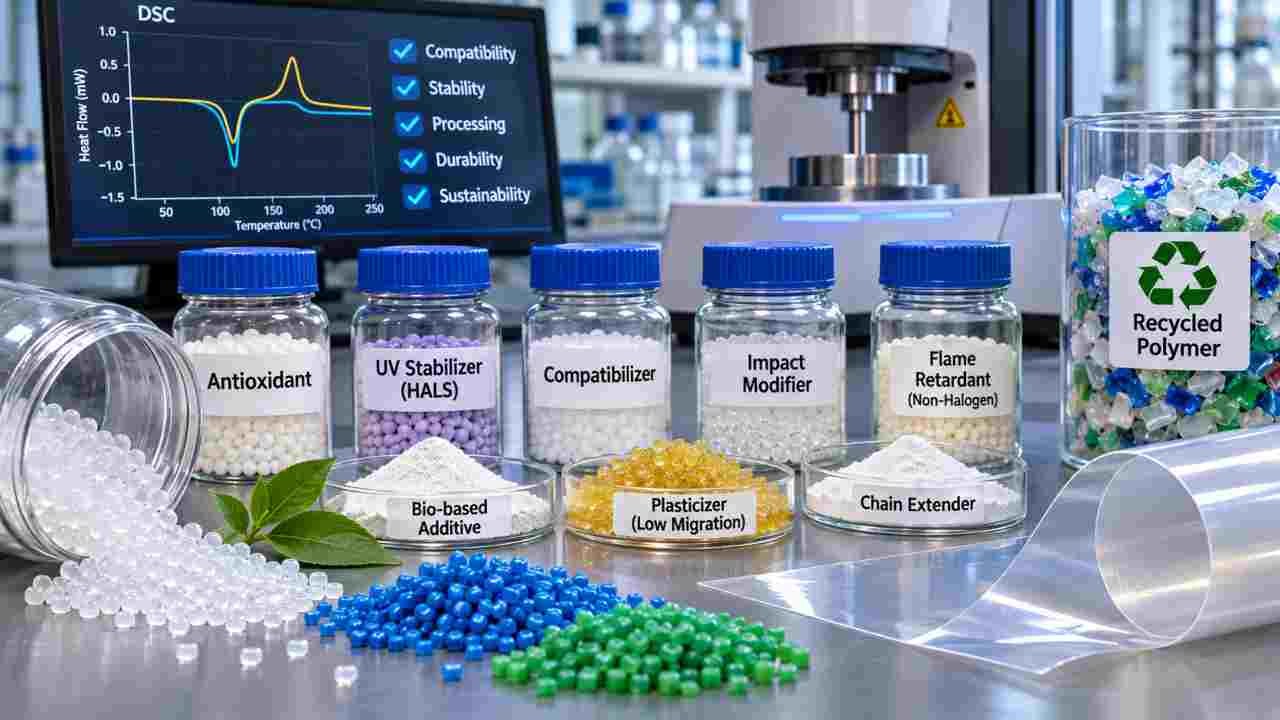
Specialty additives play a decisive role in determining whether sustainable polymer formulations achieve the mechanical, processing and durability requirements of commercial applications. From recycled polypropylene and polyethylene to bio-based polyesters and advanced polymer blends, even relatively small additive concentrations can significantly influence performance.
The challenge becomes more complicated when conventional additives are replaced with renewable, lower-migration or environmentally preferred alternatives. A stabilizer that performs well in virgin polymer may behave differently in recycled material containing residual additives and degradation products. A bio-based plasticizer may improve flexibility while changing migration behavior, thermal resistance or aging stability.
These interactions are not always apparent from initial mechanical testing. Formulations can meet early performance specifications yet subsequently develop blooming, discoloration, inconsistent processing or accelerated property loss.
Developing reliable specialty additive systems therefore requires understanding compatibility, dispersion, chemical interactions and long-term stability alongside the environmental objectives of the finished polymer.
1. Specialty Additives Must Be Selected Around Polymer Failure Mechanisms
An effective additive strategy begins by identifying the specific mechanisms responsible for unacceptable material performance.
For polypropylene, repeated processing and environmental exposure can cause oxidative degradation and molecular-chain scission. Antioxidant selection must address both melt-processing stability and longer-term resistance to oxidation. Recycled polypropylene may require a different stabilization package because some protective additives have already been consumed during its previous processing and service history.
Polyethylene formulations intended for outdoor applications introduce additional requirements involving ultraviolet exposure, oxidation and additive retention. Polyesters such as polyethylene terephthalate (PET) and polylactic acid (PLA) can be susceptible to hydrolytic degradation, particularly under processing conditions involving moisture and elevated temperatures.
Specialty additives therefore serve different functions depending on the chemistry and history of the polymer.
A chain extender may improve the melt strength of degraded polyester through reactions involving available functional end groups. The same chemistry can produce excessive viscosity development, branching or unwanted side reactions if its concentration and reaction conditions are poorly controlled.
Similarly, an impact modifier may improve toughness but affect stiffness, heat resistance or compatibility with the surrounding polymer.
Formulation development should begin with a defined material deficiency and measurable performance targets, followed by additive selection based on the mechanism involved.
2. Compatibility Limits Explain Migration, Blooming and Phase Separation
Additive compatibility is frequently underestimated during material selection. An additive may dissolve or distribute adequately at processing temperature but become less compatible as the polymer cools or crystallizes.
When the concentration exceeds the solubility limit under service conditions, phase separation can occur. Some additives migrate toward the polymer surface, producing blooming, surface deposits or changes in appearance.
The process depends on additive–polymer interactions, molecular size, concentration, diffusion rate, temperature and polymer morphology.
In semicrystalline polymers, additives are generally accommodated more readily in amorphous regions than in crystalline domains. Changes in crystallinity may therefore influence additive availability and redistribution during aging.
These effects are especially important for stabilizers, lubricants, plasticizers and other relatively mobile formulation ingredients. Surface migration can compromise appearance, adhesion, printing, coating performance or retention of the intended additive function.
A low-migration additive should not automatically be considered universally compatible. Increasing molecular weight or chemically attaching an additive to a polymer may reduce mobility, but can also alter dispersion, reactivity and the distribution of functional groups.
Compatibility screening should combine formulation observations with suitable thermal analysis, surface examination and aging studies. Where migration presents a safety or application concern, chemical identification and quantitative analysis may also be necessary.
An additive that remains visually stable after extrusion has not necessarily demonstrated acceptable long-term retention.
3. Dispersion Quality and Processing History Determine Additive Effectiveness
Even chemically suitable additives can perform poorly when their distribution within the polymer is inconsistent.
Mineral fillers, functional pigments and flame-retardant particles may form agglomerates that behave differently from individually dispersed particles. Large agglomerates can create stress concentrations, increase surface defects and reduce the efficiency of the intended additive.
Dispersion depends on particle characteristics, polymer viscosity, interfacial interactions and the mechanical and thermal conditions applied during compounding.
Masterbatch incorporation can improve additive handling and initial distribution, but the carrier polymer must be compatible with the final formulation. Direct addition can be effective when the equipment and additive characteristics support adequate distributive and dispersive mixing.
Neither approach guarantees uniform incorporation.
Increasing screw speed or kneading intensity may improve agglomerate breakup, but excessive shear and thermal exposure can accelerate polymer degradation or damage sensitive additive structures. Residence-time distribution and temperature history may be as important as nominal barrel-temperature settings.
A meaningful compounding evaluation should include melt-rheology measurements, microscopic examination where appropriate, and mechanical testing of material sampled under representative processing conditions.
When comparing formulations, engineers should also consider additive incorporation efficiency and whether changes in the manufacturing process alter the effective concentration of the active component.
4. Additive Synergy and Antagonism Can Change Long-Term Stability
Commercial polymer formulations commonly contain several stabilizers and performance modifiers. Their combined behavior cannot always be predicted from individual additive evaluations.
Primary antioxidants, including sterically hindered phenols, interrupt oxidation reactions by reacting with radical species. Secondary antioxidants, particularly phosphites, can decompose hydroperoxides formed during oxidation. Appropriately selected combinations can provide complementary protection during processing and service.
However, additives can also interfere with one another.
Certain hindered amine light stabilizers (HALS) may interact unfavorably with acidic components, potentially reducing stabilization effectiveness. Similar concerns can arise when flame-retardant packages, fillers or degradation products alter the chemical environment surrounding other formulation ingredients.
Inorganic flame retardants may require relatively high loading levels, affecting melt viscosity, mechanical properties and dispersion. Phosphorus- and nitrogen-based alternatives can offer different flame-retardant mechanisms, but their processing stability and interactions with the polymer still require evaluation.
The selection of non-halogenated or bio-derived additives should therefore be based on verified technical performance rather than chemical classification alone.
A practical investigation compares individual additives with their proposed combinations using consistent processing and aging conditions. Differences in oxidation induction behavior, mechanical-property retention, discoloration and surface condition can help identify beneficial or unfavorable interactions.
These results can reveal why replacing one formulation ingredient changes the behavior of an otherwise established additive package.
5. Processing Stability and Accelerated Aging Require Different Evidence
A formulation that survives a single extrusion operation may not maintain its properties during repeated processing or extended service.
Melt flow measurements provide a useful indication of processability and changes in polymer molecular characteristics. However, an acceptable melt flow rate does not establish sufficient resistance to oxidation, hydrolysis or weathering.
Differential scanning calorimetry can help investigate crystallization behavior and, where appropriate, oxidation induction characteristics. Thermogravimetric analysis provides information about mass loss under controlled thermal conditions, while spectroscopy and mechanical testing can help characterize degradation and property changes.
For recycled materials, controlled reprocessing studies can reveal changes in melt viscosity, color, tensile behavior and stabilization effectiveness.
Long-term durability requires additional testing based on the intended service environment. Ultraviolet exposure, thermal aging, humidity and chemical contact may produce different degradation mechanisms and should not be treated as interchangeable.
Accelerated aging results also require careful interpretation. A material that performs well under one elevated-temperature exposure condition may behave differently under combined sunlight, moisture and mechanical stress.
The objective is to establish whether the additive package retains its intended functionality under representative processing and service conditions.
Testing should include appropriate reference formulations, repeat measurements and an assessment of property changes rather than relying exclusively on initial performance values.
6. Sustainable Additive Selection Must Account for Circularity and Supplier Variability
Sustainability-focused polymer development introduces requirements that extend beyond conventional material performance.
Bio-based origin does not automatically establish biodegradability, low toxicity or a reduced carbon footprint. Similarly, a recycled-content formulation is not necessarily suitable for repeated recycling if its additive package interferes with subsequent processing, creates contamination concerns or compromises product quality.
Plasticizers, stabilizers, compatibilizers and flame retardants can influence end-of-life behavior in different ways.
For example, a compatibilizer may improve mechanical performance in a mixed recycled-polymer formulation, but the resulting material must still be evaluated for its intended recycling pathway. A biodegradable polyester formulation modified with a specialty additive requires relevant testing before claims concerning biodegradation or compostability can be justified.
The OECD's 2026 report on chemical-content validation of recycled plastics emphasizes the importance of chemical identification, traceability and suitable analytical controls for recycled materials.
These considerations become especially important when suppliers change additive grades or when recycled feedstock originates from variable sources.
Differences in active content, carrier resin, particle-size distribution, residual impurities or stabilizer composition can affect the final formulation even when products are marketed for the same function.
A practical qualification procedure should therefore examine supplier specifications, formulation tolerance, processing variability and performance after aging. Environmental claims should be substantiated separately, using appropriate methods and standards such as ISO 14021:2026 for applicable self-declared claims.
Sustainable additive substitution is most successful when performance, chemical safety, manufacturing consistency and environmental objectives are evaluated together.
From Additive Selection to Reliable Polymer Formulation
Developing advanced specialty additive packages requires a detailed understanding of how individual ingredients behave within the complete polymer formulation.
Compatibility limits, dispersion quality, stabilizer interactions, migration and long-term degradation can determine whether an apparently promising material delivers consistent results in commercial use.
For polymer formulators, compounders and R&D teams working with recycled, bio-based or conventional polymers, the central challenge is making defensible additive decisions that satisfy technical requirements without introducing unacceptable durability or sustainability trade-offs.
These formulation challenges are addressed directly in the dedicated OnlyTRAININGS program on specialty additive compatibility, stability and performance control.
ONLYTRAININGS | ADVANCED TECHNICAL TRAINING
Specialty Additives in Polymer Formulations | Compatibility and Stability Control Training
Control Additive Interactions. Improve Formulation Stability. Make Better Sustainability Decisions.
Strengthen your ability to design and evaluate specialty additive packages for reliable polymer performance.
The expert-led training covers:
Compatibility limits, phase behavior and early instability indicators.
Dispersion control, agglomeration, masterbatch selection and shear sensitivity.
Additive synergy, antagonism and unwanted chemical interactions.
Migration, blooming, surface defects and long-term property changes.
Processing stability, thermal survivability and supplier variability.
Balancing durability, cost and sustainability when replacing conventional additives.
Designed for: Polymer R&D scientists, formulation chemists, compounders, processing engineers, technical managers and product-development professionals.
EXPLORE THE TRAINING & REGISTER
Includes a shareable, verifiable certificate for your professional records, plus 6-month full training access, practical toolkits, downloadable materials and 24/7 expert connect.
Technical References
Functional Bio-Based Additives for Sustainable Polymers: A Systematic Review of Processing and Performance Enhancers. 2026. Reviews bio-based stabilizers, plasticizers, compatibilizers and functional additives. Read research.
Advances in Nonreactive Polymer Compatibilizers for Commodity Polyolefin Blends. Chemical Reviews, 2024. Examines additive design and performance in mixed polyolefin systems. Read research.
Elucidating Pathways of Polypropylene Chain Cleavage and Stabilization for Multiple Loop Mechanical Recycling. Journal of Polymer Science, 2023. Read research.
Additive Blooming in Polymer Materials: Consequences in the Pharmaceutical and Medical Field. Polymer Degradation and Stability, 2017. Discusses additive solubility, diffusion and surface migration. Read research.
Enhancing the Hydrolytic Stability of Poly(lactic acid) Using Novel Stabilizer Combinations. Polymers, 2024, 16(4), 506. Read research.
Recent Advancements in Masterbatch Filler Technology and Filler Dispersion for Rubber and Polymer Composites: A Review. Polymer Engineering & Science, 2026. Read research.
OECD. Chemical Content Validation of Recycled Plastics. OECD Series on Risk Management of Chemicals, April 2026. Official report.
ISO. ISO 14021:2026 — Environmental Statements and Programmes for Products: Self-Declared Environmental Claims. Official standard.
A Life-Cycle Based Integrated Framework for Assessing the Sustainability of Plastic Additives. ACS Sustainable Chemistry & Engineering, 2025. Read research.