
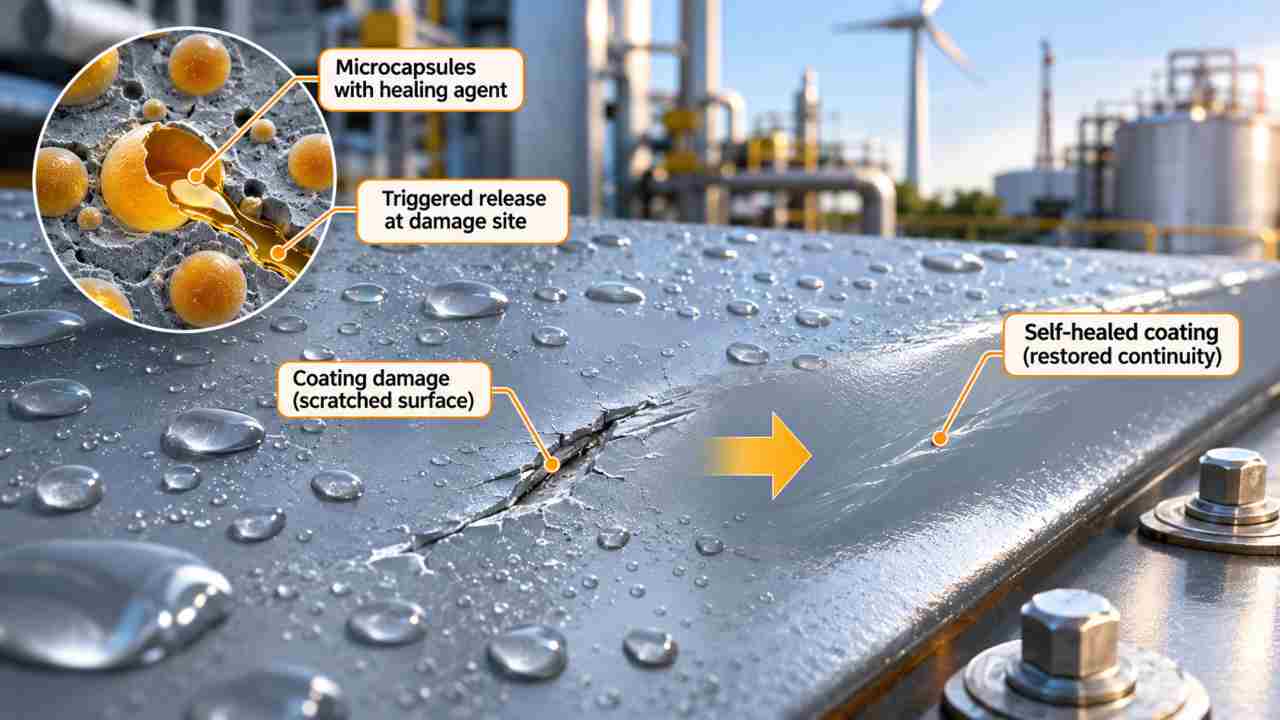
Imagine a corrosion-resistant coating that releases an inhibitor after localized damage. The demonstration looks impressive: a signal appears and protective chemistry reaches the affected region. But what happens beforehand? Will stored paint preserve its payload, or will harmless humidity changes exhaust the functional reservoir?
Smart coatings are not defined by how visibly they respond, but by whether their response is selective, repeatable where necessary, and compatible with their primary protective role. That changes how they should be formulated. Adding a responsive component is only the beginning; the binder, additives, processing conditions and validation strategy determine whether the mechanism provides useful protection.
FORMULATION INSIGHT
Trigger sensitivity is not automatically an advantage. A coating that activates too easily may spend its protective capacity before a damaging event occurs.
1. A useful trigger must discriminate between exposure and actual danger
The first design decision is to identify the event that should cause a functional response. In corrosion protection, local pH changes, moisture ingress or electrochemical activity may be used to release an inhibitor. In a damage-responsive coating, crack formation may rupture a capsule and release a healing agent. Other systems use temperature, light or reversible chemical interactions to change surface or network properties.
These mechanisms have different activation requirements and outcomes. An inhibitor reservoir delivers chemistry, a reversible network seeks to recover continuity, and a self-reporting pigment signals damage without necessarily repairing it.
The practical problem is selectivity. Routine humidity changes should not empty a pH-sensitive container. Define a trigger window: the intended stimulus, its intensity and duration, and conditions that must not activate the system.
A dramatic color change or a visible scratch closure proves only that a response occurred. It does not establish protection, adhesion or acceptable service life.
2. Microcapsules introduce their own failure mechanisms
Extrinsic systems store active ingredients in microcapsules or other reservoirs, releasing them after damage or an environmental trigger while retaining a largely conventional binder.
Yet the reservoir is itself a formulation component. Capsule size, shell strength, payload, distribution and loading influence viscosity, sedimentation, coating thickness, barrier continuity and mechanical properties. Oversized capsules can become defects in thin films; fragile shells may leak during mixing; robust shells may fail to open when damage occurs. An active ingredient also needs enough mobility and an appropriate reaction or inhibition mechanism after release.
Healing is often limited by payload: repeated damage may exhaust the local reservoir. Inhibitor containers also require controlled release rather than an uncontrolled burst.
A useful screening program measures both retained payload before triggering and functional release after triggering. Testing only the damaged specimen overlooks losses during storage, processing and film formation.
3. A reversible network trades recovery against mechanical stability
Intrinsic systems approach the problem differently. Reversible hydrogen bonding, metal–ligand interactions, disulfide exchange or other dynamic bonds can permit a coating network to reorganize. Unlike single-use reservoirs, some intrinsic mechanisms may operate through multiple recovery cycles, provided the chemistry and service conditions support them.
Molecular mobility can reconnect damaged interfaces but also reduce hardness, creep resistance or chemical resistance. Heat-assisted healing may be too slow at ambient conditions; water-assisted mechanisms can compete with swelling and adhesion loss.
For this reason, scratch closure, recovered mechanical strength and recovered barrier function are separate measurements. A closed surface can still have an electrochemically accessible pathway beneath it. A harder film may resist scratches but lack the chain movement needed for repair.
Protective steel coatings, flexible polymer coatings and interior finishes require different healing criteria.
4. Conventional additives can interfere with the smart mechanism
A responsive component rarely enters a clean polymer-only system. Industrial coatings contain pigments, fillers, dispersants, defoamers, rheology modifiers, coalescents, catalysts and other ingredients that affect both application and final performance.
Surfactants may alter capsule wetting or the permeability of a container shell. Pigment surfaces can adsorb functional molecules or change the local chemistry surrounding a responsive particle. Fillers may change crack paths, while catalysts and cure conditions affect the available mobility of a reversible binder. Sedimentation control that works for a standard pigment package may not maintain a uniform distribution of larger, lower-density capsules.
A homogeneous-looking batch can still exhibit shifted trigger thresholds or release kinetics.
Compatibility should be evaluated as functional retention, not merely as absence of separation. Compare the same base coating with and without the active system, and then challenge realistic combinations of additives. Track viscosity, dispersion quality, film defects and the specific trigger response rather than treating each property independently.
5. Production sequence determines what survives into the cured film
Processing choices can silently rewrite the formulation. High-shear dispersion may be suitable for breaking pigment agglomerates, yet damage a preformed capsule shell. A sensible sequence may require dispersing the conventional pigments first, then incorporating a sensitive reservoir at a controlled shear level. The exact order depends on the chemistry, particle strength and equipment.
Film formation creates a second set of constraints. Drying temperature, curing chemistry and solvent or water removal can affect active-agent stability and the structure of the surrounding binder. A thin film may not contain enough reservoir material to respond reliably; a thick application may change transport distances or cure uniformity. Spray application can impose very different flow and impact conditions from a carefully cast laboratory film.
Storage stability is equally important. A formulation may retain its nominal viscosity while capsules settle, payload leaks or the release mechanism ages. Shelf-life evaluation should include a post-storage functional test, not just appearance and viscosity checks.
The goal is a repeatable functional architecture, not merely an acceptable-looking coating.
6. The test must prove protection, not just responsiveness
Demonstrating activation is the first stage of qualification. The next is determining whether the response improves a measurable performance requirement relative to an appropriate control. For corrosion-protection coatings, useful evidence can include scribed-panel degradation, adhesion retention and electrochemical behavior before and after relevant exposure.
ASTM D1654-24 provides a method for evaluating painted or coated specimens after corrosive exposure, including damage around a scribe. ISO 16773-2:2016 provides guidance for electrochemical impedance spectroscopy data collection. Neither standard independently certifies a self-healing claim, and a change in impedance cannot be assumed to reveal a single mechanism without suitable controls and interpretation.
An effective validation plan distinguishes four questions:
Decision | What must be demonstrated | Common misleading shortcut |
|---|---|---|
Does it activate selectively? | Response under the intended trigger, little unintended release | Showing one dramatic activation image |
Does it restore a useful property? | Barrier, mechanical or corrosion benefit versus control | Equating visual scratch closure with protection |
Does the effect survive normal use? | Function after conditioning, aging and repeated exposure where relevant | Testing only freshly prepared specimens |
Can production reproduce it? | Comparable response after realistic mixing, application and curing | Testing only hand-prepared laboratory films |
Compare the smart system against an otherwise relevant conventional coating, not just bare metal. Thickness, pigment concentration or binder differences can otherwise masquerade as a smart-function benefit.
7. The right response is sometimes no smart function at all
A smart additive brings cost, supply requirements, formulation constraints and validation obligations. Those burdens can be justified where repair access is difficult, early warning is valuable, or localized damage is a dominant failure route. They are harder to justify when a conventional, well-qualified protective system already meets the required service life.
Define the benefit: reduced underfilm corrosion, retained function, fewer maintenance interventions or meaningful early warning. Complexity without a measurable advantage is not better protection.
Design for restraint before designing for response
The most credible smart coating is not the one that reacts fastest in a demonstration. It is the coating that stays stable when nothing is wrong, responds sufficiently when the relevant damage occurs, and continues to meet the requirements of the original protective film.
Trigger control, matrix compatibility, process survival and comparative validation are what turn an interesting mechanism into a technically defensible coating system.
ONLYTRAININGS | ADVANCED TECHNICAL TRAINING
Smart Coatings Formulation: Designing Self Healing and Responsive Systems for Industrial Performance
Build responsive coating functionality without sacrificing stability, application performance or long-term protection.
This expert-led on-demand training covers:
Choosing between microcapsule healing, reversible polymer networks and corrosion-triggered release mechanisms.
Designing binder–additive compatibility and controlling premature activation, sedimentation and phase separation.
Managing shear-sensitive ingredients, mixing order, film thickness and application constraints.
Establishing trigger sensitivity, practical performance tests and repeatable production controls.
Evaluating whether smart functionality delivers a measurable industrial advantage.
EXPLORE THE TRAINING & ACCESS THE COURSE
The course page lists six-month on-demand access, downloadable presentation, Q&A and FAQ materials, a training certificate and expert discussion-forum access.