
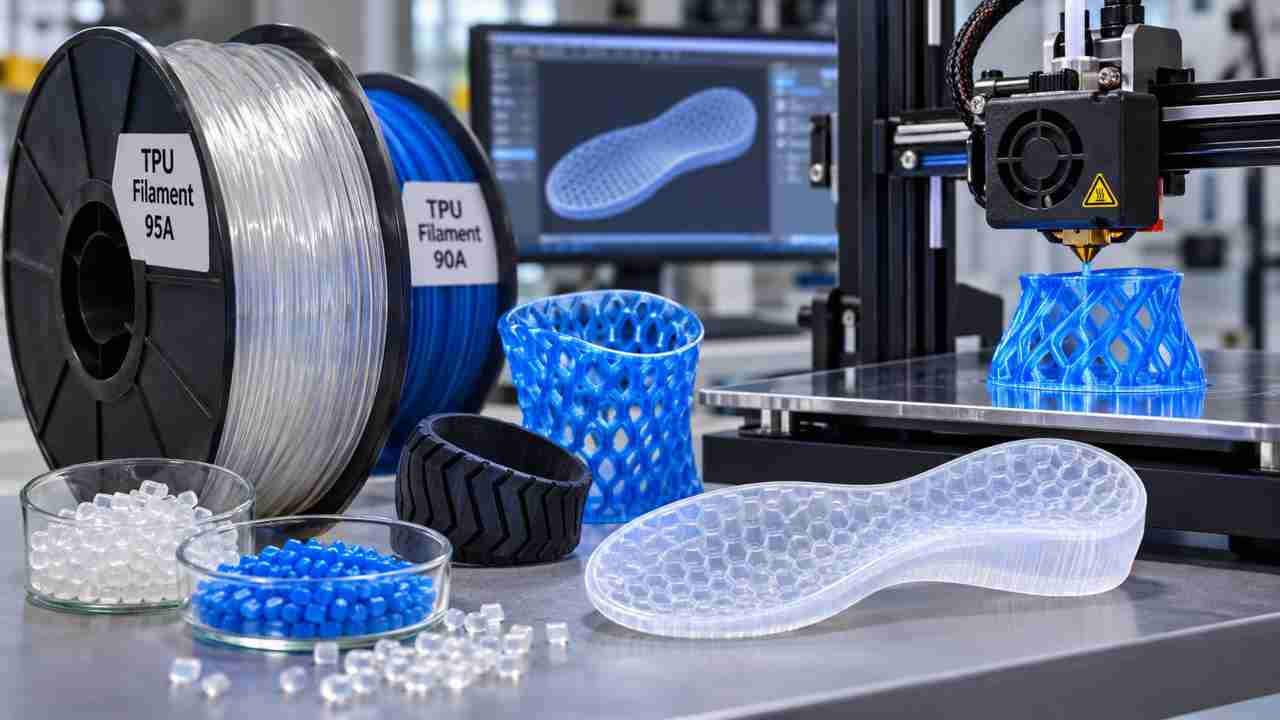
Thermoplastic polyurethane (TPU) has established an important position in material extrusion 3D printing, particularly where printed components require flexibility, impact absorption, abrasion resistance and repeated deformation. Flexible protective components, footwear structures, seals, cushioning elements and industrial prototypes are among the applications benefiting from its combination of elasticity and thermoplastic processability.
Yet developing reliable TPU filament involves substantially more than selecting a nominal Shore hardness and identifying a suitable printing temperature. The material must be sufficiently compliant in the finished component while retaining enough filament stiffness for controlled feeding. Its melt must flow through a small nozzle without excessive pressure, but also maintain stable deposition and interlayer bonding.
These requirements create competing formulation and processing demands. Polymer chemistry, molecular weight, additives, extrusion conditions, moisture management and printer architecture collectively determine whether a TPU grade becomes a dependable filament or a source of inconsistent printing performance.
1. TPU Chemistry Determines More Than Filament Hardness
TPU consists of relatively flexible soft segments and more rigid hard segments whose physical associations provide strength and elastic recovery. The chemistry, concentration and distribution of these segments influence hardness, tensile behavior, melt viscosity, thermal transitions and recovery after deformation. Two TPU formulations displaying similar Shore A hardness may therefore behave differently during filament extrusion and printing.
Polyester-based TPU grades can offer attractive mechanical strength, abrasion resistance and oil resistance, while polyether-based systems are often preferred where hydrolysis resistance and low-temperature flexibility are important. These are general tendencies rather than universal performance guarantees. Molecular architecture, additive packages and specific grade design remain decisive.
The distinction becomes particularly significant when selecting between TPU 95A, TPU 90A and softer materials. Reducing hardness may improve compliance, but it can also reduce the compressive stiffness needed for reliable feeding. A filament that performs well in a direct-drive printer may buckle or deform in a feeding system with a longer unsupported path.
Consequently, hardness should be treated as one material-selection variable, supported by tensile modulus, elastic recovery, thermal characterization and melt-rheology measurements. The objective is to define the mechanical and processing behavior needed for the intended printer and component rather than assuming that Shore hardness alone predicts printability.
2. Balancing Melt Flow, Filament Stiffness and Printing Speed
Melt rheology is among the most influential characteristics of TPU filament development. A higher-viscosity formulation may generate excessive nozzle pressure, particularly when faster material deposition is required. Conversely, reducing viscosity can improve flow while introducing greater sensitivity to uncontrolled extrusion, stringing and dimensional instability.
Melt flow rate provides a useful preliminary screening measurement, but it does not describe the complete material response. TPU melts are shear-dependent and viscoelastic, meaning that their behavior under filament extrusion conditions may differ considerably from their behavior inside a printer nozzle. Melt elasticity, relaxation behavior and the viscosity response across relevant shear rates deserve attention alongside conventional melt flow measurements.
For high-flow TPU intended for faster printing, the required volumetric throughput must be considered together with the printer's melting capacity and feeding mechanism. Greater throughput requires stable filament transport, sufficient heat transfer and consistent material deposition. A nominally high-flow grade does not automatically provide reliable high-speed printing.
Developers should therefore compare candidate formulations under controlled combinations of nozzle temperature, volumetric flow, printing speed and retraction settings. Recording extrusion-force behavior, bead continuity and the occurrence of feeding interruptions helps distinguish insufficient melt flow from mechanical filament instability.
This distinction prevents unnecessary formulation changes when the underlying problem originates from the printer's feed path.
3. Functional Additives Introduce Additional Formulation Trade-Offs
The expanding use of flexible 3D-printed components is increasing interest in TPU filaments with additional functionality. Conductive compounds, reinforced elastomers, flame-retardant formulations and specialty performance grades introduce opportunities that cannot be achieved through neat TPU alone.
However, functional additives change more than the targeted property. Carbon black, graphene and carbon nanotubes may create electrically conductive networks when adequate dispersion and loading are achieved. Their incorporation can also alter melt viscosity, filament stiffness, extrusion pressure and elastic recovery. Electrical performance may additionally depend on filler orientation and the continuity of conductive pathways within printed layers.
Short carbon fibers or mineral reinforcements may increase stiffness or dimensional stability but can compromise flexibility and affect nozzle wear, surface finish and bonding between deposited roads. Flame-retardant additives may introduce further processing constraints and require separate validation of the intended fire-performance claim.
Compounding studies should therefore examine dispersion quality, thermal stability, rheology and mechanical behavior before progressing to filament production. Functional performance must ultimately be verified in printed components, not inferred solely from pellet or molded-plaque properties.
4. Filament Extrusion Requires Control Beyond Diameter
Manufacturing TPU filament introduces processing challenges distinct from those encountered in conventional rigid thermoplastics. A typical production line includes material drying, melt extrusion, die discharge, controlled cooling, diameter measurement, haul-off and winding. Each stage can influence the consistency of the finished filament.
Die temperature and melt-pressure stability affect the extrudate, while cooling conditions influence shrinkage and solidification. Puller speed controls drawing and final dimensions. With flexible materials, excessive pulling or winding tension can introduce deformation that becomes apparent during spool storage or subsequent printing.
Diameter measurements alone are insufficient. Filament ovality, localized surface defects, bubbles and changes in cross-sectional area can interfere with feeding and alter the amount of polymer delivered to the nozzle. Two filaments with similar average diameter may therefore exhibit substantially different printing consistency.
Inline laser measurements of two perpendicular dimensions, combined with controlled haul-off and winding, can improve dimensional monitoring. Process qualification should include measurements from different production intervals and locations within a spool, rather than relying on a single average value.
Extrusion developers should also evaluate filament compression, spool unwinding behavior and dimensional recovery after storage. A geometrically acceptable filament that repeatedly deforms under feeder pressure is not necessarily suitable for reliable production printing.
5. Moisture Management Is Essential for TPU Processing
TPU is hygroscopic, and moisture can affect both filament manufacturing and subsequent 3D printing. During melt processing, absorbed water can cause bubbles, pressure fluctuations and surface defects. Under sufficiently severe thermal and moisture conditions, hydrolytic degradation may reduce polymer molecular weight and change its rheological and mechanical properties.
Moisture-related printing problems can appear as inconsistent extrusion, voids, stringing or reduced mechanical performance. Published investigations have demonstrated that absorbed moisture and filament feeding behavior can contribute independently to under-extrusion, making troubleshooting more complicated than simply changing nozzle temperature.
Drying recommendations must be selected for the particular TPU chemistry and commercial grade. Temperature, duration, airflow, initial moisture content and equipment configuration all influence the result. Excessively aggressive drying can create additional risks, particularly if spool materials or filament dimensions are not compatible with the selected temperature.
A reliable control procedure distinguishes pellet drying before filament extrusion from filament conditioning before printing. Moisture measurement, protective packaging and controlled storage should be included in qualification studies. Where practical, comparing freshly dried filament with deliberately conditioned material can help establish the sensitivity of print quality to environmental exposure.
6. Printed-Part Testing Must Verify the Complete Material–Process Combination
A successful filament extrusion trial does not establish that the resulting TPU will perform satisfactorily in service. Printed components have deposited roads, interfaces and geometries that can produce mechanical behavior different from conventionally molded specimens.
Layer adhesion is particularly important. Insufficient thermal contact or poor interfacial fusion can create weak regions, while excessive processing temperatures may encourage degradation, dimensional distortion or uncontrolled flow. Printing orientation, raster arrangement, layer thickness, speed and cooling conditions can influence tensile properties and deformation behavior.
A qualification program should address four connected performance areas:
Filament quality: Diameter variation, ovality, moisture content, surface integrity and feeding consistency.
Processing behavior: Extrusion stability, stringing, throughput capability and a reproducible printing window.
Mechanical performance: Tensile strength, elongation, tear behavior, elastic recovery and interlayer adhesion.
Application durability: Cyclic loading, compression behavior, environmental conditioning and retention of required properties.
Testing should use appropriate standardized methods wherever applicable, with the test geometry, conditioning and printing orientation reported clearly. Shore hardness, tensile strength and elongation values should not be compared without considering specimen preparation and testing conditions.
For flexible components exposed to repeated deformation, cyclic response and permanent set may be more informative than a single tensile-strength result. Likewise, a formulation showing excellent bulk elongation may still fail prematurely if deposited interfaces are weak.
Recent investigations into printed TPU have reinforced the importance of processing conditions and build architecture in determining mechanical performance. The practical task is therefore to qualify the polymer formulation, manufactured filament, printer configuration and finished component as a connected system.
Turning TPU Material Development Into Reliable Printing Performance
Reliable flexible 3D printing requires coordinated decisions across polymer selection, melt rheology, compounding, filament extrusion and printed-part validation. Improving one characteristic in isolation can introduce unwanted changes elsewhere. Softer filament may complicate feeding, higher melt flow may affect deposition stability, and functional additives can alter both elasticity and bonding.
For formulation scientists and extrusion engineers, the greatest opportunities arise from understanding these interactions before committing to a particular material design or production process.
This is the technical focus of the OnlyTRAININGS program dedicated to TPU filament formulation and flexible 3D printing, which connects material chemistry and compounding decisions with the practical challenges encountered during filament production and printing.
ONLYTRAININGS | ADVANCED TECHNICAL TRAINING
TPU Filament Formulation & Flexible 3D Printing Training
Develop a stronger technical understanding of how TPU chemistry, processing and filament design influence printability.
The expert-led program covers:
TPU 95A, 90A and softer filament formulation.
High-flow TPU development for faster printing.
Functional additives, reinforcement and compounding.
Filament extrusion, diameter control and moisture management.
Troubleshooting feeding, stringing, under-extrusion and layer adhesion.
EXPLORE THE TRAINING & REGISTER
Includes six-month training access, downloadable learning materials, a verifiable training certificate and expert interaction through the discussion forum.
Technical References
Sola, A. (2022). Materials Requirements in Fused Filament Fabrication: A Framework for the Design of Next-Generation 3D Printable Thermoplastics and Composites. Macromolecular Materials and Engineering. Read research.
Processing of Polyester-Urethane Filament and Characterization of FFF 3D Printed Elastic Porous Structures with Potential in Cancellous Bone Tissue Engineering. Materials, 2020. Read research.
Under-Extrusion Challenges for Elastic Filaments: The Influence of Moisture on Additive Manufacturing. Progress in Additive Manufacturing, 2022. Read research.
Additive Manufacturing of Flexible Thermoplastic Polyurethane (TPU): Enhancing the Material Elongation Through Process Optimisation. Progress in Additive Manufacturing, 2025. Read research.
Structural and Viscoelastic Properties of Thermoplastic Polyurethanes Containing Mixed Soft Segments. Polymers, 2021. Read research.
Prusa Research. Flexible Materials: Printing Requirements and Troubleshooting. Technical guidance.
Prusa Research. Prusament TPU 95A Material Guide. Technical guidance.