
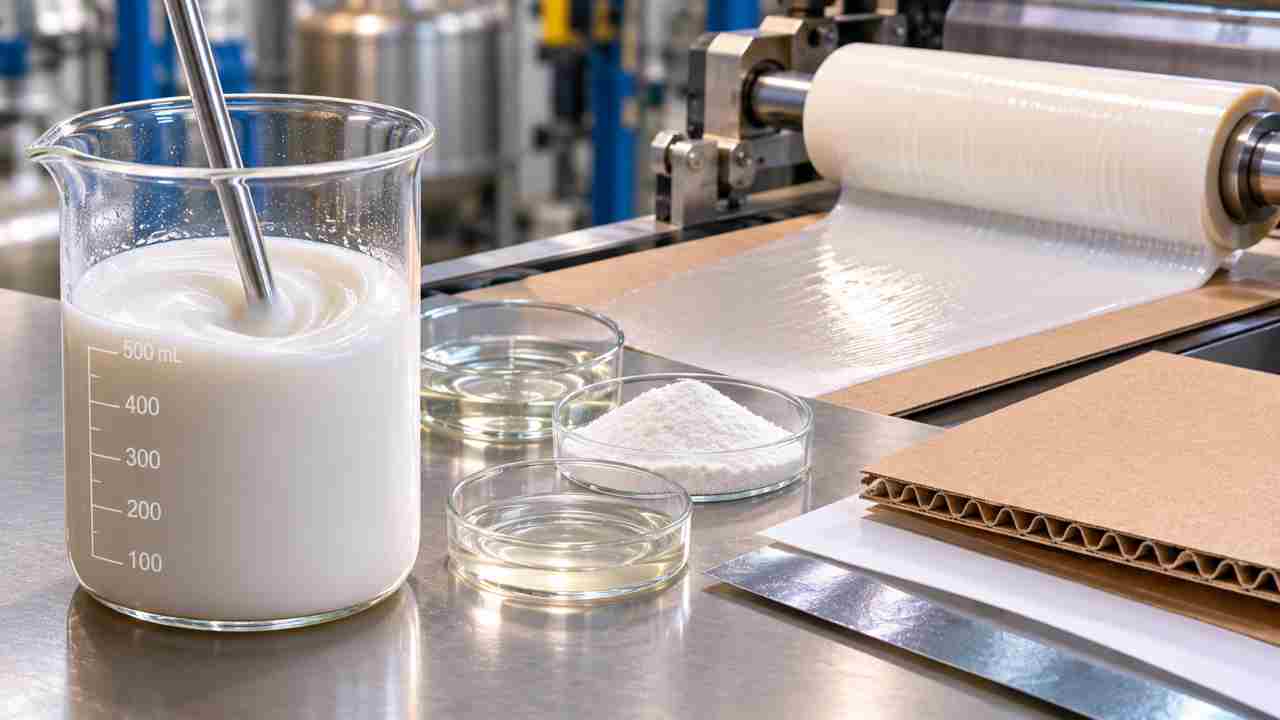
A water-based adhesive can achieve an impressive peel result and still be difficult to coat, slow to set, vulnerable to humidity or unstable in its storage container. Adding a stronger polymer rarely solves all of those problems. The usable bond is the outcome of a dispersed formulation, an application process and a drying history, not simply the strength of the resin listed on a technical data sheet.
Changing solids, neutralizer, surfactant, thickener or crosslinker can shift several properties at once. Packaging, label and construction adhesives share this challenge, despite different bond mechanics. Identify the limiting step before changing ingredients.
FORMULATION INSIGHT
Improving one laboratory bond value is not the same as improving the operating window. Control the wet adhesive, drying process and conditioned bond together.
1. Start with the required bond, not the polymer label
PVAc and vinyl acetate–ethylene (VAE) dispersions, acrylic latexes, polyurethane dispersions, polychloroprene systems and natural-polymer binders can all be water-based, but they are not interchangeable. A carton-sealing adhesive must develop a reliable bond within a machine's compression window; a label pressure-sensitive adhesive must remain tacky after drying; a laminated construction assembly may demand high humidity resistance and controlled flexibility. The correct polymer architecture depends on what the joint must do and when it must do it.
Glass-transition temperature, molecular weight, particle characteristics, functionality and film-forming behaviour influence early contact and later cohesion. Softer acrylic compositions can promote the deformation needed for pressure-sensitive tack, while increasing elastic resistance or crosslink density may improve holding power but compromise easy contact. This is a recognized tension in waterborne acrylic PSA research, not a universal prescription for every waterborne adhesive [1].
Define substrate, dry coat weight, pressure, dwell, setting time and service exposure before screening formulations. A stronger film on glass may not solve wetting on printed film or rapid paperboard bonding.
2. Wetting agents can improve coating and weaken the finished interface
An aqueous dispersion must spread on the actual substrate quickly enough for the coating or bonding operation. Static surface tension is only part of that picture. At high line speeds, dynamic wetting, contamination, surface treatment and the time available for air to escape also matter. Poor wetting can appear as skips, edge retreat, craters or inadequate contact despite acceptable viscosity [2].
Surfactants stabilize many latex particles and may help reduce surface tension, but free mobile species can migrate during drying. Depending on composition and location, they may contribute to moisture sensitivity or reduce interfacial performance [3]. Adding a wetting agent therefore needs a second question: what happens after the water evaporates? Evaluate both initial coverage and conditioned adhesion, particularly on films, metallized surfaces or humid-service assemblies. Where the substrate carries an ink, primer, release treatment or ageing-related contamination, test the actual production stack. A freshly treated laboratory coupon can make a marginal formulation look more robust than the end-use joint.
Recirculation, pumping and mixing can entrain air. Defoamers can disrupt bubbles but may cause surface defects at unsuitable dosage. Evaluate foam under actual agitation, and keep pH and ionic strength within the latex–thickener stability range.
3. Higher solids change the drying load and the coating behaviour
Solids content deserves quantitative attention because water removal can become the rate-limiting operation. For an illustrative 15 g/m² dry adhesive coat, a formulation at 50% nonvolatile content requires approximately 30 g/m² wet application, carrying 15 g/m² of water and other volatile material. At 60% solids, the same dry coat needs 25 g/m² wet application and carries approximately 10 g/m² of volatile material. That is one-third less material to evaporate, assuming the stated solids are accurate and volatiles are predominantly water.
This does not imply one-third faster drying: airflow, humidity, heat transfer and substrate absorption still matter. Higher solids can also change levelling, pump demand and foam. Porous substrates absorb some water; impermeable films require evaporation. US EPA process assessments document these trade-offs [2].
Track solids, wet and dry coat weight, and drying endpoints together. Verify application-shear viscosity and substrate temperature limits before changing dryer settings.
4. The bond must form while the water leaves
In a latex system, drying first concentrates particles; particle deformation and polymer-chain interdiffusion then contribute to a coherent film where the chemistry permits it. Minimum film-formation temperature (MFFT) is one practical screening variable, but it is neither a universal bond-strength predictor nor equivalent to the polymer's glass-transition temperature. ASTM D2354 addresses the temperature at which emulsion vehicles form continuous films [4]. Colloid research also emphasizes particle mechanics and the dynamics of film formation [5].
Cold substrates, rapid surface drying or unsuitable coalescents can interrupt film continuity. More plasticizer may improve formation but alter modulus, blocking and water resistance. The optimum differs for tacky films, fast-setting joints and crosslinked networks.
Study open time, wet tack, green strength and fully conditioned strength as separate events where relevant. For a paperboard bond, the useful window may be governed by penetration, water removal and compression time. For a dried pressure-sensitive label, adhesion may instead develop through contact under light pressure. Treating both mechanisms as the same kind of cure can lead to an attractive but misleading test programme.
5. Water resistance begins before the durability test
A waterborne adhesive is not automatically water-sensitive after drying, nor is a water-resistant polymer enough to guarantee a durable bond. Mobile surfactants, hydrophilic stabilizers, incomplete film formation, substrate swelling and unreacted additives can all contribute to moisture-related performance changes. Crosslinking or polymer modification may help, but excessive network formation can reduce flexibility, wetting or pressure-sensitive response [3, 6].
A well-designed comparison separates dry strength, humidity-conditioned strength and strength after relevant liquid-water exposure. Record failure mode as well as force: interfacial release, cohesive splitting and substrate tearing imply different next experiments. Do not compare a briefly conditioned specimen with a fully dried reference and attribute the difference solely to polymer chemistry.
Storage introduces separate risks: freeze–thaw agglomeration, skinning, sedimentation, viscosity drift and microbial spoilage. Evaluate appropriate preservation, closure, temperature and contamination controls instead of adding chemicals without diagnosis [2].
6. Optimize an operating window instead of a single test result
Use a compact design comparing, for example, two polymer blends, solids levels and rheology packages at constant substrate preparation and dry coat weight. Track pH, viscosity, foam, wetting, drying and conditioned adhesion. Avoid changing unrelated additives simultaneously.
Observed problem | Plausible limiting factor | More useful next experiment |
|---|---|---|
Good dry peel but poor humid adhesion | Hydrophilic residues, incomplete film or substrate sensitivity | Conditioned peel plus failure-mode inspection and controlled film-formation check |
Slow setting despite acceptable final strength | Excess drying load, coat weight, poor absorbency or insufficient green strength | Compare dry-coat-matched solids levels, actual water removal and compression dwell |
Pinholes and skips during coating | Air entrainment, dynamic wetting or incompatible defoamer | Run application-speed wetting and recirculation-foam trials on real substrates |
Viscosity increases after storage | pH shift, associative thickener interactions or latex aggregation | Track pH, shear-dependent rheology and particle/coagulum changes over time |
These are diagnostic directions, not automatic root causes. Select bond methods appropriate to the assembly: ASTM D903 or D1876 can support peel comparisons for suitable flexible adherends; ASTM D3330 and D3654 address particular pressure-sensitive tape peel and shear measurements [7–10]. Neither a generic peel number nor a single shear test represents all adhesive types. Keep conditioning, dwell, geometry and failure description visible in the report. Include repeat specimens and more than one production lot: a small change in average peel is not compelling when batch-to-batch scatter exceeds the apparent improvement. For water-exposed specimens, record whether the adherend softened or failed before the adhesive itself.
A change must improve the priority property without shrinking the production window. Confirm with another batch, real application equipment and conditioned bonds. Consider cost, cleaning, wastewater and energy as well as strength.
Strong bonds require a well-controlled path from liquid to service
Optimization coordinates dispersion chemistry, surface contact, water removal, film formation and durability. After every adjustment, ask: which part of the complete bonding process improved, and which part may have become less forgiving?
When wet-state measurements, production conditions and service tests are evaluated together, the formulator gains something more useful than a better laboratory result: a bond that can be made consistently, at the intended speed, on the intended substrates.
ONLYTRAININGS | ADVANCED TECHNICAL TRAINING
Water-Based Adhesives Formulation & Optimization for Maximum Performance
Connect raw-material selection, stability, coating behaviour and end-use performance in this expert-led technical training:
Choose binders and additives for substrate wetting, tack and cohesive strength.
Balance solids, pH, rheology and drying speed without creating coating defects.
Diagnose foam, viscosity drift, separation and storage-related instability.
Evaluate conditioned adhesion, water resistance and practical formulation improvements.
EXPLORE THE TRAINING & ACCESS NOW
The training page offers six-month access, presentation materials, expert-prepared FAQs and Q&A, a verifiable certificate, and an expert discussion forum.
Technical references
Acrylic PSA performance from different preparation processes, Polymers (2021)
US EPA, Solvent-Based to Waterbased Adhesive-Coated Substrate Retrofit, Volume 2
Waterborne Random Copolymers as Polymeric Surfactants for Emulsion Polymerization (2026)
ASTM D2354, Minimum Film Formation Temperature of Emulsion Vehicles
Polymer Colloids: Current Challenges, Emerging Applications and New Developments (2023)
Recent Advances in Combining Waterborne Acrylic Dispersions with Biopolymers, Polymers (2025)
ASTM D903-98(2025), Peel or Stripping Strength of Adhesive Bonds
ASTM D3330/D3330M-04(2025), Peel Adhesion of Pressure-Sensitive Tape
ASTM D3654/D3654M-06(2024), Shear Adhesion of Pressure-Sensitive Tapes
OnlyTRAININGS, Water-Based Adhesives Formulation and Optimization for Maximum Performance