
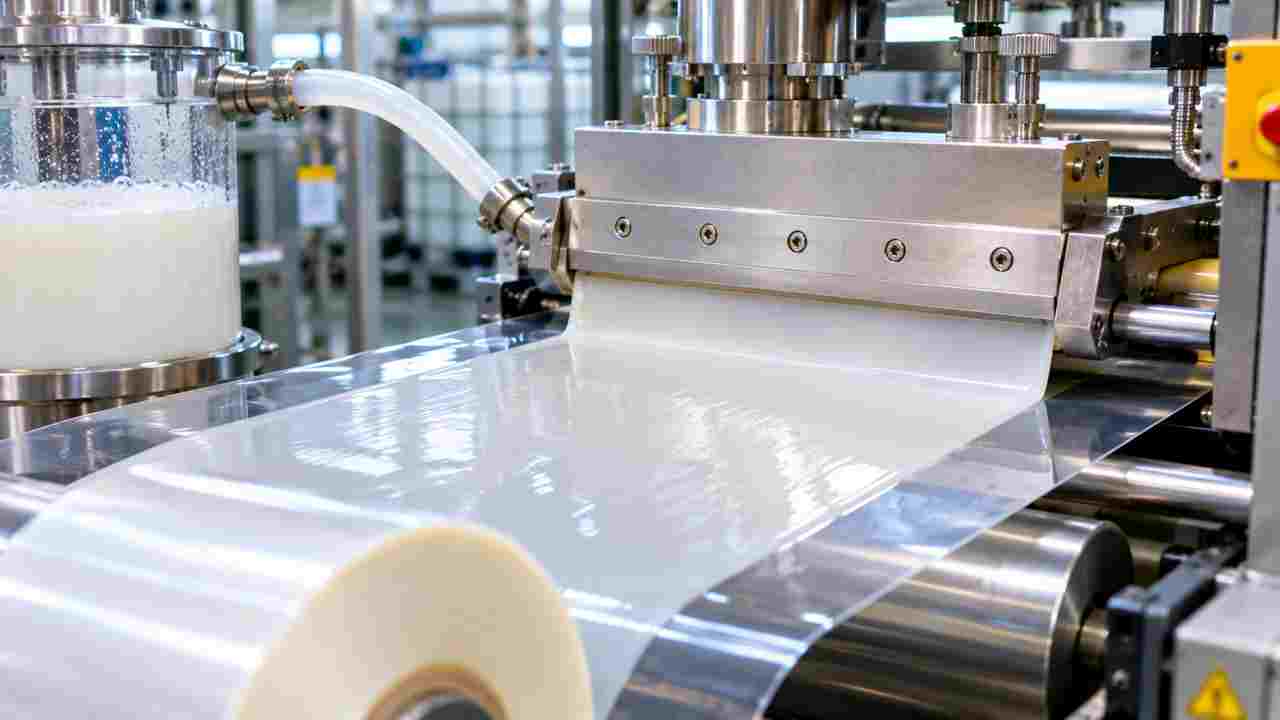
Water-based adhesive formulations can deliver excellent laboratory adhesion, attractive processing viscosity and stable storage characteristics, yet struggle to match solvent-based systems under demanding industrial conditions. The performance difference is often attributed to the presence of water, but the more important question is what happens to the polymer structure as that water disappears.
Unlike a conventional solvent solution containing dissolved polymer, many waterborne adhesives begin as dispersions of discrete polymer particles. During drying, those particles must approach one another, deform and develop sufficient interparticle cohesion to produce a reliable adhesive layer. The quality of this transformation influences bond strength, flexibility, moisture resistance and long-term durability.
A formulation can therefore lose most of its water and still retain structural weaknesses that are difficult to detect through appearance or initial adhesion testing.
For R&D teams developing high-performance waterborne adhesives, achieving solvent-based performance is not simply a matter of finding a stronger polymer. It requires controlling the interactions between dispersion chemistry, film formation, surface wetting, additives and industrial drying conditions.
1. The Adhesive Film Is Created During Water Removal
Film formation is one of the most important differences between polymer-dispersion adhesives and solvent-based adhesive solutions.
In an aqueous polymer dispersion, polymer particles are stabilized by surfactants, ionic groups or other colloidal mechanisms. As water evaporates, the particle concentration increases until the particles become closely packed.
Further water removal promotes particle deformation and, when polymer mobility permits, interdiffusion of polymer chains across particle boundaries. These processes contribute to the formation of a continuous, cohesive material.
The minimum film formation temperature (MFFT) provides an important indication of whether a dispersion can form a coherent film under specified conditions.
However, producing a visually continuous film does not guarantee that adequate mechanical properties have developed. Interparticle boundaries, residual hydrophilic components and insufficient molecular interdiffusion may still influence performance.
Research on latex film formation demonstrates that temperature, relative humidity, polymer glass-transition temperature and particle characteristics affect the transition from a dispersion to a consolidated film.
This means that laboratory drying conditions can produce properties different from those obtained on an industrial coating line.
A formulation that performs satisfactorily at elevated drying temperatures may develop weaker cohesion when applied to a cooler substrate or exposed to restricted drying conditions.
2. Polymer Architecture Determines the Available Performance Window
Water-based adhesive performance begins with the chemical and physical characteristics of the polymer.
Common technologies include acrylic dispersions, vinyl acetate copolymers, vinyl acetate-ethylene systems, styrene-butadiene latexes and polyurethane dispersions. Each provides different opportunities for controlling adhesion, flexibility, film formation and environmental resistance.
Acrylic polymers offer considerable flexibility in monomer selection. Soft monomers contribute mobility and wetting, while harder monomers can improve cohesive strength and resistance to deformation.
However, increasing polymer hardness may reduce low-temperature film formation or limit adhesion to difficult surfaces.
Polyurethane dispersions introduce additional design possibilities through soft-segment chemistry, hard-segment composition, ionic functionality and molecular architecture.
The same hydrophilic groups that enable stable aqueous dispersion may also contribute to water uptake after film formation.
Polymer molecular weight, particle morphology and glass-transition behavior must therefore be evaluated together.
For pressure-sensitive adhesives, low-temperature flexibility and controlled viscoelastic response are essential. Structural bonding applications may instead require substantially greater cohesive strength and resistance to creep.
Selecting the polymer exclusively by its advertised tensile strength, solids content or chemical family is unlikely to identify the optimum formulation.
The important question is whether its molecular structure supports the complete combination of wetting, film formation, bond development and service performance required by the application.
3. Surfactants Can Solve Dispersion Problems and Create Durability Problems
Surfactants are essential components of many emulsion-polymerized adhesive systems because they stabilize polymer particles during manufacturing and storage.
However, their contribution does not necessarily end when the adhesive dries.
Low-molecular-weight surfactants can redistribute during film formation and become concentrated at particle boundaries or exposed interfaces. Depending on their chemistry and concentration, these hydrophilic regions can influence moisture transport, adhesion and mechanical properties.
Research examining waterborne acrylic pressure-sensitive adhesives has identified surfactant-rich interparticle regions as potential pathways for water penetration into dried films.
This creates an important formulation contradiction. Increasing colloidal stabilization can improve manufacturing reliability while introducing components that may reduce the durability of the final adhesive.
Alternative stabilization approaches include polymeric surfactants, reactive surfactants and systems designed to reduce the dependence on mobile low-molecular-weight emulsifiers.
Recent research on polymeric surfactants for waterborne acrylic dispersions highlights opportunities to improve film properties by controlling surfactant mobility.
Nevertheless, these strategies introduce their own considerations involving particle nucleation, polymerization behavior, storage stability and final rheology.
The correct approach is not to remove surfactants indiscriminately, but to evaluate how the complete stabilization system affects both dispersion quality and dried-film performance.
4. Drying Speed and Bond Development Are Not the Same Property
Industrial adhesive processes are often evaluated by line speed, drying temperature and the time required before the bonded assembly can be handled.
Yet rapid apparent drying does not always correspond to optimum bond development.
Water removal depends on temperature, humidity, airflow, coating weight and substrate characteristics. Porous materials such as paperboard can absorb part of the aqueous phase, whereas nonporous films generally require greater reliance on evaporation.
Drying can become more complicated when a dense surface layer develops while moisture remains within the adhesive.
Excessive drying temperatures may also create substrate distortion, uneven film development or defects, depending on the materials and process configuration.
For laminating applications, adhesive-layer thickness and the timing of substrate contact can influence wetting and the subsequent consolidation of the adhesive.
A rheological adjustment that improves coating transfer may alter water distribution, leveling or penetration into porous substrates.
Production engineers should therefore distinguish several events: initial wetting, water removal, development of handling strength and achievement of final bond performance.
These stages may overlap, but they are not interchangeable.
Useful process-development measurements include drying-rate behavior, residual moisture, adhesive-layer temperature, bond-strength development and changes in failure mode at different conditioning times.
5. Crosslinking Can Improve Resistance Without Fixing a Poor Interface
Crosslinking is frequently used to improve the performance of water-based adhesives when conventional dispersion systems cannot provide sufficient heat, moisture or chemical resistance.
Depending on the polymer functionality, suitable technologies may include carbodiimide-based systems, polyisocyanate crosslinkers, epoxy-functional materials and other reactive chemistries.
Crosslinking can reduce molecular mobility and improve the cohesive integrity of the adhesive film.
However, greater crosslink density does not always produce a better adhesive.
Excessive crosslinking can reduce flexibility, increase stiffness or compromise the ability of the adhesive to dissipate stress during peeling and deformation.
For pressure-sensitive applications, this can alter the balance between tack, peel adhesion and shear resistance.
Published research on acrylic pressure-sensitive adhesives demonstrates how crosslink density and viscoelastic characteristics influence shear failure behavior.
Crosslinker compatibility and reaction conditions also matter. Premature reaction may reduce formulation stability or pot life, while inadequate reaction after application can leave the intended durability improvement unrealized.
Crosslinking cannot compensate reliably for poor substrate wetting, contamination or incomplete film formation.
The optimal formulation therefore requires sufficient interfacial adhesion before additional cohesive strength is introduced.
6. Challenging Substrates Expose Waterborne Adhesive Limitations
Water-based adhesives are well established in paper, paperboard and other applications where substrate properties assist wetting or water removal.
Greater formulation challenges can arise with polyethylene, polypropylene, coated films, metallized structures and other substrates with limited surface polarity or moisture permeability.
Polyolefin surfaces generally offer relatively low surface energy, which can restrict the spreading and adhesion of aqueous formulations.
Wetting additives may reduce liquid surface tension, but they can also affect foam behavior, coating defects, interfacial composition and water resistance.
Corona, plasma or other appropriate surface treatments may improve bonding by modifying substrate surface chemistry.
Nevertheless, treatment effectiveness must be assessed under actual manufacturing conditions because surface composition can change during storage and handling.
The difference between paperboard bonding and multilayer flexible-film lamination illustrates why one formulation strategy cannot be applied universally.
On porous substrates, rapid water absorption may favor initial setting. Between relatively impermeable films, insufficient water removal before lamination can create an entirely different processing challenge.
Substrate-specific evaluation should include surface condition, coating weight, application conditions, drying requirements and the mechanisms by which the adhesive develops its final strength.
7. Solvent-Grade Performance Requires More Than a High Bond-Strength Result
Comparing a water-based adhesive with a solvent-based reference requires clearly defined performance requirements.
A formulation may achieve equivalent peel strength under dry laboratory conditions while showing lower resistance after humidity exposure or elevated-temperature aging.
Conversely, a waterborne system may meet the application requirements without reproducing every characteristic of the solvent-based adhesive.
Qualification should therefore consider both initial adhesion and durability under conditions representative of actual service.
ASTM D903 addresses peel or stripping strength of adhesive bonds, while ISO 11339 describes T-peel testing of flexible-to-flexible bonded assemblies. Pressure-sensitive tape applications may additionally use ASTM D3330/D3330M for peel adhesion and ASTM D3654/D3654M for shear adhesion.
The selected method must match the adhesive type and construction being evaluated.
Performance concern | Useful development assessment |
|---|---|
Weak initial bonding | Surface wetting, film formation and early bond-strength development |
Slow strength development | Drying behavior, polymer mobility and conditioning time |
Moisture-related adhesion loss | Water uptake, surfactant effects and wet-conditioned bond strength |
Inadequate heat resistance | Polymer architecture, crosslinking and temperature-dependent mechanical behavior |
Variable coating quality | Rheology, application weight, foam and drying uniformity |
Inconsistent industrial results | Substrate variation, line conditions and process reproducibility |
Failure-mode examination is essential because a similar measured strength can arise from different combinations of adhesive failure, cohesive failure or substrate damage.
Environmental claims also deserve careful treatment. Replacing organic solvents with water can reduce certain solvent-related emissions and handling concerns, but waterborne formulations are not automatically free of volatile organic compounds or environmental impacts.
Coalescents, additives, energy-intensive drying and manufacturing conditions must still be considered.
The more meaningful objective is to achieve the required end-use performance while establishing defensible improvements in processing, emissions or resource consumption.
Water-based adhesive development has advanced considerably, but its most important challenges remain highly interconnected. Polymer structure, dispersion stabilization, film formation, crosslinking and substrate interactions must be engineered as one formulation system.
For experienced formulators, this is where the transition from conventional waterborne adhesive development to demanding industrial performance becomes most consequential.
ONLYTRAININGS | ADVANCED TECHNICAL TRAINING
Water Based Adhesives: Solvent-Grade Performance Training
Achieving demanding adhesive performance with aqueous systems requires a detailed understanding of the relationships between polymer chemistry, formulation additives, drying behavior and bond development.
This expert-led OnlyTRAININGS program examines the formulation decisions that determine whether water-based adhesive systems can meet defined solvent-based performance benchmarks.
Key technical areas covered
Performance gap analysis: Understand the formulation limitations affecting cohesion, green strength, drying and durability.
Polymer selection: Evaluate the structural characteristics of adhesive polymers and their influence on final properties.
Additives and crosslinking: Examine surfactant interactions, performance modifiers and approaches to improving resistance.
Water resistance and durability: Investigate moisture-sensitive failure mechanisms and formulation improvements.
Challenging substrates: Address wetting, interfacial adhesion and performance limitations on difficult industrial surfaces.
Practical optimization: Explore high-performance formulation examples, consistency challenges and reformulation considerations.
Included with the training: Six-month full training access, a verifiable training certificate, downloadable presentation materials and practical toolkits, plus 24/7 expert discussion forum access.
Technical References
Adhesive Technologies. Adhesive and Sealant Council. Overview of waterborne dispersion adhesive chemistries and applications. Technical reference
An Overview of Polymer Latex Film Formation and Properties. Advances in Colloid and Interface Science, 1999. Research review
Temperature and Relative Humidity Dependency of Film Formation of Polymeric Latex Dispersions. Journal of Colloid and Interface Science, 2011. PubMed
Properties of Water-Based Acrylic Pressure Sensitive Adhesive Films in Aqueous Environments. Research on surfactant effects and moisture-related adhesive behavior. USDA Forest Service PDF
Waterborne Random Copolymers as Polymeric Surfactants for Emulsion Polymerization. Industrial & Engineering Chemistry Research, 2026. Research review
A Comprehensive Review of High-Solids Waterborne Polyurethane Design Strategies, Performance Enhancement, and Future Perspectives. Journal of Applied Polymer Science, 2026. Research review
Understanding the Role of Crosslink Density and Linear Viscoelasticity on the Shear Failure of Pressure-Sensitive Adhesives. Soft Matter, 2023. Research article
Adhesives and Sealants in Packaging — Functional Roles and System-Level Classification. Materials, 2026. Research review
ASTM D903-98(2025). Standard Test Method for Peel or Stripping Strength of Adhesive Bonds. ASTM International
ISO 11339:2022. Adhesives — T-peel test for flexible-to-flexible bonded assemblies. ISO
ASTM D3330/D3330M-04(2025). Standard Test Method for Peel Adhesion of Pressure-Sensitive Tape. ASTM International
ASTM D3654/D3654M-06(2024). Standard Test Methods for Shear Adhesion of Pressure-Sensitive Tapes. ASTM International