
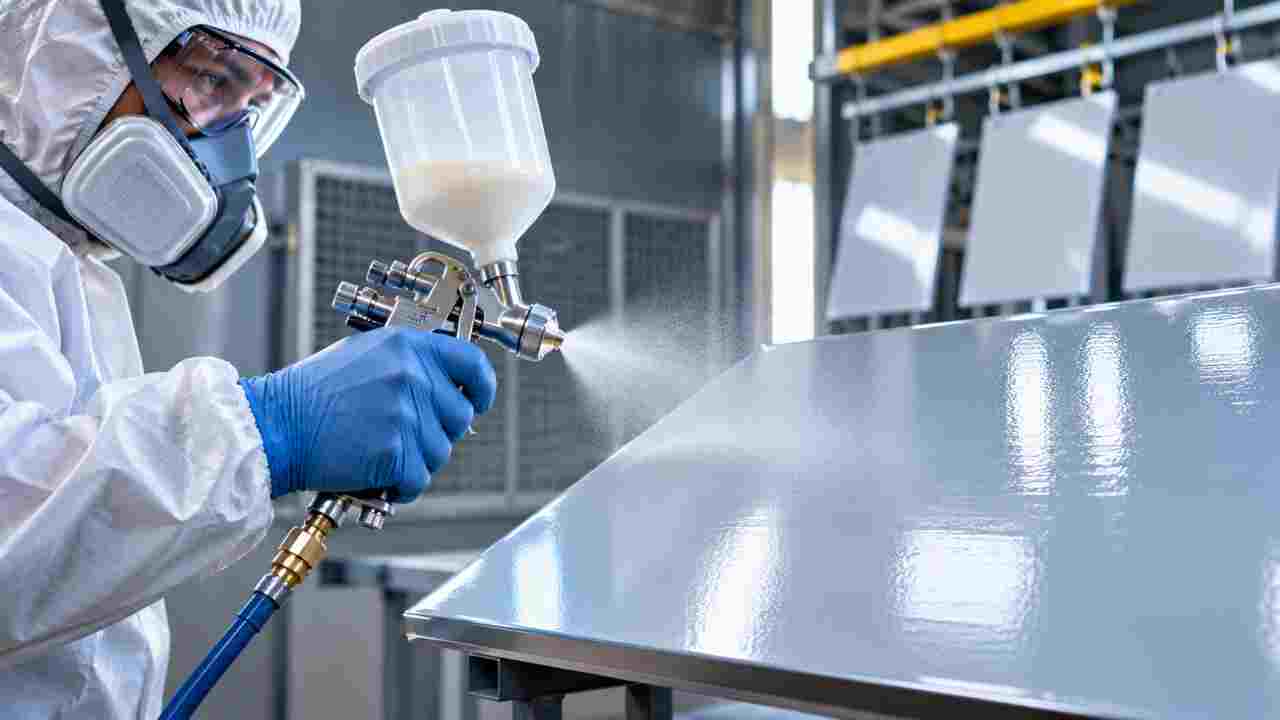
Water-based polyurethane (WPU) systems have become important formulation technologies for industrial coatings, adhesives, flexible finishes, inks and textile applications. Their versatility comes from polyurethane chemistry, which allows material properties to be adjusted through the selection of polyols, isocyanates, chain extenders and functional ingredients.
Moving polyurethane into an aqueous medium, however, introduces additional formulation requirements. The polymer must remain adequately dispersed during manufacturing and storage, tolerate other formulation ingredients, and form a continuous film when applied. These requirements can compete with the hardness, flexibility, adhesion and water resistance expected from the finished product.
A dispersion with acceptable particle size and viscosity may still produce a weak or water-sensitive film. Conversely, a polymer designed for excellent chemical resistance may prove difficult to disperse or process at commercially useful solids content.
Understanding these interactions is essential for developing reliable waterborne polyurethane formulations that satisfy both manufacturing and end-use requirements.
1. Polyol and Isocyanate Selection Establish the Performance Limits
The properties of waterborne polyurethane begin with the molecular architecture of the polymer.
Polyurethanes typically contain relatively flexible soft segments derived from polyols and harder segments associated with isocyanates and chain extenders. Their chemical composition and degree of microphase separation influence tensile strength, elongation, hardness, thermal response and resistance to deformation.
Polyester polyols can provide useful mechanical strength, abrasion resistance and adhesion characteristics, although hydrolysis resistance depends on their specific chemistry. Polyether polyols are frequently considered where flexibility and hydrolytic stability are important. Polycarbonate polyols may offer attractive durability characteristics for demanding applications, but their performance must be weighed against formulation cost and processing requirements.
The isocyanate component also affects final properties. Aliphatic and cycloaliphatic structures are commonly selected where light stability and appearance retention are important, while aromatic systems may present different performance and cost advantages but greater susceptibility to discoloration.
Adjusting the hard-segment content can improve hardness and resistance to deformation, yet excessive rigidity may compromise flexibility or low-temperature performance.
The ratio of isocyanate to hydroxyl functionality, molecular weight and chain-extension strategy additionally influence viscosity development and the resulting polymer structure.
These variables should be selected against specific performance requirements rather than assuming that increasing polymer hardness or molecular weight will improve every property.
2. Designing a Stable Polyurethane Dispersion
Unlike a polymer dissolved in an organic solvent, a conventional polyurethane dispersion contains polymer particles distributed in water. Its stability depends on the interactions that prevent particle aggregation and uncontrolled separation.
Many waterborne polyurethane systems use internal hydrophilic groups incorporated into the polymer structure. Anionic formulations commonly employ dimethylolpropionic acid (DMPA), whose carboxylic acid groups are neutralized to support dispersion in water.
The concentration of hydrophilic groups and degree of neutralization influence particle formation, particle-size distribution, viscosity and storage stability.
Increasing ionic content may improve dispersion stability or reduce particle size, but can also introduce greater water sensitivity in the resulting polymer film. The formulation must therefore balance dispersibility against final performance.
The manufacturing sequence introduces further complexity. In a common prepolymer route, an isocyanate-terminated prepolymer is prepared, neutralized and dispersed before or during subsequent chain extension, depending on the selected process.
Prepolymer viscosity, dispersion temperature, water-addition rate and mixing conditions affect the resulting particle population. The timing and extent of chain extension are also important because residual isocyanate groups can react with water, creating additional process considerations.
Particle-size measurements should be interpreted alongside distribution width, viscosity, pH and storage behavior. A small average particle size alone does not establish sufficient dispersion robustness.
3. Formulation Additives Can Improve Performance or Destabilize the System
A commercially useful polyurethane coating or adhesive rarely consists of an unmodified polymer dispersion.
Wetting agents, defoamers, rheology modifiers, coalescing aids, pigments, fillers and other additives may be required to obtain the desired application and film properties.
However, their compatibility with the dispersion cannot be assumed.
Surfactants may influence particle interactions and wetting, while some rheology modifiers can produce unexpected viscosity changes when combined with particular polymer structures or electrolyte concentrations. Pigment dispersions and other ingredients can introduce changes in ionic strength or pH that affect colloidal stability.
Foam deserves particular attention. Mechanical mixing, pumping and application equipment can introduce air into the formulation. Persistent foam may produce pinholes, craters or inconsistent surface appearance after drying.
Defoamer selection should consider the intended application method and the possibility of surface defects caused by excessive or incompatible additions.
Preservatives and other stability-related ingredients require compatibility assessment and compliance with applicable product requirements.
A useful formulation strategy evaluates additives incrementally, using controlled mixing and a defined order of addition. Measurements before and after incorporation help identify the specific ingredients responsible for viscosity drift, agglomeration or unexpected changes in application behavior.
4. Film Formation Is Different From Dispersion Stability
A stable liquid dispersion does not guarantee that the applied coating will form a mechanically satisfactory film.
Waterborne film formation involves water evaporation, increasing particle concentration, particle deformation and development of a continuous polymer structure. Depending on formulation chemistry, additional physical rearrangement or chemical crosslinking may follow.
Drying conditions influence these events. Temperature, humidity, airflow, substrate characteristics and applied wet-film thickness affect water removal and the development of final properties.
If the coating dries under conditions that prevent adequate particle deformation or interparticle bonding, the film may contain defects or demonstrate inadequate cohesion.
Conversely, prolonged water retention can delay handling and contribute to blocking or inconsistent appearance.
The distinction between physical drying and chemical curing is important. A one-component polyurethane dispersion may form a film primarily through water removal and polymer-particle consolidation. Other systems incorporate crosslinking chemistry, including two-component formulations using compatible crosslinkers, to develop additional resistance after application.
Improving hardness through crosslinking may reduce flexibility, while insufficient crosslinking can limit chemical resistance.
Film-performance evaluation should therefore reflect the actual drying or curing schedule rather than assuming that a visually dry coating has reached its final properties.
5. Balancing Water Resistance, Adhesion and Long-Term Durability
Water resistance is among the more challenging performance requirements for waterborne polyurethane systems because the chemistry supporting aqueous dispersibility can also influence water uptake.
Residual hydrophilic groups, surfactants, ionic species and other formulation ingredients may affect swelling and moisture sensitivity. Polymer architecture, crosslink density and film morphology further determine resistance to liquid water and humid conditions.
Improving water resistance may require adjusting the hydrophilic content, polymer composition or crosslinking strategy. However, these changes can influence dispersion stability, film formation or flexibility.
Substrate adhesion presents a related challenge. Polyurethane chemistry can provide strong interactions with suitable surfaces, but actual adhesion also depends on surface contamination, pretreatment, roughness and the mechanical behavior of the applied film.
A coating may resist water exposure while exhibiting poor adhesion to a particular plastic. Another may bond effectively to a substrate but lose mechanical integrity under repeated humidity or thermal cycling.
Waterborne polyurethane–acrylic hybrid systems offer one approach to modifying performance, although their effectiveness depends on polymer compatibility, morphology and manufacturing conditions.
Long-term qualification should examine relevant combinations of water exposure, abrasion, temperature, weathering and chemical contact.
Neither initial hardness nor dry-film appearance is sufficient evidence of durability.
6. Troubleshooting Requires Connected Dispersion and Film Testing
Effective troubleshooting separates problems originating in the liquid dispersion from those arising during application or subsequent film development.
Coagulation, sedimentation and viscosity drift may indicate deficiencies in colloidal stability, raw-material compatibility or manufacturing conditions. Poor leveling, foam defects and inconsistent coating thickness may instead reflect application rheology or drying behavior.
Weak adhesion, blocking, low abrasion resistance and inadequate water resistance generally require examination of the complete polymer–substrate–film relationship.
A useful qualification program combines the following measurements:
Dispersion properties: Particle size and distribution, pH, viscosity, solids content and storage stability.
Application behavior: Wetting, foam control, leveling, drying time and coating uniformity.
Mechanical performance: Hardness, flexibility, tensile behavior and adhesion.
Durability: Water immersion, abrasion, environmental conditioning and resistance to relevant chemicals.
Standard methods can support comparative testing. ASTM D3359-23 provides tape-based adhesion assessments for applicable coating/substrate systems, while ASTM D4060-25 addresses abrasion resistance using a Taber abraser.
ASTM D870-2025 provides procedures for evaluating coating resistance to water immersion. Test selection must reflect the substrate, film characteristics and intended application.
Where appropriate, differential scanning calorimetry, dynamic mechanical analysis and microscopic examination can help explain differences in polymer morphology or film development.
Testing should also establish whether changes remain acceptable after storage, repeated temperature exposure or controlled variations in production conditions.
For higher-solids formulations, viscosity and particle deformability deserve particular attention because reducing water content can create processing difficulties without delivering proportional improvements in manufacturing efficiency.
The strongest development decisions come from connecting these observations with polymer chemistry and processing history, rather than adjusting additives in response to individual failures.
Turning Waterborne Polyurethane Chemistry Into Reliable Formulations
Successful waterborne polyurethane development requires a coordinated understanding of polymer architecture, colloidal stabilization, additive compatibility and film-formation behavior.
A formulation must remain usable during storage and application while delivering the hardness, flexibility, adhesion, appearance and durability required by the end product. Improving one characteristic in isolation can produce unintended changes elsewhere.
For formulation scientists, R&D managers and technical professionals, the practical challenge is identifying which chemistry or processing variable controls the observed performance limitation and determining how to modify it without compromising the rest of the formulation.
These are the challenges addressed by the dedicated OnlyTRAININGS program on water-based polyurethane formulation and performance optimization.
ONLYTRAININGS | ADVANCED TECHNICAL TRAINING
Water Based Polyurethane Training | Formulation And Performance
Improve Dispersion Stability, Film Formation and Long-Term Polyurethane Performance
Strengthen your ability to select raw materials, formulate stable aqueous polyurethane systems and resolve performance problems in industrial applications.
The expert-led training covers:
Polyol and isocyanate selection, reaction chemistry and curing mechanisms.
Internal and external emulsifiers, neutralization and particle-size control.
Dispersion viscosity, storage stability and additive compatibility.
Film formation, hardness, flexibility, adhesion and water resistance.
Drying behavior, weather resistance and formulation cost considerations.
Practical formulation examples, troubleshooting and case studies.
Designed for: R&D chemists, polyurethane formulators, coating and adhesive developers, technical managers and quality professionals.
EXPLORE THE TRAINING & REGISTER
Includes a shareable, verifiable certificate for your professional records, plus 6-month full training access, practical toolkits, downloadable materials and 24/7 expert connect.
Technical References
Advances in Waterborne Polyurethane and Polyurethane-Urea Dispersions and Their Eco-friendly Derivatives: A Review. Polymers, 2021, 13(3), 409. Read research.
Design, Preparation and Properties of Polyurethane Dispersions via Prepolymer Method. Polymers, 2023. Examines prepolymer, emulsification and chain-extension conditions. Read research.
Formulation, Structure and Properties of Waterborne Polyurethane Coatings: A Brief Review. Journal of Adhesion Science and Technology, 2024. Read research.
Progress in Waterborne Polymer Dispersions for Coating Applications: Commercialized Systems and New Trends. RSC Sustainability, 2024. Read research.
Morphology Control in Waterborne Polyurethane Dispersion Nanocomposites through Tailored Structure, Formulation, and Processing. Langmuir, 2025. Read research.
A Comprehensive Review of High-Solids Waterborne Polyurethane: Design Strategies, Performance Enhancement, and Future Perspectives. Journal of Applied Polymer Science, 2026. Read research.
ASTM International. ASTM D3359-23: Standard Test Methods for Rating Adhesion by Tape Test. Official standard.
ASTM International. ASTM D4060-25: Standard Test Method for Abrasion Resistance of Organic Coatings by the Taber Abraser. Official standard.
ASTM International. ASTM D870-2025: Standard Practice for Testing Water Resistance of Coatings Using Water Immersion. Standard listing.